


In every finance department, Procure to Pay is no longer treated as a back-office accounts payable function. It has become a core driver of cash flow, compliance, and spend control. Vendor networks have expanded. Invoice volumes have increased. Audit scrutiny has intensified. As a result, Procure to Pay performance is now closely reviewed by CFOs and boards.
Yet many leaders feel frustrated. Tools have been purchased. Dashboards have been deployed. Automation has been configured. Still, delays continue. Exceptions pile up. Vendor calls rise before quarter close. The question is quietly asked: Why does our Procure to Pay process still feel heavy?
This is where the debate around Procure to Pay Software vs Managed Services becomes critical.
Procure to Pay Software vs Managed Services: The Core Difference
Procure to Pay software enables workflows and captures data. A P2P Managed Service takes ownership of execution, controls, and outcomes. While systems support tasks, Procure to Pay Managed Services ensure approvals are completed, invoices are matched, vendors are managed, and reporting is delivered accurately.
In simple terms: Procure to Pay software enables tasks. Procure to Pay managed services deliver outcomes.
What Is the Difference Between Procure to Pay Software and a P2P Managed Service?
Procure to Pay software provides automation tools within an ERP environment. Internal teams are still responsible for daily execution. A P2P Managed Service assumes responsibility for running the end-to-end Procure to Pay process with defined SLAs, compliance controls, and measurable results.
For leaders asking, Is Procure to Pay managed service better than P2P software? The answer depends on whether technology or accountability is the priority.
Executive Summary: Why Procure to Pay Decisions Are Changing
In the United States, Procure to Pay decisions are being reexamined at the executive level. What was once viewed as an accounts payable activity is now treated as a strategic finance function. Rising invoice volumes, global vendor networks, and tighter regulatory expectations have reshaped how Procure to Pay performance is measured.
Across industries, finance teams are processing more transactions than ever. At the same time, talent shortages are being reported in US accounting and AP roles. Skilled professionals are difficult to hire and even harder to retain. As a result, the daily execution of Procure to Pay is being stretched.
Compliance pressure has also increased. SOX controls, 1099 reporting, and tax documentation are closely reviewed. Audit trails must be maintained. Errors are no longer tolerated. ERP environments have become more complex, often integrating multiple systems. In this context, the debate around Procure to Pay Software vs Managed Services has gained urgency.
What CFOs Expect from Procure to Pay
- Clear spend visibility
- Faster invoice approvals
- Strong compliance controls
- Reduced processing costs
- Predictable working capital impact
What Actually Happens in Many Organizations
- Backlogs build at month-end
- Exceptions dominate workflows
- Vendor escalations increase
- Internal teams struggle to scale
This gap has driven interest in Procure to Pay Managed Services. With a P2P Managed Service, execution is owned, SLAs are defined, and controls are strengthened. For leaders asking, Is Procure to Pay managed service better than P2P software? The question is now tied to accountability, not just automation.
The Reality of Modern Procure to Pay Operations
Finance operations today are far more complex than they were a decade ago. Vendor networks now span multiple regions and currencies. Global sourcing has expanded supplier ecosystems. Insights from SAP Ariba and the Deloitte Global CPO Survey show that supplier environments are becoming larger and more fragmented. As a result, transaction volumes are increasing, and control risks are rising.
Global Vendor Networks Increase Operational Pressure
More suppliers mean more invoices, approvals, and compliance documentation. Each relationship must be validated and reconciled. Teams are expected to move faster while maintaining tighter controls. As scale increases, internal bandwidth is strained.
Month-End Backlogs and Vendor Escalations
During month-end close, invoice queues expand. Approvals are delayed. Escalations rise before quarter close. Leaders often discover that processes have become reactive rather than controlled. In the broader discussion of Procure to Pay Software vs Managed Services, this gap in execution becomes clear.
Missed Discounts and ERP Complexity
Slow approvals and disconnected systems often lead to missed early-payment discounts. APQC benchmarks confirm that inefficiencies directly affect working capital. Many organizations operate across multiple ERP platforms where data is not fully synchronized. Tools alone rarely resolve these structural gaps. This is where Procure to Pay Managed Services and a structured P2P Managed Service approach are increasingly evaluated.
Why Has the Process Become Operationally Heavy?
Transaction growth, compliance pressure, and system complexity have outpaced internal capacity. For executives asking, Is Procure to Pay managed service better than P2P software? The answer often depends on whether operational ownership is strengthened beyond technology.
What Companies Expect from Procure to Pay Software
When technology investments are approved, expectations are clear. Automation is expected to reduce manual effort. Matching is expected to be faster. Approval cycles are expected to shorten. It is assumed that once systems are live, performance will stabilize.
The Automation Promise
Platforms are positioned as end-to-end solutions. Dashboards improve visibility. Analytics highlight spend patterns. Cost reduction targets are tied to automation initiatives. In discussions around Procure to Pay Software vs Managed Services, these benefits are emphasized as transformative.
However, automation does not eliminate responsibility. Exceptions continue. Non-PO invoices are received. Documentation must be validated. Approvals must still be chased. Technology enables workflows, but execution must still be managed.
The Practical Reality
Adoption is often uneven across departments. Some users follow structured processes. Others revert to manual workarounds. Duplicate invoices and approval gaps can still occur if controls are not monitored.
This is where interest in Procure to Pay Managed Services grows. Leaders begin to ask whether tools alone are sufficient.
The honest answer is that software reduces tasks but does not remove oversight. The comparison increasingly shifts from features to accountability and measurable outcomes.
Where Procure to Pay Software Falls Short
Systems are frequently implemented with the expectation of automatic improvement. Yet performance gaps often appear after go-live. In evaluating Procure to Pay Software vs Managed Services, the difference is found in execution ownership rather than system capability.
Execution Still Sits Internally
Approvals must still be followed up. Missing documentation must still be located. Exceptions must still be resolved. Internal teams remain responsible for daily oversight. Even when automation exists, follow-through requires discipline. A structured P2P Managed Service model addresses this ownership gap.
Talent and Hiring Challenges
High turnover within US accounting roles increases instability. Recruiting experienced professionals is expensive and time-consuming. Training costs add further burden. In contrast, Procure to Pay Managed Services provide continuity without recurring hiring cycles.
Long Implementation Timelines
Technology deployments can take six to twelve months. Configuration and adoption delays postpone measurable impact. During this period, inefficiencies continue. A managed model prioritizes execution improvements immediately.
Vendor Escalations Increase
Payment inquiries and documentation gaps often lead vendors to contact internal finance teams directly. Over time, finance teams function as reactive helpdesks. Within a structured service model, vendor communication is handled systematically.
Errors and Duplicate Payments
Duplicate invoices are still sometimes identified during audits. Controls must be actively monitored. Software alone does not prevent breakdowns. This reinforces why the debate centers on accountability rather than functionality.
Is Procure to Pay Managed Service Better Than P2P Software in Execution?
When execution quality is evaluated, ownership becomes decisive. Software enables processes but does not guarantee completion. A managed model assigns responsibility, enforces SLAs, and measures performance.
For leaders assessing risk, control, and operational stability, the distinction lies in consistency and disciplined execution across the lifecycle.
Introducing Procure to Pay Managed Services

As companies evaluate the limits of technology, attention is increasingly shifting toward Procure to Pay Managed Services. A broader mindset is being adopted. The focus is no longer placed only on system features. Instead, emphasis is placed on ownership, accountability, and measurable outcomes across the finance lifecycle.
In many enterprises, the Procure to Pay process has been enabled through automation tools. Workflows have been configured. Dashboards have been deployed. Yet execution gaps continue to surface. This is where the distinction between Procure to Pay Software vs Managed Services becomes more apparent.
Software vs Accountability in Finance Operations
Software provides workflow enablement. It supports invoice routing, matching, and reporting. However, responsibility for execution remains internal. Approvals must still be followed up. Exceptions must still be resolved. Vendor communication must still be coordinated.
A P2P Managed Service model operates differently. Daily operational responsibility is assigned to a specialized partner. Service-level agreements are defined. Performance metrics are monitored. Compliance controls are enforced. Instead of managing tools internally, the entire Procure to Pay function is governed through structured ownership.
What Are Procure to Pay Managed Services?
Procure to Pay Managed Services are structured service engagements in which the end-to-end transaction cycle is executed and optimized by a dedicated provider. This includes requisition review, invoice validation, two-way and three-way matching, exception resolution, vendor coordination, and reporting under defined performance standards.
Why Accountability Matters in the Procure to Pay Model
In the comparison of Procure to Pay Software vs Managed Services, the key difference lies in accountability. Systems support tasks. A P2P Managed Service delivers outcomes. For leaders asking, Is Procure to Pay managed service better than P2P software? the answer often depends on whether predictable execution and measurable results are required.
How a P2P Managed Service Works
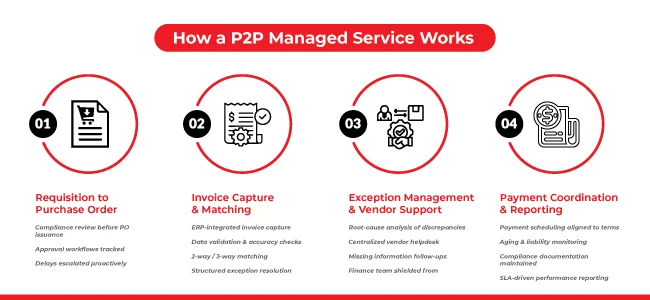
When a structured service model is adopted, the full Procure to Pay lifecycle is managed under defined ownership and performance metrics.
Step 1: Requisition to Purchase Order
Requisitions are reviewed for compliance before purchase orders are issued. Approvals are tracked. Delays are escalated. Control and visibility are established from the start.
Step 2: Invoice Capture and Matching
Invoices are captured within ERP-integrated workflows. Data is validated. Two-way or three-way matching is performed. In the debate around Procure to Pay Software vs Managed Services, this is where operational discipline becomes visible. Exceptions are actively resolved.
Step 3: Exception Management and Vendor Support
Exception cases are analyzed. Missing information is requested. Vendor communication is centralized through a structured helpdesk. The finance team is shielded from daily escalations.
Step 4: Payment Coordination and Reporting
Payment schedules are aligned with terms and internal controls. Aging reports are reviewed. Compliance documentation is maintained. Under a P2P Managed Service, SLAs and reporting standards are consistently monitored.
In this model, operational results speak clearly. Defined SLAs, audit-ready documentation, and structured ownership ensure that the Procure to Pay function delivers consistent performance.
Procure to Pay Software vs Managed Services – Simplified Comparison
When the debate around Procure to Pay Software vs Managed Services is reviewed at the executive level, the difference is rarely about features. It is about who owns execution. In most organizations, Procure to Pay software is installed within an ERP environment. However, daily responsibility remains with internal teams. A structured P2P Managed Service model operates differently. Accountability is assigned, and results are measured.
Below is a simplified comparison to clarify how Procure to Pay Managed Services differ from software-led models.
|
Area |
P2P Software |
P2P Managed Service |
|---|---|---|
|
Execution |
Internal team manages tasks |
End-to-end delivery under defined SLAs |
|
Talent |
Hire & train AP staff |
On-demand expertise provided |
|
Time to Value |
Long setup & adoption |
Faster results through proven workflows |
|
Vendor Management |
Handled internally |
Service-owned communication model |
|
Errors |
Internal risk exposure |
Control framework reduces risk |
|
Scalability |
Licenses + hiring required |
Seamless scaling without added burden |
Why Ownership Defines Procure to Pay Success
In the comparison of Procure to Pay Software vs Managed Services, technology is present in both models. The real distinction lies in ownership. Software enables workflows. A P2P Managed Service assumes responsibility for execution, compliance, and reporting.
For leaders asking, Is Procure to Pay managed service better than P2P software? the answer often depends on whether consistent accountability and measurable outcomes are required across the entire Procure to Pay lifecycle.
Real-World Scenarios Where Managed Services Deliver Stronger Results
In high-pressure environments, the debate between Procure to Pay Software vs Managed Services becomes practical. Research from Deloitte and Gartner shows that finance leaders now value execution discipline over system features. While automation tools support workflows, structured service models demonstrate greater resilience when volume, compliance, and continuity are tested.
1. High Invoice Growth
When invoice volumes surge due to expansion or seasonal spikes, internal teams are often stretched. Backlogs form quickly. Delays increase.
Under a P2P Managed Service, transaction spikes are absorbed through scalable delivery models. SLAs are maintained. The Procure to Pay process remains stable even during growth cycles.
2. Compliance and Audit Pressure
SOX requirements, tax documentation, and audit trails must be monitored continuously. Software generates logs, but oversight is still required.
Through Procure to Pay Managed Services, compliance controls are embedded in daily operations. Monitoring is structured. Audit readiness is maintained proactively.
3. Vendor Escalations
Vendor inquiries typically increase before quarter close. Internal finance teams can become reactive.
A P2P Managed Service centralizes communication. Escalations are managed systematically, reducing operational strain.
4. Talent Shortage
High turnover in US accounting roles creates disruption. Training new staff slows cycle time.
With Procure to Pay Managed Services, expertise remains stable and execution continuity is protected.
5. M&A and Rapid Expansion
Mergers and acquisitions increase complexity overnight. Vendor bases expand. Processes must be aligned quickly.
Structured service models integrate additional entities efficiently, protecting performance during transition.
For leaders asking, Is Procure to Pay managed service better than P2P software? the answer is often confirmed in these stress scenarios, where accountability and scalability define results.
Cost Comparison: Visible vs Hidden Costs
When Procure to Pay investments are reviewed, license fees are typically emphasized. However, total cost extends beyond subscription pricing. In the comparison of Procure to Pay Software vs Managed Services, hidden operational expenses must be evaluated carefully.
License Cost vs Total Cost
Software licenses represent only one component. Hiring AP specialists, training teams, and managing attrition increase long-term cost. Knowledge loss and ramp-up delays affect efficiency.
Rework adds further burden. Exceptions, duplicate invoices, and missed early-payment discounts directly impact working capital and margins.
Under a P2P Managed Service, cost structures are more predictable. Fixed staffing overhead is converted into defined service fees. Controls reduce rework and error exposure.
For CFOs evaluating Procure to Pay, ROI should be assessed beyond licensing. Margin protection, working capital improvement, and operational stability must be included when comparing Procure to Pay Software vs Managed Services.
Technology in Procure to Pay Managed Services
Technology plays an important role in modern finance operations. In a well-structured P2P environment, systems are treated as enablers rather than complete solutions. Within Procure to Pay Managed Services, technology is aligned with execution discipline and control.
Most enterprises operate on established ERP platforms such as SAP, Oracle, or Microsoft Dynamics. These systems support the Procure to Pay lifecycle from requisition to payment. OCR tools are deployed to reduce manual data entry. RPA is configured to automate validations and reconciliations. Workflow tools are used to route approvals and flag exceptions.
In the comparison of Procure to Pay Software vs Managed Services, the real difference lies in governance. Under a P2P Managed Service, ERP workflows, automation tools, and reporting dashboards are monitored continuously. Exceptions are reviewed. Controls are enforced. Performance metrics are tracked.
The principle remains clear: Technology supports the Procure to Pay service not the other way around.
This structured approach ensures that Procure to Pay Managed Services deliver measurable results beyond system capability.
When Procure to Pay Managed Services Make the Most Sense
Not every organization requires structural change. However, certain conditions make Procure to Pay Managed Services a strategic decision. When the Procure to Pay function becomes operationally heavy, execution risk increases.
A P2P Managed Service model is particularly valuable when:
- Invoice volume exceeds 2,000 per month
- Multiple entities operate within one ERP environment
- A SOX-heavy environment demands strict compliance
- Finance teams are lean and capacity is limited
- Rapid growth or expansion is underway
In these situations, the discussion of Procure to Pay Software vs Managed Services becomes practical. While tools may already be in place, ownership gaps often remain.
When scale, compliance, and control are prioritized, Procure to Pay Managed Services provide structured accountability. For senior leaders assessing operational risk, this model delivers stability, scalability, and measurable governance across the entire process.
Key Takeaways for Finance Leaders
The evaluation of Procure to Pay performance should not stop at system capabilities. For senior leaders, the real question is whether execution, compliance, and measurable outcomes are consistently delivered.
In the broader comparison of Procure to Pay Software vs Managed Services, several conclusions are often reached:
- Software is not a strategy. Tools enable workflows, but they do not ensure completion, compliance, or performance within the Procure to Pay lifecycle.
- Ownership drives results. A structured P2P Managed Service model assigns clear accountability, defined SLAs, and measurable controls.
- Managed services reduce operational risk. Under Procure to Pay Managed Services, execution gaps are minimized, vendor escalations are managed, and compliance standards are maintained.
For finance leaders responsible for working capital, audit readiness, and margin protection, Procure to Pay must be governed with discipline. The decision between technology alone and structured service ownership ultimately determines the stability and effectiveness of the entire function.
Final Thoughts - Rethinking Your Procure to Pay Model
For many US enterprises, Procure to Pay has already been digitized. Systems have been implemented. Workflows have been automated. Yet performance gaps often remain. When the comparison of Procure to Pay Software vs Managed Services is reviewed carefully, the issue is rarely technology. It is execution and accountability.
Procure to Pay Managed Services are designed to deliver measurable outcomes across cost control, compliance, and working capital improvement. A structured P2P Managed Service model provides defined SLAs, ownership, and continuous oversight of the full Procure to Pay lifecycle.
For leaders asking, Is Procure to Pay managed service better than P2P software? the answer often depends on whether predictable results are required beyond automation.
If your Procure to Pay process still feels operationally heavy, it may be time to reassess the model. A structured evaluation or discovery call can provide clarity. A focused process assessment can identify execution gaps and opportunities for measurable improvement.

Leave your thought here
Your email address will not be published. Required fields are marked *