OCR Services for Accurate Document Data Capture & Conversion
Turn scanned documents, PDFs, images, forms, invoices, and legacy records into searchable, editable, structured business data.
Request Your Assessment

Turn scanned documents, PDFs, images, forms, invoices, and legacy records into searchable, editable, structured business data.
Request Your Assessment
Home » OCR Services
Rely Services provides OCR Services for businesses that need more than basic text recognition. We combine OCR technology, document processing, data extraction, cleanup, validation, and human review to convert difficult source files into usable digital information.
Our OCR Data Extraction Services support high-volume and recurring document workflows across finance, healthcare, insurance, logistics, legal, publishing, and other document-intensive operations.
Whether you need to digitize an archive or build an ongoing document-processing workflow, our team can help you move from manual document handling to structured digital data.
OCR Services use Optical Character Recognition technology to convert text contained in scanned documents, images, and image-based PDFs into machine-readable data. IBM describes OCR as automated data extraction technology that converts images of text into machine-readable formats.
For a business, however, recognizing characters is only the first step.
The extracted information may need to be classified, cleaned, formatted, validated, indexed, or mapped into another business system. Tables, unusual layouts, poor scans, handwritten content, and inconsistent document structures can also create exceptions that require human review.
That is why Rely Services approaches OCR as a document-processing workflow rather than a standalone software function.
Our Outsource OCR Services can support the process from source-file assessment and OCR capture through data validation, cleanup, conversion, indexing, and final delivery.
This approach helps businesses turn document archives and incoming files into information that people and systems can actually use.

Different documents require different processing rules. A clean digital invoice is very different from an old scanned contract, handwritten form, insurance document, or complex table.
Rely Services configures the workflow around your document types, expected outputs, business rules, and quality requirements.
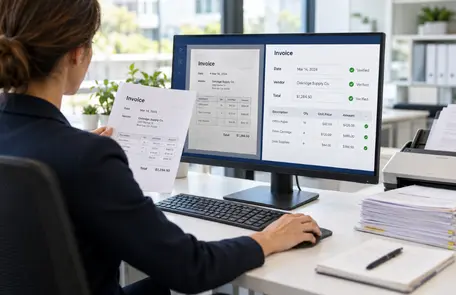
Our OCR Data Extraction Services capture text and required fields from scanned documents, PDFs, images, forms, invoices, statements, reports, and other source files.
Depending on the project, extracted information can be prepared as searchable text, editable content, structured fields, or data suitable for downstream processing.
For field-based projects, we can align capture requirements around the information your workflow needs rather than simply converting every character on a page.
OCR output is not always production-ready.
Poor image quality, unusual fonts, tables, skewed scans, page layouts, handwriting, and damaged source files can affect recognition. IBM notes that document-processing workflows may need to redirect inconsistent formats or OCR errors for human review.
Our OCR Cleanup and Conversion Services add a review layer after automated capture. The team checks exceptions and prepares cleaner output for the required destination format.
This is particularly useful when the information will support financial processing, records management, search, reporting, or another business workflow.
Traditional OCR focuses primarily on recognizing characters. Modern document processing can go further.
AI-powered Document Data Capture can combine OCR with document classification, machine learning, and structured data extraction. IBM explains that Document AI can process structured, semi-structured, and unstructured documents while using machine learning and natural language processing to understand their content and structure.
For businesses, this creates an opportunity to move beyond simple digitization toward intelligent document workflows.
Rely Services combines technology-assisted capture with operational review so exceptions do not simply disappear into an automated workflow.
High document volumes can make manual rekeying expensive and difficult to scale.
Our Automated OCR Data Entry and Cleanup Services use OCR to capture information first, followed by cleanup, validation, formatting, and exception handling where required.
This hybrid model is useful when organizations need automation without eliminating human oversight from complex or sensitive document workflows.
Paper documents and image-only files can be difficult to search or reuse.
Our OCR scanning support converts scanned files into searchable digital documents. Text can then be located without manually reviewing every page.
This capability can support document archives, historical files, contracts, manuals, reports, records, and other large repositories.
Digitization creates more value when documents are easy to locate.
Rely Services supports OCR indexing to organize captured information and improve document search and retrieval. Indexing can form part of a broader document digitization and data management workflow.
Rely Services supports OCR and document conversion requirements across a range of business records.
Finance teams often receive invoices in multiple layouts and formats. Our OCR Data Extraction Services can capture information from invoices and related financial documents and prepare the data for downstream processing. OCR can also complement invoice processing, accounts payable, data entry, and broader finance operations where documents need to be converted into structured information.
Insurance workflows involve applications, claims forms, policy records, supporting documents, and correspondence. Our Outsource OCR Services help convert these documents into searchable or structured digital information that can support claims and policy-processing workflows.
Healthcare organizations often manage high volumes of historical and current documents. Rely Services' existing OCR capabilities include support for medical records and microfiche conversion. OCR can help convert suitable source documents into digital information for authorized downstream workflows. The exact handling requirements should be established during process mapping based on the data involved and the client's security and compliance requirements.
Contracts, correspondence, case files, forms, reports, and historical documents may contain information that is difficult to search when stored only as scans. OCR Cleanup and Conversion Services can make appropriate documents searchable and editable while adding review for recognition exceptions.
Organizations with books, manuals, reports, historical files, and archives can use OCR to create searchable digital collections. Rely Services also provides document digitization and book scanning capabilities, allowing OCR to form part of a broader archive-conversion workflow.
A reliable OCR project starts before the first document is processed.
Rely Services can structure the transition around document characteristics, required fields, expected outputs, quality requirements, and workflow rules.
We begin by understanding the source documents, approximate volume, document types, input formats, required fields, expected output, and downstream use. Representative samples help identify potential exceptions such as handwriting, poor scans, unusual layouts, tables, or inconsistent templates.
The team maps how documents should move through the workflow. This stage defines what information needs to be captured, how exceptions should be handled, what validation is required, and how completed data should be delivered. The objective is to create a repeatable operating process rather than simply run files through OCR software.
Documents are processed using OCR and appropriate document-processing technology. Depending on the requirement, the workflow may identify text, document types, fields, tables, or other required information. Deloitte describes intelligent document processing as combining technologies such as AI, machine learning, RPA, and document extraction to convert semi-structured and unstructured information into usable data.
Automated recognition can produce exceptions. Our OCR Cleanup and Conversion Services provide a human review layer where required. Operators can review flagged or difficult content, correct capture issues, and apply agreed business rules. This step is especially important for poor-quality scans, complex tables, irregular templates, and other documents where automation alone may not provide the required output.
Validated information is prepared according to the agreed output. The final deliverable may include searchable documents, editable content, structured data files, indexed records, or another client-defined format.
For recurring outsourcing engagements, OCR becomes part of an operating process rather than a one-time conversion exercise. Volumes, exceptions, turnaround requirements, quality checkpoints, and escalation procedures can be defined during transition and managed through an agreed delivery framework.
Buying OCR software and building a reliable OCR operation are not the same thing.
Software can recognize characters. Businesses still need to decide how documents are classified, which fields matter, how errors are identified, how exceptions are resolved, and where validated information goes next.
Outsourcing can be particularly useful when:
Document volumes fluctuate or grow quickly.
Internal teams spend significant time entering information manually.
Source files contain several formats or layouts.
OCR output requires human cleanup.
Historical records need large-scale digitization.
The organization needs ongoing document processing rather than a one-time software tool.
Operations teams need capacity without building a dedicated document-processing team.
The value of Outsource OCR Services is therefore not simply access to OCR technology. It is access to the people, workflow, quality controls, and operating capacity needed around that technology.

OCR outsourcing should solve an operational problem, not create another vendor-management problem.
Rely Services brings more than 25 years of experience in back-office and data-processing operations. Our existing OCR delivery model combines technology with trained human review for exceptions and cleanup.
Automation handles repeatable recognition work efficiently. Human reviewers address exceptions that require judgment. This combination is particularly valuable because document quality and structure vary in real business environments.
OCR does not operate in isolation. Rely Services also supports data processing, data entry, document digitization, book scanning, invoice processing, data cleansing, and data management. That means OCR output can form part of a wider operational workflow rather than becoming another disconnected data source.
A one-time archive project has different requirements from a recurring invoice, claims, or forms-processing operation. We can structure OCR outsourcing around the document volume, process scope, required output, review requirements, and operating model agreed during transition.
Good outsourcing requires defined ownership. Before recurring production begins, the workflow should establish inputs, outputs, business rules, QA checkpoints, exception handling, turnaround expectations, and escalation paths. That gives both teams a clearer framework for measuring delivery.
Documents rarely arrive in one perfect template. Rely's existing OCR capabilities cover invoices, insurance documents, medical records, legal documents, scanned files, online content, and document indexing. Our OCR Data Extraction Services can therefore support broader document-processing requirements instead of treating every file as identical.
OCR captures information that employees would otherwise need to retype from scanned documents or images. IBM notes that OCR can eliminate redundant manual data-entry effort by converting images of text into machine-readable information. For an operations team, that can mean spending less time rekeying documents and more time reviewing exceptions and completing higher-value work.
Scanned files may look digital but still behave like paper if their contents cannot be searched. OCR conversion creates machine-readable text, helping teams locate information across digitized records more efficiently.
When document volume rises, purely manual processing often requires additional staffing. Automated OCR Data Entry and Cleanup Services create a model in which technology handles repeatable capture while trained resources focus on exceptions and validation.
OCR becomes more valuable when extracted information can move into another workflow. IBM describes intelligent document processing as a process involving document classification, data extraction, and data output. Validated structured data can then support subsequent business processes.
An outsourced workflow can define clear responsibilities for intake, extraction, validation, exception handling, QA, and delivery. This gives operations leaders greater visibility into where documents are in the process and where recurring exceptions occur.
Consider OCR outsourcing when your organization has a measurable document-processing problem rather than simply a need for OCR software.
Common triggers include:
A backlog of paper or scanned records;
Recurring high-volume invoices or forms;
Manual rekeying that consumes employee time;
Inconsistent OCR results requiring regular cleanup;
Multiple document templates;
Growing archive digitization requirements;
Data that must be extracted before another process can begin;
Seasonal or unpredictable processing volumes.
For smaller volumes of clean, standardized documents, an internal OCR tool may be sufficient.
For complex, high-volume, exception-heavy, or recurring workflows, an outsourcing model can provide the additional operating layer needed around the technology.

OCR often sits inside a larger data and document workflow.
Consider connecting this page with:
Validate, organize, clean, and structure captured information for downstream business processes.
Convert paper records and legacy documents into organized digital assets.
Support information that requires manual capture, review, or validation alongside automated OCR.
Capture and process invoice information for accounts payable and finance workflows.
Maintain structured, accessible, and usable business data after extraction.
Digitize books, manuals, archives, and historical documents with OCR-enabled search.
Your documents already contain valuable business information. The challenge is making that information searchable, structured, accurate enough for its intended use, and available to the people and systems that need it.
Rely Services combines OCR Services, OCR Data Extraction Services, OCR Cleanup and Conversion Services, AI-powered Document Data Capture, and human review to support complete document-processing workflows.
Whether you are digitizing historical records or building an ongoing OCR outsourcing operation, we can help you define a practical process around your documents, data requirements, and business rules.
OCR Services convert text contained in scanned documents, PDFs, images, and other suitable source files into machine-readable information. A complete OCR service can also include document classification, data extraction, cleanup, validation, indexing, formatting, and human exception review.
Businesses outsource OCR Services when document volumes, manual processing effort, cleanup requirements, or operational complexity make an internal software-only approach difficult to manage. Outsourcing combines technology with processing capacity, QA, and exception handling.
OCR outsourcing can reduce repetitive rekeying, make scanned information searchable, convert documents into structured data, and provide operational capacity for high-volume processing. The exact benefit depends on source quality, document complexity, output requirements, and the amount of human validation required.
OCR can be applied to many scanned and image-based documents, including invoices, forms, insurance documents, contracts, reports, books, manuals, records, and other printed materials. Suitability depends on scan quality, layout, handwriting, language, and required output.
No OCR system should be assumed to deliver perfect recognition across every document.
Image quality, handwriting, tables, fonts, layouts, and source-document condition can affect results. This is why Rely Services includes cleanup and human review where the workflow requires it.
OCR primarily converts visible characters into machine-readable text. AI-powered Document Data Capture can add document classification, contextual field extraction, machine learning, and other intelligent document-processing capabilities.
Yes. OCR can recognize information contained in suitable invoice documents. The extracted data can then be validated and prepared for invoice-processing or accounts-payable workflows.
Yes. OCR Cleanup and Conversion Services are part of Rely's existing OCR capabilities. Human review can address recognition conflicts and other exceptions that automated processing cannot resolve reliably.
The process should begin with representative document samples, volume information, input formats, required data fields, expected output, quality requirements, and downstream use. Rely Services can then define the proposed workflow, validation approach, exception handling, and delivery model.