


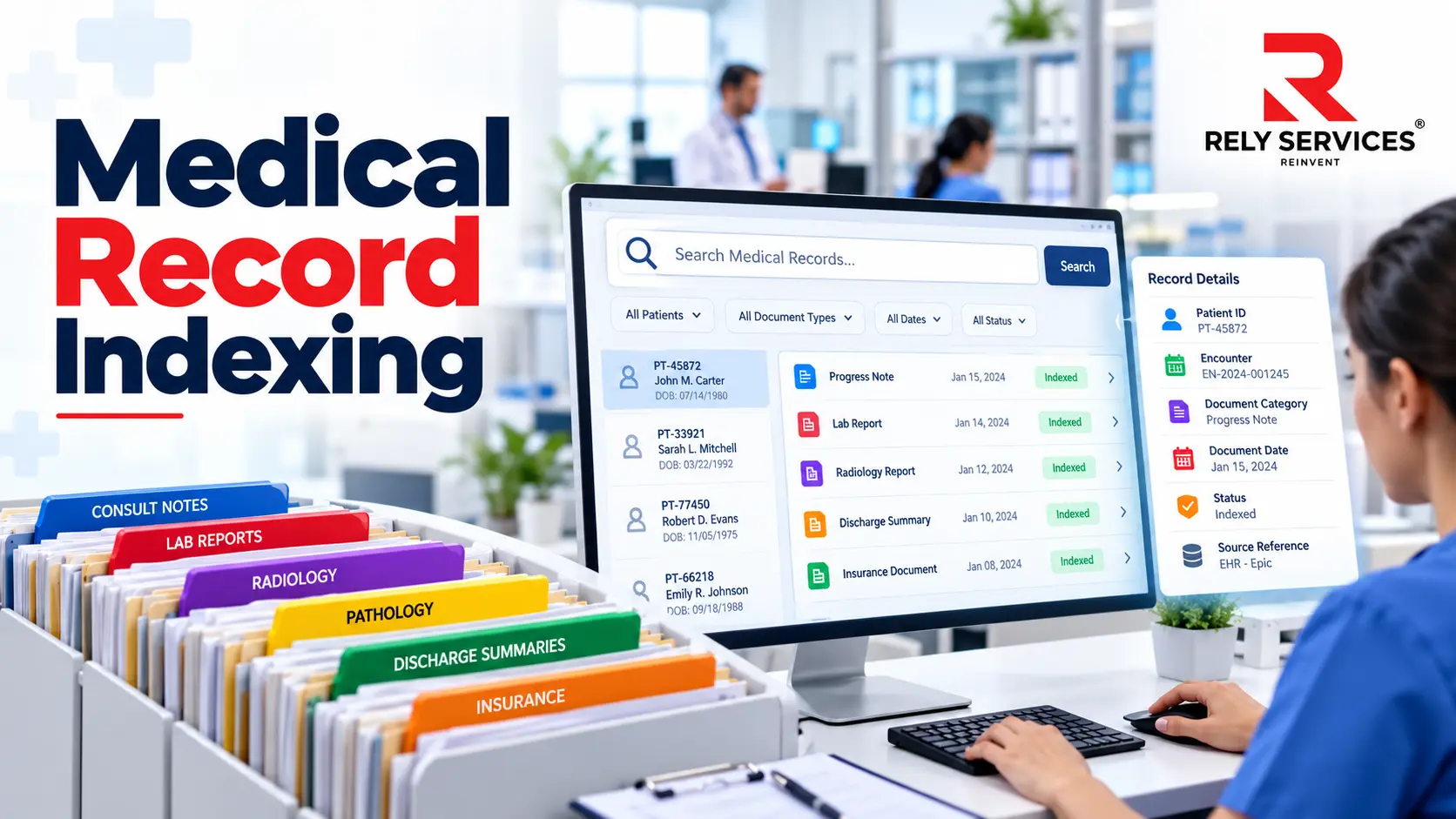
Medical record indexing assigns structured descriptors to healthcare documents so authorized users can locate and distinguish the records they need. A useful index connects each document with the appropriate patient, encounter where applicable, document category, and other approved retrieval fields.
When record volumes grow, inconsistent indexing turns routine retrieval into an investigation. Staff may see several nearly identical documents, search by an unreliable date, or open files that belong to the right patient but the wrong visit. Effective medical data entry services can support accurate healthcare information handling, helping teams organize records and maintain reliable document workflows.
This guide explains how to design an index, control classification decisions, organize a large backlog, and test retrieval. It focuses on finding the correct record rather than extracting every field from its contents. All examples describe hypothetical workflows.
Define what users need to retrieve
Start with retrieval questions from the teams that use the records. A health information management team may need the signed version of a document. A referral coordinator may need records associated with a specific incoming referral. A revenue cycle reviewer may need the document supporting a particular encounter.
Translate those questions into search scenarios. “Find the latest record” is ambiguous. “Find the signed consultation note for this encounter, while preserving visibility into earlier versions” describes a testable requirement.
Separate document indexing from clinical coding
Indexing helps users organize and retrieve a document. Clinical coding classifies information for another purpose and requires its own rules and qualifications. An index category such as “consultation note” does not establish a diagnosis or a billing code.
Keep that boundary in job instructions and system permissions. If an indexing reviewer encounters ambiguous clinical content, the response should follow an approved escalation process. Do not ask the reviewer to infer a diagnosis simply to populate a metadata field.
Identify the system that owns each descriptor
Some descriptors may come from a registration system, others from document content, and others from a controlled category list. Record the authoritative source and permitted correction process for each.
This prevents a reviewer from replacing a system identifier with a familiar-looking value or inventing an encounter association because the screen requires one. Where the authoritative source is unavailable, define a hold or escalation state.
Which metadata fields belong in a medical record index?
A medical record index should include approved descriptors needed for retrieval, such as patient identifier, encounter association where applicable, document category, relevant dates, status, and source reference. Define each field’s meaning, accepted values, and review requirements. More fields are not automatically a better index.
| Descriptor | Retrieval purpose | Rule to establish |
| Patient identifier | Locate material for the intended patient | Approved source and uncertain-match handling |
| Encounter identifier, when applicable | Separate records within a patient’s history | When an encounter link is required or unavailable |
| Document category | Filter by the kind of record needed | Controlled list and category definitions |
| Relevant date | Distinguish time periods or versions | Exact meaning of each date field |
| Document status | Distinguish draft, final, or other approved states | Source evidence and allowed values |
| Source reference | Trace the indexed record to its origin | Stable reference and permitted access |
Validate the schema against the receiving system’s capabilities. A thoughtfully defined field is not useful if the application silently truncates it, drops it during import, or cannot use it in search.
Keep dates separate when they mean different things
A received date, service date, creation date, and signature date can refer to different events. Choose explicit labels and record how each is obtained. Do not place whichever date is easiest to find into a generic date field.
When the source lacks a required date, use an approved exception path. A guessed date can appear precise while making retrieval less trustworthy. Include missing and conflicting dates in reviewer training.
Design for unavailable information
Decide which descriptors are mandatory for release and which can remain unavailable. Distinguish “not present in source” from “not reviewed” if that difference affects use.
Track the reason for an exception without turning the index into a narrative case file. Keep the information sufficient to route the decision, and place detailed investigation material only in the approved location.
Create a document taxonomy reviewers can apply
A taxonomy is the controlled set of categories used to describe documents. Categories should reflect how users distinguish records, with definitions clear enough that different reviewers can make consistent choices.
Define category boundaries with examples
For each category, document what belongs, what does not belong, and how to handle a mixed packet. Use approved synthetic or properly authorized examples. Include neighboring categories that reviewers might confuse.
For instance, a referral order and a consultation note serve different retrieval purposes even if they arrive together. Define whether the system stores the packet as a unit, separates its components, or preserves both levels of association.
Control the miscellaneous category
A temporary miscellaneous category can support uncertain cases, but it needs ownership and review. Monitor why documents enter it and whether common patterns justify a new category or clearer instructions.
Avoid creating a new category for every unusual label. Excessive fragmentation can make the index harder to search. Require a demonstrated retrieval need and an approved definition before expanding the taxonomy.
Establish patient and encounter association controls
Correct categorization cannot compensate for a document attached to the wrong patient. Treat identity and encounter association as separate decisions with approved evidence and escalation rules.
Handle ambiguous identity before release
Define what the reviewer must compare and which source is authoritative. Use an approved matching workflow rather than relying only on a name. Include scenarios involving similar names, incomplete identifiers, and documents containing inconsistent patient details.
Hold unresolved cases in an access-controlled exception process. Document who can release them and what evidence supports the decision. Do not let backlog pressure turn an uncertain association into an accepted one.
Allow appropriate records without encounter links
Not every document fits a single encounter in the same way. Establish the organization’s rule for longitudinal records, historical external material, or records whose encounter cannot be confirmed.
Make the absence of an encounter association visible where needed. Assigning a convenient encounter to avoid an empty field can create a false context that later users may not recognize.
Plan the backlog as a controlled migration
A large indexing backlog is not just a larger daily queue. It may contain older naming practices, obsolete categories, mixed formats, and records whose source systems have changed. Inspect it before estimating effort or choosing automation.
Inventory and segment the material
Create an inventory using approved metadata and representative sampling. Group material by source, period, file type, existing index quality, and known retrieval need. Identify unreadable files and inaccessible source references early.
Use the inventory to distinguish simple relabeling from work requiring identity review, packet separation, or source follow-up. These activities need different skills and acceptance criteria. A page count alone does not describe that complexity.
Prioritize by operational need and risk
Work with record owners to set priorities. Records needed for an active workflow may warrant attention before a low-use historical group. Sensitivity, identity uncertainty, and source availability can also affect sequencing.
Do not treat prioritization as authority to delete material or change retention. Have the responsible records and legal teams evaluate applicable obligations and organizational schedules before disposal or destructive migration decisions.
Keep a batch manifest
For each migration batch, record the source set, expected item count, transformation or indexing rules, operator or process, exceptions, and acceptance status. Keep a link between each source item and its destination reference.
Reconcile the manifest before declaring the batch complete. Explain duplicates, exclusions, and unresolved items. A lower destination count might reflect valid deduplication, but it might also indicate missing material. The reason needs evidence.
Use automation with a defined review boundary
Automation can assist with suggested categories, metadata extraction, and routing. Decide what the system is permitted to do before selecting a tool. Suggesting an index value and releasing a record into the clinical repository are different actions.
Evaluate on representative retrieval cases
Test ordinary records and difficult cases from the actual document families in scope. Include poor scans, mixed packets, absent identifiers, unfamiliar layouts, and documents with several dates.
Evaluate the proposed index against approved expected results. Do not rely solely on a vendor’s overall accuracy claim or a tool’s confidence score. Assess patient association, category, date meaning, and version handling separately.
Route uncertainty rather than concealing it
Define conditions that require review, including conflicting identifiers and unsupported categories. Preserve the suggested value and the final approved decision where appropriate so reviewers can investigate recurring errors.
Measure how much work goes to review and how long it waits. A system that labels uncertainty accurately can still create an operational bottleneck if the exception queue lacks capacity or a clear owner.
How do you test medical record retrieval?
Test medical record retrieval by asking authorized users to locate specific documents through realistic search tasks, then verify patient association, encounter context, document type, date meaning, and version. A completed metadata field alone does not demonstrate that the intended record is findable.
Run scenario-based acceptance checks
Ask an authorized tester to find a specific document using the same tools and permissions as the intended user. Confirm the patient, encounter where relevant, category, date meaning, and status.
Include negative cases. A search should not suggest that an unavailable record exists, and users should be able to recognize when the expected document has not yet been indexed. Record the actual result and unresolved ambiguity for each scenario.
Record how testers searched as well as what they found. If the intended result appears only after someone uses undocumented terminology or asks the indexing team for help, the test has revealed a usability problem. Review field labels, category names, and search instructions before assuming that more metadata is the answer.
Repeat selected scenarios with another authorized user who did not prepare the index. This helps distinguish a genuinely usable retrieval path from one that depends on the preparer’s memory of the batch. Keep any unresolved result visible in the acceptance decision.
Review version and duplicate behavior
Test how the system presents corrected, replaced, or duplicate documents. Define which version should appear for each search purpose and how a user can identify its status.
Avoid silently replacing an original simply because a later file looks more complete. Correction and version-handling procedures require appropriate organizational approval. Index metadata should make the approved status visible without misrepresenting the document’s history.
Maintain the index after release
Assign ownership for category changes, field definitions, correction requests, and recurring exceptions. Review these changes with the users who rely on retrieval, not only the team that enters metadata.
Track defects by retrieval consequence
Separate missing descriptors, incorrect values, wrong patient associations, and inaccessible source links. Count defects against a defined population and explain how the sample was selected.
Supplement field-level measures with retrieval results and unresolved correction age. A high metadata completion rate can coexist with poor search outcomes if the wrong fields are populated or users cannot interpret the categories.
Manage access and correction carefully
Evaluate indexing permissions, search visibility, audit information, and correction workflows under the organization’s privacy and security procedures. HHS guidance is a reference point for reviewing applicable HIPAA obligations, not proof that a specific indexing arrangement satisfies them.
Use Rely Services’ healthcare back-office service overview when assessing staffing options, then confirm indexing tasks, training expectations, permitted access, and evidence required for acceptance.
Calibrate reviewers before increasing volume
Give reviewers the same approved sample set and compare their indexing decisions before expanding production. Focus on disagreements about patient association, category boundaries, relevant dates, and document status. A disagreement identifies an instruction or evidence problem to investigate, not automatically an individual performance failure.
Have the accountable owner resolve each disputed example and record the rationale in the working instructions. Repeat the exercise when a new document family or material taxonomy change is introduced. Keep clinical and identity questions with the qualified reviewers designated for those decisions.
Use the results to plan workload as well as training. If a category repeatedly needs specialist review, build that review capacity into the schedule rather than setting a processing target that assumes every record is straightforward. Explain which decisions the indexing team can complete independently and which must wait for authorization.
Begin with a retrieval problem you can demonstrate
Choose one document family and a small set of meaningful retrieval tasks. Define its descriptors, train reviewers on ambiguous examples, and validate a representative batch from source to search result.
Expand only after the results are accepted and exceptions have owners. The purpose of medical record indexing is not to create the largest possible metadata set. It is to help authorized people find the correct record with a clear understanding of what it represents.
If a records backlog needs additional hands, review Rely Services’ medical data entry service options and ask whether your indexing requirements and acceptance checks are within the available scope.
Frequently asked questions
Is full-text search a substitute for an index?
Full-text search can help locate words within documents, but a word match does not establish patient association, document status, or the meaning of a date. Evaluate it as a complementary retrieval method. Test whether users can distinguish similar documents and identify the authoritative record for their task.
Should a legacy index be replaced all at once?
A phased approach may be more manageable when the inventory includes varied sources and uncertain metadata. Define how old and new descriptors will coexist and how users will search during transition. Validate each migrated group and reconcile it before expanding, rather than assuming a successful import proves usable retrieval.
Can file names replace structured indexing fields?
File names can support a workflow, but they should not be the sole mechanism for patient association or retrieval. Define approved metadata separately and test the destination’s search behavior. Avoid placing unnecessary patient details in names that may appear in exports or logs.
How should an index handle an undated document?
Use the approved missing-date state and distinguish it from the received date. Record a review exception if a required date cannot be established. Do not present the upload date as the service date simply because the system requires a date value.
Who should approve a new document category?
The designated taxonomy owner should approve a new category with input from the teams using it for retrieval. Document its purpose, boundaries, examples, and relationship to existing categories. Confirm that the receiving system and reviewer instructions support it before release.
Can indexing work continue while a backlog is migrated?
Yes, if new arrivals and migrated records have clear operating rules and can be reconciled separately. Define how users distinguish migration status and overlapping submissions. Test the transition so work processed through one path is not duplicated or omitted in the other.