


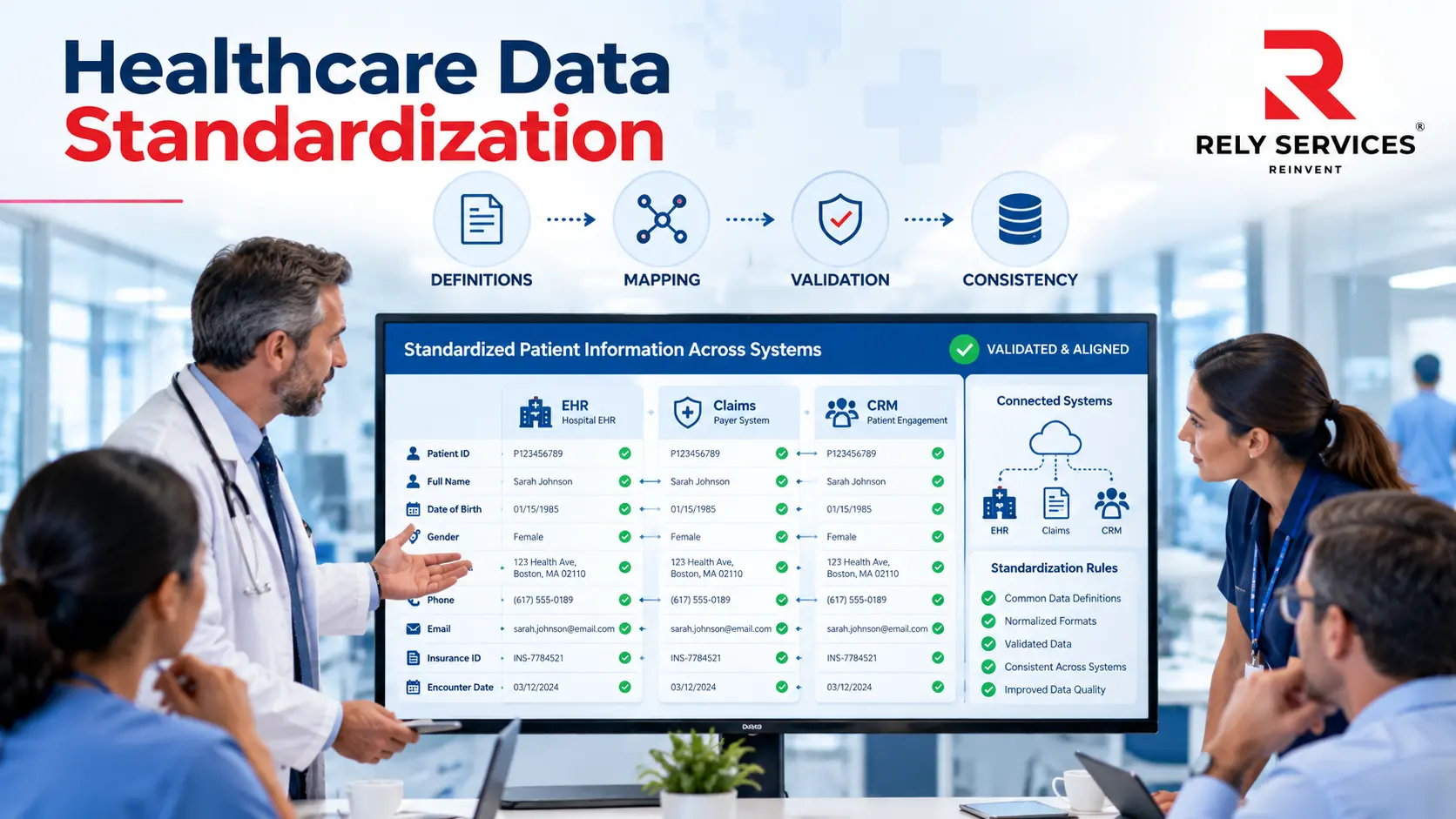
Healthcare data standardization gives teams a shared way to represent patient information across systems. It addresses differences in field definitions, formats, units, identifiers, and terminology so information can be interpreted consistently after it moves. For healthcare administrators, the practical goal is straightforward: make the same information mean the same thing wherever an authorized team uses it.
A date that loads successfully can still be misunderstood. A test result can arrive without its unit. Two departments can use the same label for different business events. These problems call for more than another interface. They require decisions about meaning, ownership, validation, and correction.
This guide explains how to build a manageable standardization program, starting with one consequential workflow. The examples are hypothetical implementation scenarios, not claims about a particular provider’s results.
For support with capturing and maintaining healthcare information, explore medical data entry services as a potential part of your broader data quality workflow.
How do you start a healthcare data standardization project?
Start with the decisions people need to make. A registration team may need reliable demographics before scheduling. A revenue cycle manager may need consistent encounter and payer information before downstream review. A clinical analytics team may need comparable measurements across locations.
Describe the problem in operational terms: which information differs, where it differs, and what work stops because of it. “Improve data quality” is too broad. “Ensure receiving systems distinguish an unknown discharge date from a missing transmission” gives a project an observable outcome.
Separate representation, meaning, and identity
Three different issues often appear in the same record:
| Issue | Example | Decision required |
| Representation | One system stores a date as text and another expects a date field | Define an accepted format and parsing rule |
| Meaning | “Visit date” means scheduling date in one report and service date in another | Agree on separate definitions |
| Identity | Two systems associate an encounter with different patient identifiers | Establish an approved matching and escalation process |
Do not solve an identity problem by merely reformatting identifiers. Similarly, standardizing the appearance of a clinical term does not establish that two terms have equivalent meaning. Route ambiguous clinical interpretation to a qualified reviewer.
Choose a bounded first workflow
Select a flow with a named owner, accessible examples, and a clear downstream consumer. An outpatient referral intake feed is more manageable than a promise to standardize every patient record. Define its source systems, receiving applications, expected users, and exception path.
Document what remains outside scope. If the pilot covers demographic fields and referral status, it should not quietly become a project to recode historical diagnoses. A bounded scope makes acceptance criteria and review responsibilities more credible.
What should a healthcare data dictionary include?
A healthcare data dictionary should include each field’s definition, authoritative source, accepted values, missing-value rules, transformation logic, and accountable owner. Treat it as a working agreement between operational users, technical teams, and the people responsible for data quality.
For each field, specify its business definition, source, accepted values, required status, transformation rule, and owner. Add the reason the field matters downstream. That reason helps reviewers distinguish a material defect from a cosmetic difference.
Make missing information explicit
Blank, unknown, not applicable, and not yet received can represent different conditions. Decide how the workflow will distinguish them. Avoid inserting a default value simply because a destination requires something in the field.
For example, a missing date of birth should not become an arbitrary date that later appears authoritative. Define whether the record is held, sent with an allowed missing-value indicator, or escalated. Confirm that the receiving application handles the chosen approach correctly.
Record provenance alongside standardized values
Keep enough information to trace a standardized value back to its source. Useful context can include the source system, original value, transformation rule version, processing time, and review decision.
Access to that context should follow the organization’s approved controls. Provenance is not a reason to create uncontrolled copies of patient data. Instead, design a traceable route to the source within the permitted environment.
Select standards according to the information being exchanged
Healthcare interoperability involves several kinds of standards. A format for exchanging information, a terminology for describing a measurement, and a classification used in coding solve different problems. They should not be treated as interchangeable products.
Distinguish exchange structures from terminology
HL7 FHIR provides a framework for representing and exchanging healthcare information. USCDI identifies a standardized set of health data classes and elements for interoperable exchange. Neither label, by itself, establishes that every connected system uses identical local definitions or mappings. Verify the applicable release and implementation requirements before making design commitments.
LOINC concerns identifiers for observations and related information. ICD-10-CM is used for diagnosis coding in the US context. These examples illustrate why the vocabulary must fit the information and purpose. An operational analyst should not choose a clinical code solely because its text resembles a local label.
Maintain a mapping register
For every local-to-standard mapping, record the source value, target value, rationale, reviewer, effective date, and status. Include a category for “no approved mapping.” That category is safer than a rule that silently guesses.
Test mappings against representative examples and difficult cases. A map that works for the most common value can still mishandle retired codes, unexpected punctuation, or a change in the source system’s meaning. Keep the review focused on semantic equivalence, not visual similarity.
Build validation around operational consequences
A useful validation plan asks whether the information is suitable for its intended use. It should cover structure, allowed values, relationships between fields, and the destination’s ability to interpret the result.
Check fields and relationships
Field checks can identify malformed dates, unsupported codes, unexpected characters, and missing required values. Relationship checks examine whether fields make sense together, such as whether an end date precedes a start date.
Use rules carefully where genuine exceptions exist. An unexpected sequence can merit review without proving that the record is wrong. Define which failures stop processing and which create a warning for an authorized reviewer.
Test units and conversion rules
Where a workflow includes measurements, preserve the unit and relevant context. Never assume two numeric values are comparable because they share a field name. A conversion needs an approved rule, suitable precision, and a review path for values outside the expected range.
A hypothetical test might send the same measurement through two source applications and compare the normalized outputs. The purpose is to validate the transformation, not to interpret the result clinically. Include a case where the unit is absent and confirm that the workflow does not invent one.
Define patient matching separately
Document which identifiers and approved matching methods the workflow uses. Handle uncertain matches through an authorized exception process rather than automatically merging records to improve a completion metric.
Use synthetic or otherwise approved test data to exercise similar names, changed addresses, missing identifiers, and duplicate submissions. Define what a reviewer must see before accepting a match. Patient identity decisions need governance beyond a field-formatting rule.
Establish an exception and correction process
Standardization work does not end when a rule flags a record. Someone needs authority to investigate it, resolve the underlying problem, and communicate the result to affected users.
Give every exception a destination
Create categories such as missing source information, invalid format, uncertain identity, unsupported terminology, and interface failure. Assign each category to a responsible team. Include an escalation route when the first reviewer cannot resolve it.
Record why the exception occurred and what changed. Avoid a shared queue where all problems look identical and no one can distinguish a source-system correction from a transformation defect.
Preserve the distinction between correction and conversion
Converting an approved date format is different from correcting a date believed to be inaccurate. Define who can authorize each action. A technical team should not silently change the underlying business or clinical information while performing a format conversion.
For consequential corrections, assess which downstream systems received the earlier value. Plan how to communicate or reprocess the correction without creating duplicate transactions. The exact method depends on the applications and the organization’s approved record-management procedures.
Pilot the complete flow before expanding
Use a test set that reflects ordinary records, incomplete records, ambiguous cases, and changes in the source data. Include both accepted and rejected examples. Testing only clean inputs gives little evidence about exception handling.
Agree on acceptance criteria with receiving teams
Define acceptance before the pilot begins. Criteria might include correct interpretation of required fields, complete provenance for transformed values, successful handling of approved missing values, and clear ownership for unresolved exceptions.
Have receiving users inspect the information in their application, not just an integration log. A successful transmission does not demonstrate that the destination displays or uses the information as intended.
Keep a reusable acceptance record
For each test case, retain the approved input, expected standardized output, actual output, rule version, reviewer, and result in a permitted location. Use synthetic examples where possible. Record unresolved questions rather than editing the expected result after seeing the system’s behavior.
When a mapping changes, rerun affected cases and selected neighboring cases. A correction to one category can unintentionally alter another if both use a shared transformation. The acceptance record gives the team a concrete basis for comparing releases and explaining why a change was approved. Keep it separate from any unsupported claim that the entire data set is now accurate.
Plan release and rollback
Identify the mapping version being released, the affected interfaces, the approval owner, and the conditions for pausing or reversing the change. Retain the approved previous configuration where the system supports it.
Do not assume rollback can undo every downstream action. Determine whether corrected messages, user notifications, or targeted reconciliation would be required. Practice the operational response before relying on it during a live release.
Measure whether consistency is improving
Choose measures tied to the workflow rather than broad promises about transformation. Useful measures include the share of records failing a specific rule, unresolved exceptions by age, and the frequency of downstream corrections linked to a mapping.
Define every numerator, denominator, and exclusion. If a team measures missing required fields only among accepted records, rejected records can disappear from view. Track coverage alongside quality so apparent improvement does not come from processing fewer difficult records.
Review trends by source system and rule version. A sudden change may indicate a new upstream export, altered field definition, or a deployment problem. Use the measurement to investigate the process, not to assume which team caused the issue.
Assign ownership that survives the initial project
Name a business owner for definitions, a technical owner for transformations, and qualified reviewers for clinical terminology and identity questions. Establish who approves updates and who tells receiving teams about them.
When another team or service provider participates, document the permitted tasks, access boundaries, escalation rules, and evidence needed for acceptance. Do not assume that outsourcing transfers accountability for definitions or patient information.
Privacy and security review should cover the actual systems, data flows, and contractual arrangements involved. HHS guidance is a starting point for evaluating applicable HIPAA obligations; this article does not establish that a particular workflow or provider meets them. [S5]
For a broader staffing assessment, use Rely Services’ healthcare BPO overview to frame questions about task ownership, permitted access, and escalation responsibilities.
Review changes before a source system updates
A mapping can remain technically valid while its business context changes. Ask source-system owners to notify the standardization team about new fields, revised labels, changed value lists, and interface updates. Identify the workflows that depend on each affected field.
Test a changed definition against existing consumers
Suppose a hypothetical registration system adds a second contact-preference field. The existing destination may interpret the original field as the only preference. Before accepting the new export, determine whether the destination needs a separate field, an approved combined representation, or a change to its workflow.
Document the decision and test both old and new records. Confirm how the system behaves during the transition, especially when one source has adopted the change and another has not. Do not infer that a successful import means the revised information remains comparable.
Keep change notices understandable to operational users. Explain which interpretation changes, when it takes effect, and where to raise an exception. This gives receiving teams a practical way to detect unexpected behavior after release.
Use a practical standardization readiness checklist
Before expanding the workflow, confirm that:
1. Each in-scope field has an approved definition and owner.
2. Source-to-target mappings have documented review and version history.
3. Missing and ambiguous values have explicit handling rules.
4. Patient matching has its own approved exception process.
5. Receiving teams have checked interpretation in their applications.
6. Corrections can be traced and communicated downstream.
7. Release, monitoring, and rollback responsibilities are assigned.
Begin with the highest-consequence ambiguity in one workflow. Build an agreement around it, test the agreement end to end, and use what you learn to guide the next expansion. Healthcare data standardization becomes useful when people can trust both the standardized value and the process behind it.
If inconsistent source entries are part of the problem, explore Rely Services’ medical data entry services and discuss where additional support could fit your approved workflow.
Frequently asked questions
Should historical records be standardized before new records?
Choose based on the intended use, risk, and available resources. A forward-looking rule can stop new inconsistencies while a separate backlog project addresses selected historical records. Define how users will recognize records processed under different rules. Do not imply that an unreviewed historical conversion is clinically equivalent to the original.
Can two departments keep different local labels?
They can, if the shared definition and mapping remain clear and tested. Local convenience becomes a problem when the same label carries different meanings without that distinction being visible. Record the local context, shared representation, and ownership so later changes do not silently break the agreement.
Can a spreadsheet support an initial standardization pilot?
A controlled spreadsheet can document a small pilot’s dictionary and mappings if ownership, access, and version history are clear. Avoid using it as an uncontrolled patient-data repository. Reassess the tool when concurrent edits or dependencies become difficult to manage.
Does a standardization project require replacing the EHR?
Not necessarily. First assess whether existing applications and supported interfaces can apply the approved definitions and transformations. A standardization plan should identify specific system limitations before proposing replacement. Confirm feasible changes with application owners rather than assuming a new platform is necessary.
How should teams handle conflicting source values?
Use an approved rule that identifies the authoritative source for the specific field and workflow. If no rule resolves the conflict, hold it for review. Do not automatically choose the newest value unless that decision has been justified and approved.
What should an initial standardization project deliver?
A practical pilot should produce an approved dictionary, reviewed mappings, test results, an exception process, and named operating owners. Include a record of unresolved issues. These deliverables help the team assess readiness without claiming that every source record is accurate.