


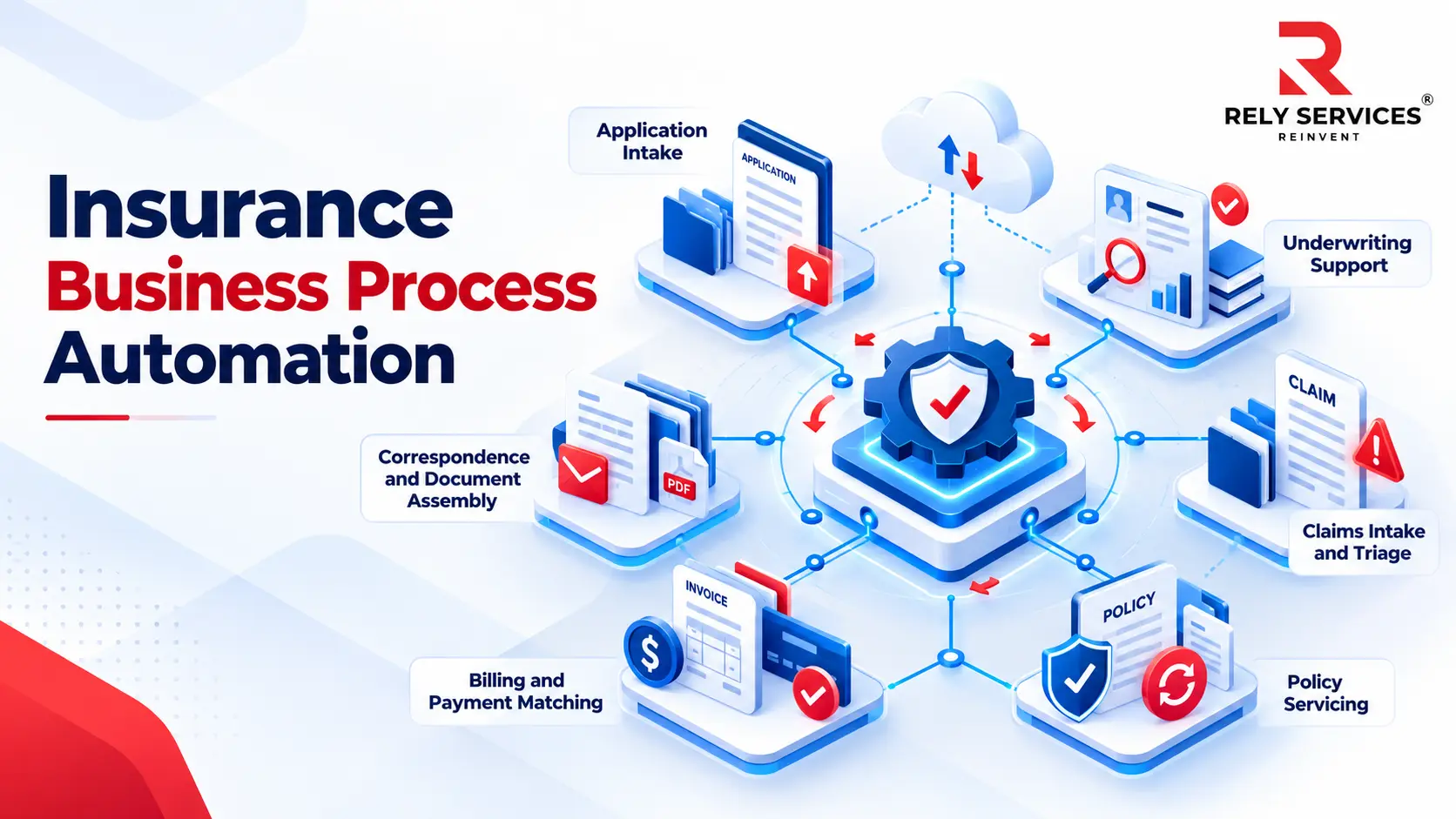
Insurance business process automation uses software and defined rules to perform repeatable operational tasks, move work between systems, and route exceptions for review. For US insurers, useful opportunities often sit inside familiar processes: collecting application information, organizing claims submissions, preparing policy changes, and reconciling payments. Insurers reviewing their operational workflows can explore insurance BPO services to assess where external operational support may complement their existing processes.
The practical starting point is the task, not a promise to automate an entire department. Checking whether an application includes a required attachment is different from deciding whether to accept the risk. Routing a claim is different from deciding coverage or payment.
This guide identifies areas worth assessing and explains how to select a controlled first use case. Examples are hypothetical workflow designs. They are not performance claims, legal conclusions, or descriptions of Rely Services’ capabilities.
How do you set boundaries for insurance automation?
Break each process into receipt, preparation, evaluation, decision, communication, and reconciliation. Identify the tasks governed by stable rules and the decisions that require delegated authority or qualified judgment.
This distinction helps prevent a small workflow tool from quietly taking on a consequential decision. Record what the automation may do, what it may only recommend, and what must remain with an authorized person.
Match the method to the work
Workflow automation moves tasks and enforces defined steps. Rules engines apply explicit conditions. Robotic process automation can perform configured interactions with applications. AI-based tools can assist with activities such as interpreting unstructured content, but their outputs need evaluation appropriate to the use.
Choose a method after understanding the task and available integration options. A stable system interface may be preferable to a screen-based workaround. An uncertain classification task may need a review step rather than a more elaborate rule tree.
Specify observable completion
Define what must be true when the automated task finishes. “File sent” is weaker than “the correct attachment is associated with the intended application and the receiving system acknowledged it.”
Include what happens after partial failure. If a record is created but an attachment fails, the process must detect and resolve that state. Otherwise, a retry can create a duplicate while leaving the original problem unresolved.
Application intake and submission preparation
Application intake is a useful candidate when work involves repeated completeness checks, document organization, and requests for missing information. First map variations by product, channel, and distribution arrangement.
Check presence and consistency
Automation can be designed to check whether required fields and attachments are present for the specified workflow. It can also flag conflicting dates or mismatched identifiers for review.
Keep a distinction between a completeness check and substantive evaluation. A submitted answer is not necessarily accurate merely because a field is populated. Avoid allowing an intake status to imply that underwriting review is complete.
Route incomplete submissions clearly
Assign missing-information work to an owner and approved communication path. Record what was requested, what arrived, and whether the application is ready for the next step.
Set limits on repeated requests. If the source cannot supply a required item or the request itself is disputed, route the situation to an authorized reviewer. An endless automated reminder sequence is not a resolution process.
Underwriting support and case preparation
Insurers can assess automation for assembling information, organizing documents, and preparing a consistent case summary. The goal should be to make reviewed information easier to evaluate, with clear links to the source.
Preserve source evidence in summaries
A summary should distinguish quoted source information, extracted fields, and inferred content. Require reviewers to verify consequential details against the original material before using them in a decision.
If an AI tool produces a summary, test for omissions, unsupported statements, and errors involving names, amounts, dates, and qualifications. A fluent paragraph is not evidence that the underlying application has been represented accurately.
Reserve authority for approved decision makers
Document who can approve, decline, refer, or modify terms. If a system recommendation influences that work, define the permitted use, review controls, and applicable governance requirements.
Do not describe a human approval button as sufficient oversight by itself. The reviewer needs relevant evidence, enough time, and practical authority to challenge the recommendation. Evaluate these conditions before expanding use.
Claims intake and operational triage
Claims workflows contain tasks that can be assessed independently from coverage and payment decisions. Examples include receiving first-notice information, checking attachments, identifying a likely work category, and creating a review assignment.
Build a usable first-notice record
Define the information needed to establish the work item for the relevant product and channel. A workflow can identify missing operational fields and route follow-up without assuming that a complete submission establishes a valid claim.
Preserve the source submission and record material corrections. If information changes during follow-up, authorized users should be able to understand what changed and which version informed later work.
Keep triage separate from disposition
Triage can route work according to approved criteria such as product, geography, or required expertise. A routing label should not silently become a conclusion about coverage, liability, fraud, or payment.
Test unusual and conflicting submissions, not only ordinary ones. Define when routing must pause for review. If the system detects a possible duplicate, investigate before merging or closing a work item that might contain new information.
Policy servicing and routine change requests
Policy servicing may involve address updates, document requests, renewal preparation, and other recurring administrative activities. Assess each change type individually because authorization, validation, and downstream consequences differ.
Validate the request and permitted action
Confirm the requester’s authority through the insurer’s approved process before making changes. Define which changes can proceed automatically and which require further review. The permitted path may vary by product and jurisdiction.
For example, a request to correct contact information can have different consequences from a change affecting insured exposure. Do not let a common intake form obscure the different approvals needed for each action.
Reconcile downstream updates
Identify all systems and communications affected by an approved change. Check that updates reached the intended destinations and that failures create actionable work.
Record effective dates explicitly. A change that appears in one application but takes effect differently elsewhere can create conflicting information. Include timing and partial updates in the acceptance test, rather than checking only that the first screen changed.
Billing, payment matching, and reconciliation
Finance-related automation candidates can include invoice preparation, payment-to-account matching, exception routing, and reconciliation support. Use the organization’s accounting rules and approved control framework to define the task boundaries.
Separate suggested matches from approved postings
A process can propose a match using references, amounts, and dates. Define when that proposal is reliable enough for the permitted action and when someone must investigate.
Test partial payments, combined remittances, reversals, and duplicate references. A rule that works for a single straightforward payment may fail when one remittance covers several items or arrives without useful identifiers.
Keep exceptions visible in the ledger workflow
Assign unmatched and conflicting items to a named owner. Record the reason, supporting evidence, and approved resolution. Make sure completion measures include these items rather than counting only successful automatic matches.
Reconcile the source transactions, processing results, and destination records. Do not infer financial correctness from a successful software run. An accountant or other authorized reviewer should approve the relevant controls and acceptance evidence.
Correspondence and document assembly
Template-based communications can be candidates for automation when the content, data fields, approval rules, and delivery requirements are well defined. Assess document assembly separately from legal or substantive approval.
Control templates and variable data
Maintain approved templates with version history and an accountable owner. Test names, dates, amounts, product references, and conditional text against expected examples.
Define which situations should prevent automatic release. Missing fields, conflicting instructions, or an outdated template should create a review task. Avoid letting a default phrase conceal that required information is absent.
Confirm the permitted communication path
Have the appropriate legal and compliance teams review product-specific and jurisdiction-specific requirements, including content and timing where applicable. Do not assume that one template or delivery channel is appropriate across all states and lines of business.
Capture delivery results and failures using approved systems. An attempted email or generated PDF is not necessarily evidence that the communication met the required operational or legal condition.
Which insurance tasks should you automate first?
Start with a repeatable task that has stable rules, accessible approved data, a clear completion condition, and an accountable exception owner. Compare candidates using operational fit, decision consequences, integration options, and recovery requirements rather than an unsupported savings estimate.
| Criterion | Question to resolve before a pilot |
| Rule stability | Are the inputs, decisions, and expected outputs clearly defined? |
| Data readiness | Is necessary information accessible, reliable, and permitted for this use? |
| Exception handling | Who owns uncertain or failed cases? |
| System fit | Can the workflow integrate through a supported method? |
| Decision consequence | Could an error affect coverage, payment, rights, or financial records? |
| Reversibility | Can the organization detect and correct a mistaken action? |
| Review capacity | Can reviewers handle the expected exception workload? |
A narrow, stable preparation task may be a better first pilot than a high-volume process with unclear ownership. Document why a candidate was selected and which risks need evidence before expansion.
Build governance into the pilot
Assign an operational owner, technical owner, and appropriate legal, compliance, security, and finance reviewers. Specify the evidence each needs to approve the workflow. Responsibilities should remain clear when a vendor operates part of the process.
Test decisions, errors, and recovery
Use approved test data to cover ordinary inputs, missing information, conflicting records, system downtime, and retries. Compare actual outputs with expected outcomes. Confirm that exceptions reach the responsible person and can be resolved without guessing.
Define rollback or suspension conditions before release. Test whether work can continue through an approved alternative and whether partially completed transactions need reconciliation. Recovery is part of the workflow, not a separate future project.
Keep an action record that connects the source request, rule or model version where relevant, processing result, exception decision, and destination acknowledgment. Store only the information permitted for the operational purpose. Reviewers need to reconstruct a consequential action without creating an uncontrolled duplicate store of customer data.
Test that the record remains useful after a retry or manual correction. A successful final result should not conceal an earlier partial action that still needs reconciliation. Have the business owner review the evidence with the technical team, so the log describes the work in terms both can interpret. Define who may access that evidence and how long it is retained under the approved policy.
Review AI use for its specific context
If AI contributes to a task, document its intended use, limitations, data inputs, and review requirements. Use a risk-management framework to organize evaluation, but do not treat adoption of a framework as certification.
NAIC materials are a starting point for research on insurance AI governance. Their existence does not establish a uniform nationwide requirement or prove that a particular use is permitted. Verify current state-specific expectations and applicability with qualified reviewers.
For cross-functional staffing questions, review Rely Services’ business process services overview and clarify responsibilities across operations, finance, and technology before involving an external team.
Measure outcomes without hiding the hard cases
Define a baseline and choose measures tied to the selected task. Examples include elapsed time to accepted completion, repeat handling, exception volume by cause, and downstream corrections. Specify the population and time window.
Compare quality and flow together. Faster handling may shift work into another queue or create more corrections. Examine whether review capacity, customer communication, or reconciliation changed alongside the automated task.
Record results as observed outcomes for the pilot, with limitations. Do not generalize a small test into guaranteed cost savings, processing accuracy, or revenue improvement. Use the evidence to decide whether to expand, revise, or stop.
Prepare the operating handoff
Before the pilot becomes routine work, document who monitors it during operating hours and who handles failures outside those hours. Include access requirements, escalation contacts, and the approved method for pausing new work. Avoid a handoff that depends on one developer remembering how the process works.
Create a concise runbook for recurring failures. For example, if the destination application becomes unavailable, explain how to identify pending transactions, prevent duplicate retries, and reconcile work after service returns. Test the instructions with someone who did not build the automation.
Also define what happens when a rule, product, form, or vendor changes. The operational owner should know which changes trigger retesting and who can approve release. Schedule a review of open exceptions and unsupported workarounds so temporary responses do not quietly become permanent operating procedures.
Start with one controlled operational task
Select a task with clear rules, available information, and a responsible receiving team. Define the automation boundary, exception path, acceptance evidence, and recovery procedure before launch.
Insurance business process automation is most useful when the organization can explain what happened and intervene when conditions change. Choose the next pilot by operational need and evidence, then validate it before extending the approach to consequential decisions.
If a pilot reveals administrative capacity gaps, explore Rely Services’ insurance BPO services and discuss the tasks needing support, decision boundaries, and exception ownership before defining a service scope.
Frequently asked questions
Can an insurer automate work while keeping a legacy platform?
Possibly, depending on supported interfaces, permissions, and the stability of the workflow. Assess approved integration options first. If a screen-based approach is considered, test application changes, interruptions, and recovery carefully. Keeping the core platform does not remove the need to validate the full transaction path.
Who owns a failed automated task when a vendor operates it?
Define that responsibility before deployment. The operating agreement should identify who detects failure, who can pause the process, who investigates, and who approves correction. Outsourcing operation does not remove the insurer’s need for accountable business ownership and appropriate oversight.
Does insurance process automation require AI?
No. A task with explicit conditions may use workflow rules or supported system integrations without AI. Assess the simplest suitable method against the actual inputs, exceptions, and review requirements. Introducing AI requires its own evaluation rather than being a default project requirement.
Should a pilot run in observation mode first?
Observation mode can help compare proposed actions with approved expected outcomes before enabling live actions. Keep its outputs clearly separated from production decisions. Establish what evidence would justify a controlled release and which unresolved errors would prevent it.
How should rules differ across insurance products?
Maintain explicit product-specific rules and approval ownership where requirements differ. Do not copy a rule into another product or jurisdiction without review. Include representative cases for each approved variation and document which version applies to each transaction.
When should an insurer pause an automated workflow?
Pause according to predefined escalation criteria, such as unexplained mismatches, unsupported inputs, incorrect customer communications, or incomplete transaction records. Assign authority to stop new work and reconcile affected items. Resume only after the responsible owners approve the correction and supporting tests.