


Introduction: Why US Companies Are Looking at BPO Differently
Why BPO Outsourcing Companies in USA Are Evaluated Differently
Business process outsourcing (BPO) is viewed differently across the US market than it was in the past. Outsourcing was once treated mainly as a way to reduce operating costs. Today, companies evaluate BPO outsourcing companies in USA not only for cost savings, but also for process efficiency, skilled capacity, technology-enabled workflows, and flexibility as business volumes change.
For CFOs, COOs, finance leaders, and operations managers, outsourcing decisions are now measured against service quality, data security, scalability, workflow control, and measurable business outcomes. Instead of simply handing off tasks, these leaders expect a more controlled and accountable operating model.
What US BPO Companies Are Expected to Deliver
Modern US BPO companies are expected to provide structured business process outsourcing services supported by documented workflows, dedicated teams, quality checks, service level agreement (SLA) reporting, exception management, and process optimization.
Specialized support is also common across critical business functions. A healthcare BPO company may handle medical billing, claims processing, revenue cycle management, and healthcare back-office support. Financial BPO services may cover accounts payable (AP), accounts receivable (AR), bookkeeping, reconciliations, and finance and accounting outsourcing.
As operating pressure increases, outsourcing is more than a cost-saving option. For many US businesses, it is a practical way to strengthen operations, improve consistency, and scale without adding the same level of internal complexity.
What Do BPO Outsourcing Companies in USA Actually Do?
Which Business Processes Do BPO Providers Manage?
BPO outsourcing companies in USA manage specific business processes that would otherwise be handled by internal teams. These processes may include finance and accounting, healthcare administration, data processing, customer support, claims management, document processing, and other back-office functions.
Rather than simply adding outside staff, providers usually build structured workflows around the outsourced process. Responsibilities, service levels, turnaround times, quality standards, and reporting requirements are defined before day-to-day work is transferred.
This allows internal teams to stay focused on business strategy, customer relationships, financial control, and other higher-value responsibilities.
How US BPO Companies Manage Business Processes
Most US BPO companies follow a structured delivery model. They first review the current process and identify which activities can be standardized or transferred.
A typical BPO workflow may include:
Process assessment → transition planning → workflow setup → service delivery → quality control → SLA reporting → continuous improvement
Providers generally measure performance through key indicators such as accuracy, turnaround time, productivity, backlog levels, and exception rates.
When managed properly, business process outsourcing can provide greater visibility into operational performance while reducing pressure on internal teams.
Why Are US Companies Outsourcing More Business Processes?
Why Are US Businesses Increasing Their Use of BPO Services?
More US companies are outsourcing business processes because internal teams alone are struggling to keep up with operational demands. Rising labor costs, talent shortages, growing transaction volumes, and pressure to improve efficiency are forcing many organizations to rethink how they handle routine work.
For many decision-makers, BPO outsourcing companies in USA offer a way to add skilled capacity without building the same level of fixed internal infrastructure. Outsourcing can also provide access to specialized teams, defined workflows, performance reporting, and technology-supported processes.
The goal is no longer only to reduce costs. Companies now place greater value on scalability, process control, consistency, speed, and access to experienced operational support.
Access to Specialized Skills Through US BPO Companies
Certain business processes require experience that may not always be available internally. This is especially true in areas such as accounts payable, healthcare revenue cycle management, claims processing, reconciliations, and high-volume data processing.
By working with US BPO companies or global delivery partners that serve US businesses, organizations can gain access to teams that already understand these workflows.
Training time may be reduced, standard operating procedures can be established more quickly, and specialized resources can be added without lengthy hiring cycles.
This can be especially valuable for managers whose internal teams are already operating at capacity.
How Outsourcing Can Help Control Operating Costs
Cost control remains an important reason for outsourcing, but the benefit extends beyond labor savings alone.
When repetitive business processes are transferred to an outsourcing partner, costs associated with hiring, training, infrastructure, supervision, and technology may be reduced or better controlled.
A portion of fixed operating costs may also be converted into a more flexible service model.
This can help businesses manage changing workloads while keeping internal teams focused on higher-value responsibilities.
Scaling Business Processes Without Constant Hiring
Work volumes rarely remain constant.
Transaction levels may increase because of business growth, acquisitions, seasonal demand, new customer contracts, or expansion into new markets. If every increase in workload requires additional hiring, operating costs and management complexity can rise quickly.
Outsourcing provides another option.
Capacity can be expanded through an existing delivery model, while processes remain governed by agreed workflows, service levels, and reporting standards.
This is one reason businesses that need more flexibility as transaction volumes change often evaluate BPO outsourcing companies in USA.
Standardizing Processes Across Departments and Locations
Outsourcing can also create an opportunity to document and standardize processes.
Before work is transitioned, teams typically review and map activities and divide them into clear responsibilities. Approval points, exceptions, quality checks, and escalation paths can then be defined.
For multi-location or fast-growing organizations, this can help reduce differences in how the same work is completed across departments.
Standardized processes can also make performance easier to measure and improve over time.
Helping Internal Teams Focus on Higher-Value Work
One of the strongest reasons for outsourcing is the ability to redirect internal resources.
When employees spend less time on repetitive administrative work, they can give more attention to analysis, process improvement, customer relationships, vendor management, financial planning, and decision-making.
For managers, directors, CFOs, controllers, and COOs, this can create a more balanced operating model.
Business process outsourcing is therefore not simply a way to move work outside the organization. It helps leaders decide which activities should remain internal and which a specialized partner can manage more efficiently.
Healthcare BPO: What Can Healthcare Organizations Outsource?
What Does a Healthcare BPO Company Do?
A healthcare BPO company supports hospitals, physician groups, medical practices, and other healthcare organizations by managing selected administrative and revenue cycle processes.
These services may include medical billing, claims processing, eligibility verification, payment posting, denial management, accounts receivable follow-up, and healthcare data processing.
When evaluating BPO outsourcing companies in USA for healthcare operations, organizations should look beyond cost. They should also review process expertise, accuracy, data security, turnaround time, and reporting.

Medical Billing and Revenue Cycle Management
Medical billing is one of the most commonly outsourced healthcare processes.
Support may include:
- Charge entry
- Claims submission
- Payment posting
- Insurance follow-up
- Denial management
- Accounts receivable follow-up
- Patient billing support
A healthcare BPO company may also support broader revenue cycle management activities, including eligibility verification and claim status tracking.
Routine administrative work can be handled externally, while internal healthcare leaders continue to manage financial strategy, payer relationships, and critical decisions.
Claims Processing and Denial Management
Claims processing requires accurate patient, insurance, and billing information.
An outsourcing team may support:
Claim review → submission → status tracking → denial review → correction → resubmission → follow-up
The team can also monitor denial trends to identify recurring issues that may be affecting collections or delaying revenue.
Healthcare Data Security and Compliance
Healthcare outsourcing requires strong controls because sensitive patient information may be accessed during billing, claims, or administrative processing.
Organizations should review the provider’s approach to:
- Access control
- Data security
- Employee training
- Confidentiality
- Quality checks
- Escalation procedures
- HIPAA-related requirements
Compliance claims should be backed by documented processes, not offered only as a sales pitch.
Choosing the Right Healthcare BPO Partner
The right partner should understand healthcare workflows, work with existing systems, measure service levels, and provide clear performance reporting.
For healthcare organizations considering US BPO companies, the goal should be to improve operational efficiency without giving up control over patient care, financial decisions, or compliance responsibilities.
A well-structured outsourcing model can help internal teams focus more on patient service, revenue strategy, and higher-value operational work.
Financial BPO Services: What Finance Functions Can Be Outsourced?
What Financial BPO Services Can US Companies Outsource?
Financial BPO services help US businesses manage repetitive, transaction-heavy finance activities while strategic control remains with internal finance leaders. Functions such as accounts payable, accounts receivable, bookkeeping, reconciliations, transaction processing, and reporting support can be assigned to specialized outsourcing teams.
When evaluating BPO outsourcing companies in USA for finance operations, pay attention to accuracy, approval controls, turnaround time, data security, reporting, and integration with existing accounting or enterprise resource planning (ERP) systems.
Accounts Payable Outsourcing
Accounts payable is often outsourced because high invoice volumes can place significant pressure on internal finance teams.
A structured AP process may include:
Invoice receipt → data capture → validation → coding → purchase order (PO) matching → exception handling → approval → payment preparation → reconciliation
Defined controls can also help identify duplicate invoices, missing information, and approval delays. Final payment authorization should remain with the appropriate internal personnel.
Accounts Receivable and Collections Support
Financial BPO services can also support accounts receivable processes.
Activities may include customer invoicing, cash application, payment posting, aging reviews, collections follow-up, and dispute tracking. Clear reporting keeps overdue balances and collection risks visible to finance managers.
Internal teams can then focus more closely on customer relationships, credit decisions, and cash flow strategy.
Bookkeeping, Reconciliation, and Close Support
US BPO companies may also handle routine bookkeeping and general ledger activities under documented accounting procedures.
Support can include:
- Transaction recording
- Bank reconciliation
- Credit card reconciliation
- Expense classification
- Supporting schedules
- Month-end close preparation
- Management reporting
Providers should escalate exceptions and unusual transactions rather than process them without review.
Why Financial BPO Services Should Support, Not Replace, Finance Leadership
Outsourcing should not remove financial governance from the organization.
CFOs, controllers, and finance leaders should continue to manage financial policy, treasury decisions, final approvals, budgeting, risk oversight, and strategic planning.
The strongest financial BPO services model is therefore usually a hybrid one. A specialized team handles routine processing, while the company retains critical financial decisions and controls.
For growing US businesses, this approach can provide additional capacity, standardized processes, and improved visibility without requiring new internal hires for every increase in transaction volume.
BPO vs. In-House vs. Hybrid Operations
Should Business Processes Be Outsourced or Kept In-House?
Not every business process should be outsourced. The right operating model depends on the level of control, expertise, transaction volume, compliance needs, and business risk involved.
When evaluating BPO outsourcing companies in USA, companies should first determine which activities can be standardized and managed through defined workflows.
Three common models are usually considered:
| Operating Model | Best Suited For |
| In-House | Strategic, sensitive, and decision-driven processes |
| Outsourced | Repetitive, transaction-heavy, and process-based activities |
| Hybrid | Internal control combined with outsourced execution |
When Outsourcing Makes Business Sense
Outsourcing may be suitable when a company faces high transaction volumes, backlogs, talent shortages, or seasonal workloads.
Specialized US BPO companies can often manage processes such as invoice processing, data entry, claims administration, accounts receivable follow-up, and other back-office activities.
Why Hybrid BPO Models Are Often Used
A hybrid model allows routine activities to be outsourced while approvals, policies, and strategic decisions are retained internally.
For example, a healthcare BPO company may process claims while payer strategy stays in-house. Similarly, financial BPO services may cover AP or reconciliation while final payment approval remains with the finance team.
The goal should be to create the right balance between operational efficiency, control, and accountability.
How to Evaluate BPO Outsourcing Companies in USA
What Should You Look for in a BPO Partner?
Choosing the right outsourcing partner requires more than comparing service costs. When reviewing BPO outsourcing companies in USA, look at industry experience, process knowledge, security, service levels, technology, scalability, and communication.
A provider should be able to explain how it will transition, manage, measure, and improve the work. Clear responsibilities should also be established before operations move outside the organization.
Review Industry and Process Experience
Start by reviewing relevant experience.
A provider supporting healthcare, finance, insurance, or other specialized operations should understand the workflows, terminology, risks, and common exceptions within that industry.
For example, a healthcare BPO company should understand billing, claims, revenue cycle workflows, and data-security requirements. Providers offering financial BPO services should understand AP, AR, reconciliations, transaction controls, and reporting processes.
Define SLAs and Performance Metrics
Agree on service expectations before work begins.
Common performance measures may include:
- Accuracy
- Turnaround time
- Productivity
- Backlog levels
- Error rates
- Exception resolution
- Response time
- SLA compliance
Providers should share reports regularly so that internal managers can review performance.
Evaluate Security and Technology Capabilities
Review data access, user permissions, confidentiality, and system controls carefully.
The provider should also be able to work with the company’s existing ERP, accounting, healthcare, workflow, or reporting systems where required.
Modern US BPO companies may also use automation to support data capture, validation, workflow routing, and reporting. Human review should still be maintained wherever exceptions or higher-risk decisions are involved.
Check Scalability and Governance
A BPO partner should be able to explain how additional volume will be managed during growth, seasonal demand, or unexpected workload increases.
Governance should also be clearly defined through operational reviews, escalation paths, performance dashboards, and regular management communication.
The right outsourcing partner should provide more than additional capacity. It should build a structured operating model that maintains service quality, accountability, and business control as the relationship grows.
How Are Automation and AI Changing Modern BPO?
How BPO Providers Use Technology Today
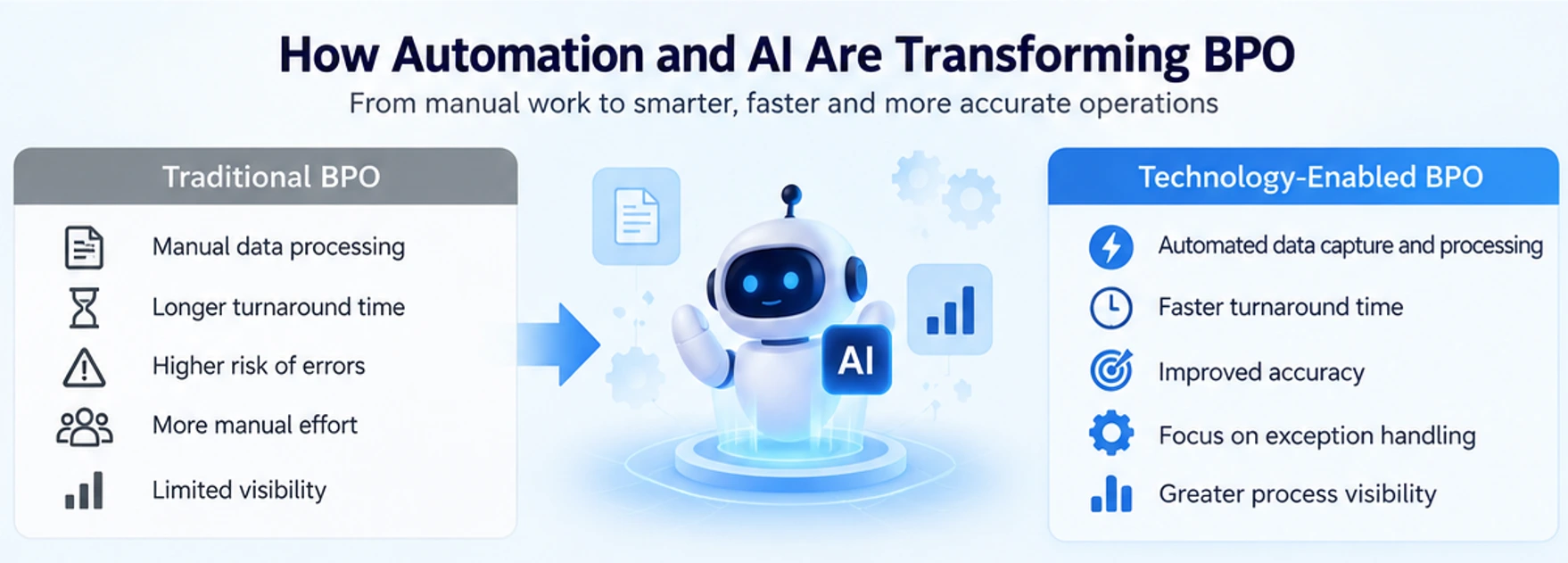
Automation and AI improve speed, accuracy, and visibility across many outsourced processes. At modern BPO outsourcing companies in USA, technology is usually applied to repetitive tasks such as data capture, document classification, invoice processing, workflow routing, and reporting.
The purpose is not simply to replace people. A stronger model combines automation with human review, quality checks, and clear exception handling.
Where Automation Adds the Most Value
Automation works best for high-volume, rules-based activities such as:
- Invoice and document capture
- Data extraction and validation
- Duplicate detection
- Workflow routing
- Status updates
- Basic reporting
For US BPO companies, these tools can reduce manual effort and help standardize how routine transactions are processed.
Where Human Expertise Is Still Required
Human review remains important when exceptions, unclear documents, customer disputes, complex claims, or judgment-based decisions are involved.
A healthcare BPO company may use automation to support claim or billing workflows, but denials, coding questions, and unusual cases may still require trained specialists. In the same way, financial BPO services can use automation for invoice processing or reconciliation while finance teams review exceptions and final approvals.
The most effective BPO model is therefore built around technology-supported operations rather than full automation. Accuracy, accountability, and business control should remain visible as automation is introduced.
What Should Business Leaders Ask Before Outsourcing?
Questions to Ask BPO Outsourcing Companies in USA
Before outsourcing a process, make sure you understand the operating model. Leaders should know what will be transferred, how performance will be measured, and which responsibilities will remain internal.
When evaluating BPO outsourcing companies in USA, ask these questions:
- What experience do you have in our industry?
- Which parts of our process should be outsourced?
- How will the transition be managed?
- What SLAs and KPIs will be used?
- How are errors and exceptions handled?
- How is sensitive data protected?
- Can you work with our current systems?
- How quickly can capacity be increased?
- Who will manage daily communication?
- How often will performance reports be provided?
Why Governance Should Be Defined Early
Document the answers before delivery begins.
Establish clear ownership, escalation paths, reporting schedules, approval controls, and review meetings. This is especially important when US BPO companies handle finance, healthcare, or other critical processes.
Manage a successful outsourcing relationship as an operating partnership. Review performance regularly and identify improvement opportunities as the process matures.
Frequently Asked Questions About BPO Outsourcing Companies in USA
What Services Do BPO Outsourcing Companies in USA Provide?
BPO outsourcing companies in USA may support finance and accounting, healthcare administration, data processing, claims management, document processing, customer support, and other back-office functions. The exact scope is usually defined around the client’s process, transaction volume, systems, and service requirements.
What Is the Difference Between BPO and Outsourcing?
Outsourcing is a broad term for using an external provider for any kind of work. BPO usually involves transferring a defined business process, such as accounts payable, medical billing, or claims processing, to a specialized operating team.
What Does a Healthcare BPO Company Handle?
A healthcare BPO company may support medical billing, claims processing, eligibility verification, payment posting, denial management, AR follow-up, and other revenue cycle or administrative activities.
What Financial BPO Services Can Be Outsourced?
Common financial BPO services include accounts payable, accounts receivable, invoice processing, bookkeeping, reconciliations, transaction processing, and reporting support. Strategic decisions and final approvals should normally remain with internal finance leadership.
Can US BPO Companies Work With Existing Systems?
Many US BPO companies can work within a client’s existing ERP, accounting, healthcare, customer relationship management (CRM), or workflow systems. Access, integration needs, security controls, and user permissions should be reviewed before transition.
How Should BPO Performance Be Measured?
Organizations can measure performance through accuracy, turnaround time, productivity, backlog, error rates, SLA compliance, and exception resolution. Agree on the right metrics before the process is transferred.
How Rely Services Supports Healthcare, Finance, and Back-Office Operations
How Rely Services Fits the Needs of US Businesses
Rely Services provides business process outsourcing support for companies that need additional capacity, stronger process control, and consistent execution. Its services cover finance and accounting, healthcare, insurance, data management, logistics, transaction processing, and other back-office functions.
For companies comparing BPO outsourcing companies in USA, this broader coverage can be useful when more than one operational process needs to be improved or scaled.
Healthcare BPO Support
Rely Services supports medical billing, claims processing, revenue cycle management, patient data processing, and healthcare administrative work. These services can reduce repetitive workloads while maintaining defined workflows, quality checks, and performance reporting.
For organizations seeking a healthcare BPO company, support across multiple revenue cycle and back-office processes can simplify vendor management.
Finance and Accounting BPO Support
Rely Services also provides financial BPO services across accounts payable, accounts receivable, invoice processing, bookkeeping, reconciliations, payroll support, and reporting activities.
Its dedicated teams use documented workflows and quality controls for transaction-heavy finance operations, while strategic oversight remains with the client.
A Scalable BPO Operating Model
Rely Services combines experienced teams with automation and AI-enabled workflows, and applies defined SLAs, quality checks, and reporting across engagements.
For businesses evaluating US BPO companies, the right fit depends on process complexity, expertise, security needs, systems, and service levels.
Organizations considering outsourcing should begin by identifying the processes that create the most workload, delay, or operational risk. A structured model can then be designed around volume, turnaround time, controls, and measurable outcomes.
Conclusion
Choosing among BPO providers is ultimately a decision about control, accuracy, and scale. The right partner takes on routine, high-volume work in healthcare, finance, and back-office operations, while your team keeps oversight of strategy, approvals, and compliance. To discuss your requirements, connect with Rely Services and explore how a structured BPO model can support your operations.