



Introduction
In finance and accounting departments across the United States, purchasing and payment tasks are often handled through disconnected systems, so invoices are matched manually and approvals are delayed. These problems are the reason procure-to-pay services and business process outsourcing solutions are being adopted by many organizations.
Procure-to-pay services are designed to connect procurement and payment activities into a single, streamlined workflow. The procure-to-pay process – from purchase requisition to final vendor payment – is managed end to end, so both purchasing and accounts payable teams are supported at every stage.
This guide is written for finance and accounting managers who want to understand how procure-to-pay services work, why they matter, and how they can be used to control costs. The benefits of procure-to-pay services for finance teams are explained in detail, along with how accounts payable automation supports the process today.
Because procure-to-pay services are used across industries, including life sciences, manufacturing, and financial services, the ideas in this guide can be adapted to fit almost any organization. Whether an in-house team or a business process outsourcing partner is used, procure-to-pay services can help finance teams work faster with fewer errors.
What Are Procure-to-Pay Services?
Procure-to-pay services are defined as the combined management of purchasing and payment activities within a single, coordinated workflow. Through these services, goods and materials are requested, orders are approved, invoices are checked, and payments are released, all within one connected system.
Unlike traditional procurement, where purchasing and finance teams often work in separate silos, procure-to-pay services are structured to link every step together. This means that data is shared between departments automatically, and manual handoffs are reduced.
Core Components of Procure-to-Pay Services
The following elements are typically included when procure-to-pay services are delivered by a provider or platform:
- Requisitioning: Employee purchase requests are captured and routed for approval.
- Purchase order management: Approved requests are converted into formal orders sent to suppliers.
- Goods receipt confirmation: Deliveries are verified against what was ordered.
- Invoice matching: Vendor invoices are checked against purchase orders and receipts.
- Payment processing: Approved invoices are paid according to agreed terms.
The procure-to-pay process is what powers this entire cycle behind the scenes. When it is managed well, spend is controlled, compliance is strengthened, and supplier relationships are protected.
For finance leaders, procure-to-pay services are not simply a technology upgrade. They are treated as a strategic function that supports better decision-making across the organization, since the procure-to-pay process is tied directly to cash flow and reporting accuracy.
Why Procure-to-Pay Services Matter for Finance & Accounting Teams
For finance and accounting managers, procure-to-pay services are valued because they are directly connected to how well an organization controls its spend. When purchasing and payment activities are managed separately, errors are more likely to occur, and visibility into cash flow is often lost.
Accounts payable automation is one of the main reasons procure-to-pay services have become so important in recent years. Through automation, invoices are captured, matched, and routed for approval without manual data entry. As a result, processing time is reduced, and duplicate payments are avoided.
Key Reasons Procure-to-Pay Services Are Prioritized by Finance Teams
- Spend visibility: Every purchase is tracked from request to payment.
- Faster invoice cycles: Accounts payable services supported by automation can shorten the time between invoice receipt and payment.
- Fewer errors: Manual entry mistakes are minimized when workflows are automated.
- Audit readiness: Documentation is stored and organized for compliance reviews.
- Stronger supplier relationships: Vendors are paid accurately and on time.
Because life sciences, manufacturing, and financial services companies are held to strict regulatory standards, procure-to-pay services are often seen as essential rather than optional for finance departments in these sectors.
The Procure-to-Pay Process Behind the Service
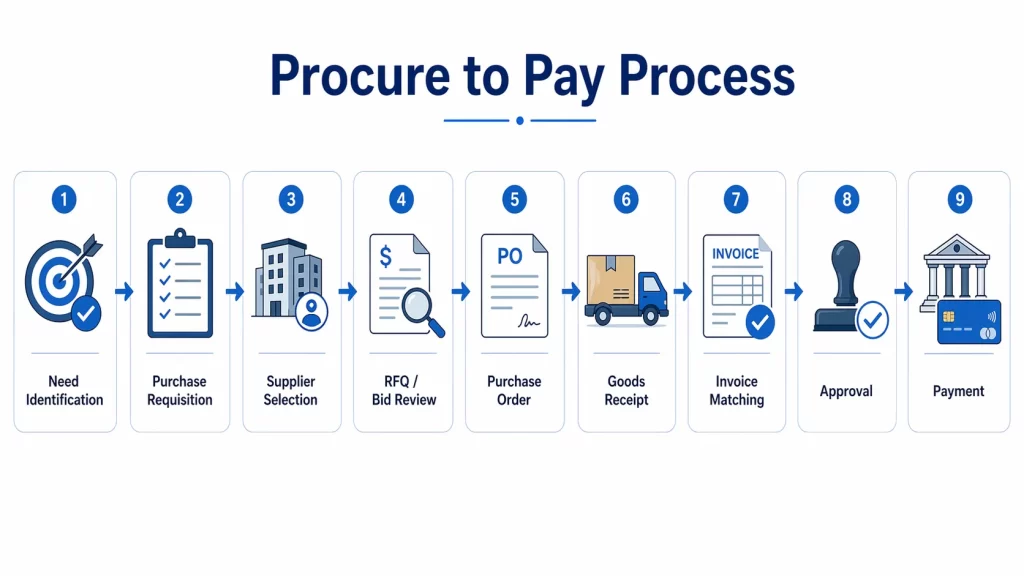
Every provider of procure-to-pay services relies on a structured procure-to-pay process to deliver results. This process is what connects purchasing and payment activities into one smooth workflow. Below, each stage of the procure-to-pay process is explained in detail.
Stage 1: Requisition and Purchase Order
The procure-to-pay process begins when a purchase requisition is submitted by an employee. Within the procure-to-pay process, this request is reviewed against budget and policy rules before it is approved.
Once approved, a purchase order is generated. This document is sent to the supplier and becomes the foundation of the procure-to-pay process moving forward.
Stage 2: Goods Receipt and Order Confirmation
After the order is placed, the supplier confirms the order and arranges delivery. In this part of the procure-to-pay process, goods or services are received and checked against what was ordered.
- Quantities are verified.
- Quality is inspected.
- Discrepancies are flagged immediately.
This step is critical, because errors caught late in the procure-to-pay process are far more costly to correct.
Stage 3: Invoice Matching
Once goods are received, the supplier’s invoice is submitted for review. Within the procure-to-pay process, invoice processing services help verify invoice details and match them against the correct purchasing documents before payment approval.
Invoices are typically matched using one of the following methods:
Two-way matching: The invoice is checked against the purchase order.
Three-way matching: The invoice is checked against both the purchase order and the goods receipt.
This matching stage of the procure-to-pay process is where most inefficiencies are found if manual invoice processing, delayed approvals, or disconnected systems are still being used.
Stage 4: Payment and Reconciliation
In the final stage of the procure-to-pay process, the approved invoice is paid according to agreed vendor terms. Payment records are then reconciled against financial statements, so the procure-to-pay process is closed out with accurate reporting.
When each stage of the procure-to-pay process is managed properly, spend control, compliance, and supplier trust are all strengthened.
Procure-to-Pay Services vs. Purchase-to-Pay: Clarifying the Terms
The terms “procure-to-pay” and “purchase-to-pay” are often used interchangeably, which can cause confusion for finance teams researching procure-to-pay services. In most cases, both terms refer to the same overall workflow.
Are the Terms Different?
In practice, no meaningful difference exists between the two:
- Procure-to-pay is the term more commonly used in the United States.
- Purchase-to-pay is more commonly used in the United Kingdom and parts of Europe.
Both terms describe the same process: requisition, purchase order, goods receipt, invoice matching, and payment. When a provider is selected, procure-to-pay services and purchase-to-pay services should be evaluated using the same criteria.
For finance managers comparing vendors, it is recommended that the underlying capabilities be reviewed, rather than the terminology alone, since providers may use either term to describe identical offerings.
Common Challenges Procure-to-Pay Services Help Solve
Many finance and accounting teams continue to struggle with outdated purchasing and payment workflows. These challenges are the main reason procure-to-pay services are being adopted at a growing rate across industries such as life sciences and manufacturing.
Manual Data Entry and Errors
Without accounts payable automation, invoices are often entered by hand into finance systems. This manual approach increases the risk of duplicate payments, incorrect amounts, and missed discrepancies.
- Data is re-keyed multiple times across systems.
- Human error is introduced at each entry point.
- Reconciliation is delayed as a result.
Lack of Spend Visibility
When purchasing and payment data are stored separately, spend is difficult to track in real time. Accounts payable automation addresses this by consolidating data into a single, visible workflow.
Delayed Approvals
Purchase requests are sometimes held up because approval chains are not automated. As a result, invoices are paid late, and early payment discounts are missed.
Poor Supplier Coordination
Without a centralized system, vendors are often uncertain about invoice status. This uncertainty can strain supplier relationships and lead to unnecessary disputes.
How P2P Outsourcing Helps
For organizations without the resources to build these capabilities internally, P2P outsourcing is often considered. Through P2P outsourcing, these same challenges are addressed by an experienced partner, so internal teams are freed to focus on strategic work rather than transactional tasks.
A PwC study found that 56% of companies still rely on spreadsheets and manual processes to track procurement performance, which shows why these challenges remain widespread.
Key Benefits of Procure-to-Pay Services
When procure-to-pay services are adopted, finance and accounting teams typically experience measurable improvements across cost, compliance, and supplier management. The benefits of procure-to-pay services for finance teams are outlined below.
Cost Savings Across the Procure-to-Pay Cycle
Throughout the procure-to-pay cycle, spend is tracked more closely, so negotiated discounts are captured and maverick purchasing is reduced. Invoice processing costs are also lowered when manual tasks are automated.
- Early payment discounts are captured more consistently.
- Duplicate and erroneous payments are reduced.
- Labor costs tied to manual invoice processing are lowered.
Fewer Errors Across Supply Chains
Because purchase orders, goods receipts, and invoices are matched systematically, errors are reduced at every point in the supply chain. Procurement teams are able to spot discrepancies early, before they affect supplier payments or financial reporting.
Improved Supplier Relationships
When procure-to-pay services are used, suppliers are paid accurately and on schedule. This consistency helps supplier relationships remain strong, and it reduces the number of payment disputes raised by vendors for goods or services delivered.
Better Visibility for Procurement Teams
Procurement teams are given real-time access to spend data, so purchasing decisions are made with more confidence. This visibility supports better negotiation with suppliers and more accurate budget forecasting.
Best Practices When Choosing Procure-to-Pay Services
Selecting the right provider is one of the most important decisions a finance team will make. The following best practices are recommended when procure-to-pay services are being evaluated.
Assess the Full Procure-to-Pay Process Coverage
Before a provider is selected, it should be confirmed that the entire procure-to-pay process is supported, from requisition through payment. Some providers only manage select stages, such as invoice processing, which can leave gaps in internal control.
- Requisition and approval workflows should be included.
- Purchase orders should be generated and tracked automatically.
- Goods receipt confirmation should be built into the workflow.
- Order processing services should support accurate order creation, tracking, documentation, and coordination between purchasing and accounts payable teams.
- Payment and reconciliation should be handled end to end.
Prioritize Accounts Payable Automation Capabilities
Strong accounts payable automation is a key differentiator between providers. Invoice processing should be automated using two-way or three-way matching, so errors are reduced before payments are released.
Confirm Audit Trail and Compliance Support
Because regulated industries require detailed documentation, it should be verified that audit trails are created automatically for every transaction. This is particularly important for organizations managing complex supply chains across multiple vendors.
Evaluate Scalability for Procurement Teams
Procurement teams should confirm that the service can scale with invoice volume, whether hundreds or hundreds of thousands of transactions are processed each year. A provider that cannot scale may create new bottlenecks later.
Review Supplier Relationship Management Tools
Finally, it should be checked whether the provider offers a dedicated point of contact for suppliers. Strong supplier relationships are maintained when vendors have a clear channel for resolving invoice disputes or payment questions.
The Role of Automation Within Procure-to-Pay Services
Automation has become the foundation of modern procure-to-pay services. Without it, most of the benefits described earlier in this guide would be difficult to achieve at scale.
How Accounts Payable Automation Powers the Procure-to-Pay Cycle
Throughout the procure-to-pay cycle, accounts payable automation is used to capture invoices electronically, match them against purchase orders, and route them for approval. As a result, manual data entry is reduced, and invoice processing is completed in a fraction of the time.
- Invoices are captured directly from email or supplier portals.
- Matching is performed automatically against purchase orders and receipts.
- Exceptions are flagged for review rather than delaying the entire batch.
- Approvals are routed digitally, including through mobile devices for managers working outside the office.
Strengthening Audit Trails Through Automation
When accounts payable automation is applied, every action taken within the procure-to-pay process is recorded automatically. This creates reliable audit trails, which are especially valuable when compliance reviews are conducted in regulated sectors such as life sciences.
Reducing Errors Across the Supply Chain
Automation is also credited with reducing errors across supply chains, since data is no longer transferred manually between disconnected systems. Purchase orders, receipts, and invoices are kept synchronized, so discrepancies are caught before payments are released.
Supporting Procurement Teams with Real-Time Data
Procurement teams are given real-time dashboards that show spend by category, vendor, and department. This visibility allows procurement teams to make faster, better-informed decisions without waiting on manual reports.
How Rely Services Delivers Procure-to-Pay Services
For finance and accounting teams that do not have the resources to build these capabilities internally, Rely Services offers a fully managed approach to procure-to-pay services. Rather than simply providing software, an experienced team is used to manage the entire procure-to-pay process on behalf of the client.
A Fully Managed Procure-to-Pay Process
Through Rely Services, every stage of the procure-to-pay process is handled by trained specialists. Purchase orders are standardized, goods receipts are verified, invoices are matched, and payments are released securely and on time.
- Spend intake is standardized across departments.
- Purchase orders are tracked from creation through fulfillment.
- Three-way matching is used to confirm goods or services before payment.
- Payments are processed accurately, protecting supplier relationships.
Why P2P Outsourcing Is Chosen Over Software Alone
Many finance leaders find that software alone is not enough to fully optimize the procure-to-pay cycle. With P2P outsourcing, execution is handled by the provider, rather than adding new tools that still require internal teams to manage errors and exceptions.
P2P outsourcing through Rely Services includes:
- A single point of contact for suppliers, reducing internal workload.
- Scalable support, whether thousands or hundreds of thousands of invoices are processed annually.
- Internal control and audit trails built into every transaction, supporting compliance and regulatory reviews.
- Reduced errors across the supply chain, since manual handoffs are eliminated.
Proven Results with P2P Outsourcing
Organizations that adopt P2P outsourcing and managed procure-to-pay services have reported measurable results. For example, one U.S. bank operating across 10 states used a managed platform to streamline its procure-to-pay process, resulting in a tailored system now handling over $900,000 in spend. In a separate case, a managed services program helped a major bank shorten its procure-to-pay cycle by 49 days while achieving 10% cost savings on spend under management.
These outcomes demonstrate why P2P outsourcing is increasingly chosen by finance teams that want measurable, accountable results rather than added software to manage internally.
Conclusion & Next Steps
Throughout this guide, it has been shown how procure-to-pay services connect purchasing and payment into a single, coordinated workflow. From requisition through final payment, the procure-to-pay process is designed to reduce errors, strengthen internal control, and protect supplier relationships.
For finance and accounting teams, the benefits of procure-to-pay services for finance teams are clear: costs are reduced, compliance is strengthened, and procurement teams are given real-time visibility into spend. Whether these capabilities are built internally or delivered through P2P outsourcing, the goal remains the same – a faster, more accurate, and better-controlled procure-to-pay cycle.
Explore our full range of finance and accounting outsourcing services
Organizations that continue to rely on manual, disconnected processes are likely to fall behind competitors that have already modernized. As shown by the case studies referenced in this guide, measurable cost savings and cycle-time reductions are achievable when the right approach is taken.
Ready to Optimize Your Procure-to-Pay Process?
Finance and accounting leaders who are ready to explore procure-to-pay services are encouraged to speak with the team at Rely Services. Through P2P outsourcing, purchasing and payment operations can be modernized without disrupting existing ERP systems, so internal teams are free to focus on higher-value work.
Ready to Simplify Your Procure-to-Pay Process?
Rely Services helps finance and accounting teams reduce errors, strengthen internal control, and pay suppliers on time – without disrupting existing ERP systems. Whether you process thousands or hundreds of thousands of invoices a year, our team can manage your procure-to-pay services end to end.
Talk to a Procure-to-Pay Specialist → https://www.relyservices.com/schedule-your-discovery-call