


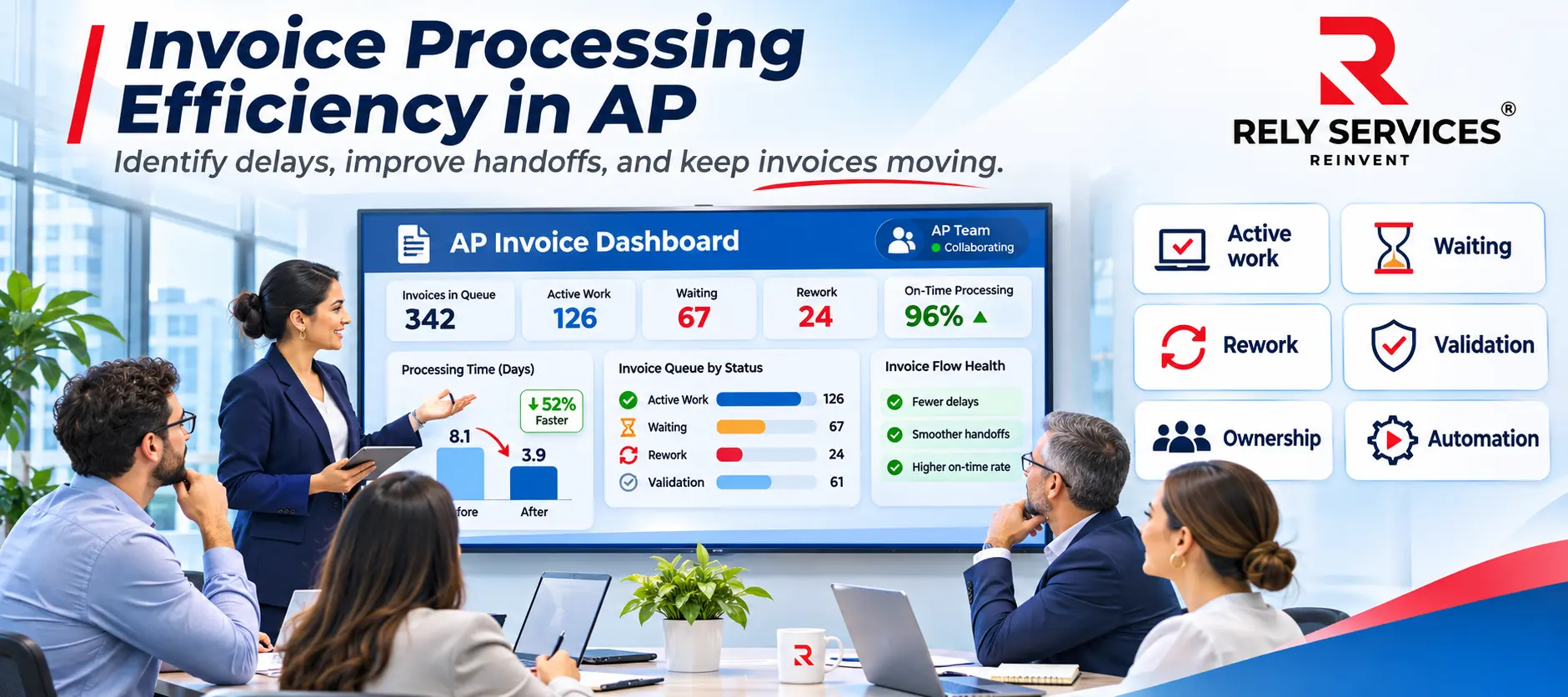
To streamline invoice processing, identify where invoices wait, repeat work, or lose ownership, then redesign those points while preserving the controls needed for acceptance and payment. The goal is a clearer path to completed, usable work rather than simply faster data entry.
An AP team can introduce another tool and still leave the main bottleneck untouched. An invoice may be captured promptly but spend days awaiting a business owner, return for missing purchasing information, or fail during posting. Improvement starts with understanding those states separately.
This guide addresses operational diagnosis and change design. For the underlying stages, use the invoice processing lifecycle guide. The methods here are recommendations to test in your environment, not quantified promises about performance.
Where should an AP improvement project start?
Start with a defined invoice population, an agreed completion condition, and a map of the current process. Establish what the team is trying to improve before selecting automation or setting a processing target.
Choose a bounded scope, such as one business unit or a common invoice category. Record which suppliers, channels, systems, and decision owners are included. Mixing fundamentally different flows can make an apparent average difficult to interpret.
Define completion from the receiving team’s perspective
Completion might mean that the invoice is correctly posted and ready for a separately authorized payment process. Another project may focus on accepted entry into the approval queue. State the boundary explicitly so measurements describe the same event.
Do not count a successful upload as completion if another team must repair the record before using it. Interview the receiving team and examine examples of returned work. That evidence helps reveal whether a local improvement merely transfers effort downstream.
Map active work, waiting, and rework separately
Trace selected invoices through the actual process. Record the state changes, owners, timestamps where available, and reasons for returning to an earlier step. Include exceptions rather than observing only the cleanest path.
Distinguish three different causes of delay
| Work pattern | Diagnostic question | Possible response to test |
| Active handling takes substantial effort | Which repeated task requires unnecessary entry or comparison? | Simplify the task or evaluate a supported integration |
| Work waits without action | Is ownership, authority, or required information missing? | Clarify assignment or redesign the handoff |
| Completed work returns | Which acceptance condition was not met? | Improve source quality or validation before release |
These are diagnostic categories, not proof of cause. For example, a long queue may reflect staffing, missing information, an unreliable system, or several factors together. Review case evidence before selecting a remedy.
Examine variation, not just averages
Segment results by relevant differences, such as PO versus non-PO purchases, business unit, source channel, and exception type. A simple invoice population can hide a smaller group that generates most unresolved work.
Where data allows, inspect the distribution and aged tail as well as an average. Record how incomplete and still-open invoices are treated. Excluding them can make the measured cycle time appear better without improving the underlying operation.
Once AP teams identify where invoices are delayed, returned, or handled repeatedly, they can evaluate whether the current process has the capacity and resources to address those issues. Businesses looking for additional operational support can explore Rely Services’ invoice processing services. Rely supports invoice data capture, validation, purchase order matching, and related accounts payable activities to help businesses manage invoice workflows.
Establish a baseline the team can reproduce
Define the observation period, population, start and end events, and exclusions. Keep the method stable long enough to compare the pilot with the baseline. If the definition changes, explain the change instead of treating the figures as directly comparable.
Choose a small set of useful measures
Candidates include elapsed time to accepted completion, repeat handling, unresolved work by age, failed handoffs, and downstream corrections. The most useful combination depends on the selected problem.
For each measure, name an owner and the source of evidence. If timestamps are unavailable, a documented sample can still inform diagnosis, but its limitations should remain explicit. Do not turn a small sample into an unsupported organization-wide claim.
Define first-pass acceptance carefully
First-pass acceptance can mean an invoice reaches a specified receiving state without being returned for an in-scope correction. Define the receiving state, what counts as a return, and which records are eligible.
Do not equate acceptance with overall accuracy. A missed error may not appear until later. Pair the measure with downstream correction reviews and appropriately selected quality samples so improved speed does not conceal problems.
Improve the input before accelerating the workflow
Clear supplier instructions can reduce avoidable ambiguity, but the instructions need to reflect the organization’s actual purchasing process. State the required references, permitted channels, and contact route for questions.
Remove conflicting intake instructions
Check whether suppliers receive different instructions from purchasing, business units, and AP. Agree on the authoritative version and who updates it. A central mailbox does not help if order documents tell suppliers to send invoices somewhere else.
Test the instructions with realistic cases. A supplier handling a permitted non-PO purchase should understand what evidence is expected. Avoid requirements that force the supplier to invent a reference the organization never created.
Validate fields needed for the next decision
Require only the information necessary for the workflow and establish handling for missing or ambiguous values. Unnecessary fields increase review work, while omitted essential information can cause a later return.
Keep document capture separate from acceptance. A populated field can still contain the wrong date or identifier. The invoice data extraction guide covers field definitions, review boundaries, and testing of extracted information.
Simplify handoffs and decision rights
For every queue, identify the responsible role, entry condition, expected next action, and fallback owner. Review places where an invoice is copied to several people without anyone accepting the task.
Managing invoice processing alongside approvals, exception handling, payment coordination, and other AP responsibilities can put pressure on internal teams. Businesses that need additional operational support can explore accounts payable outsourcing services to manage selected accounts payable activities while maintaining control over internal policies, approval authority, and financial decisions.
Remove duplicate checking only after understanding its purpose
Two reviews may repeat the same work, or they may protect different decisions. Ask what each review verifies, what evidence it uses, and what could happen if it were removed.
Design for absence and reassignment
Maintain approved coverage when an owner is unavailable. Define delegation boundaries and what happens when responsibility changes after a purchase is made. An escalation should reach someone authorized to act, not merely someone online.
For detailed authority and escalation design, use the invoice approval workflow guide. Keep this improvement project focused on the observed bottleneck rather than changing the entire approval policy by default.
Reduce repeat handling at the source
Classify returned work by the condition that caused it. Missing receipt evidence, unclear coding, and failed system posting require different responses. A single rework count can obscure the next action.
Test a targeted change
Suppose a hypothetical AP team repeatedly sends invoices back because service acceptance is not documented. A possible pilot would define an accepted confirmation method and assign a service owner before the invoice reaches final review.
The team should then inspect whether confirmations are usable, whether work is merely waiting earlier in the flow, and whether exceptions remain visible. The example illustrates a test design, not a reported reduction in processing time.
Keep unresolved disagreements in an owned path
Streamlining is not a reason to bypass disputes. Preserve the responsible owner, evidence requirements, and escalation route. If recurring disagreements need attention, consult the invoice exception management guide rather than inventing a shortcut or tolerance.
Document whether the change removes unnecessary handling or simply stops recording it. A lower rework count is meaningful only if the downstream user still receives correct, usable work.
How should AP choose invoice processing automation?
Assess whether a task has consistent inputs, explicit rules, reliable system access, and a controlled exception route. A supported interface or workflow rule may solve a narrow problem without a broader technology replacement.
Distinguish preparation from authorization
A system may prepare a suggestion, route work, or perform an approved action. Define those boundaries separately. Automating a reminder does not authorize the invoice, and extracting information does not establish that the charge is valid.
If AI contributes to interpretation or classification, evaluate the specific use and failure modes. NIST’s AI Risk Management Framework is a candidate evaluation reference, not certification or evidence that a proposed system will perform well on the organization’s invoices.
Test failures and partial success
Include destination downtime, interrupted transfers, duplicate retries, changed supplier layouts, and conflicting source information. Record how the workflow identifies incomplete actions and who can approve recovery.
An automated step that succeeds on ordinary inputs can still shift substantial work into an unstaffed exception queue. Measure the review burden and validate the fallback before expanding volume.
Run a pilot with a clear comparison
Select a defined population and establish expected results before release. Keep the test small enough to investigate problems while including the variety needed to evaluate the selected change.
Record system or policy changes occurring during the observation period. Supplier mix, purchasing patterns, staffing, and other events can affect results. Explain these factors when comparing the pilot with the baseline rather than attributing every change to the intervention. Include the people responsible for unresolved work in the review of pilot findings.
Decide whether to expand, revise, or stop
Use acceptance criteria tied to the original problem. The receiving team should confirm usability, control owners should review evidence, and operational owners should assess workload and exception handling.
Do not expand solely because a demonstration processed a clean batch quickly. If the pilot creates unresolved work, identify the cause and test a correction. Stopping an unsuitable design can be a sound outcome when the evidence does not support wider use.
Compare an improvement with the original problem
Consider a hypothetical business unit where invoices are captured promptly but repeatedly returned by service owners. The project team initially suspects insufficient processing capacity. A trace of selected cases instead shows that the approval request lacks an understandable description of the work being accepted.
The proposed change is narrow: agree on the evidence the service owner needs and make that evidence available with the request. The team preserves the existing authority rule. It tests whether the revised request is understandable and whether missing evidence enters an owned exception path rather than an approval inbox.
During the pilot, reviewers compare like-for-like cases using the agreed start and end events. They check returns and downstream corrections as well as elapsed time. They also record whether someone now performs additional preparation that was absent from the earlier measurement.
If less work returns but preparation takes more effort, the team has a tradeoff to assess, not an automatic success claim. If an exception disappears from reporting because it now enters another queue, the measurement needs correction. The decision to expand should reflect the complete workload and the receiving team’s acceptance.
Preserve a short change record with the original problem, intervention, evidence reviewed, limitations, and decision. This record helps the next process owner understand why the workflow changed. It also gives the team a basis for revisiting the change when the business, supplier inputs, or receiving system evolves.
Maintain the improvement after the project ends
Assign an owner to monitor queue health, returned work, and process changes. Update operating instructions when channels, business responsibilities, forms, or systems change. Keep a route for the receiving team to report recurring defects.
Review a balanced set of flow and quality measures at an agreed interval. Investigate unexplained changes rather than assuming a new performance figure proves a lasting improvement. Preserve the ability to trace a sample invoice through the revised process.
If repetitive processing is taking time from higher-value AP work, explore Rely Services’ invoice processing service options and discuss your bottlenecks, controls, and acceptance criteria before assessing external support.
Frequently asked questions
Should AP set a universal processing-time target?
Set targets against clearly defined invoice populations and operational needs. Different purchase types and unresolved issues can require different treatment. A single target without scope or quality conditions can encourage teams to rush decisions or exclude difficult items from reporting.
Can a shared inbox improve efficiency by itself?
A shared inbox can centralize receipt, but it still needs assignment, duplicate handling, status tracking, and reconciliation. Evaluate whether items become accountable work after arrival. Centralized storage without ownership may simply make an existing backlog easier to see.
How should teams evaluate manual workarounds?
Record why the workaround exists, what control or system gap it addresses, who approves it, and how its results are reconciled. Review recurring workarounds as process-design evidence. Do not assume they are harmless because an experienced employee has used them successfully.
Is outsourcing the same as streamlining a process?
No. Changing who performs work does not automatically clarify inputs, decisions, or ownership. Define the process and service boundaries first, then evaluate whether an external arrangement fits. Retain accountability for policy, approval authority, controls, and acceptance of completed work.
How can AP avoid shifting delays to another team?
Measure the selected workflow through an agreed receiving state and review downstream corrections. Ask receiving teams whether the output is usable without additional repair. A faster handoff is not a demonstrated improvement if another queue absorbs more waiting or rework.
When should a pilot’s baseline be reset?
Review the baseline when a material change makes the original population or measurement method no longer comparable. Document the reason and preserve the earlier definition. Do not reset it simply because the pilot failed to meet an expected outcome.