


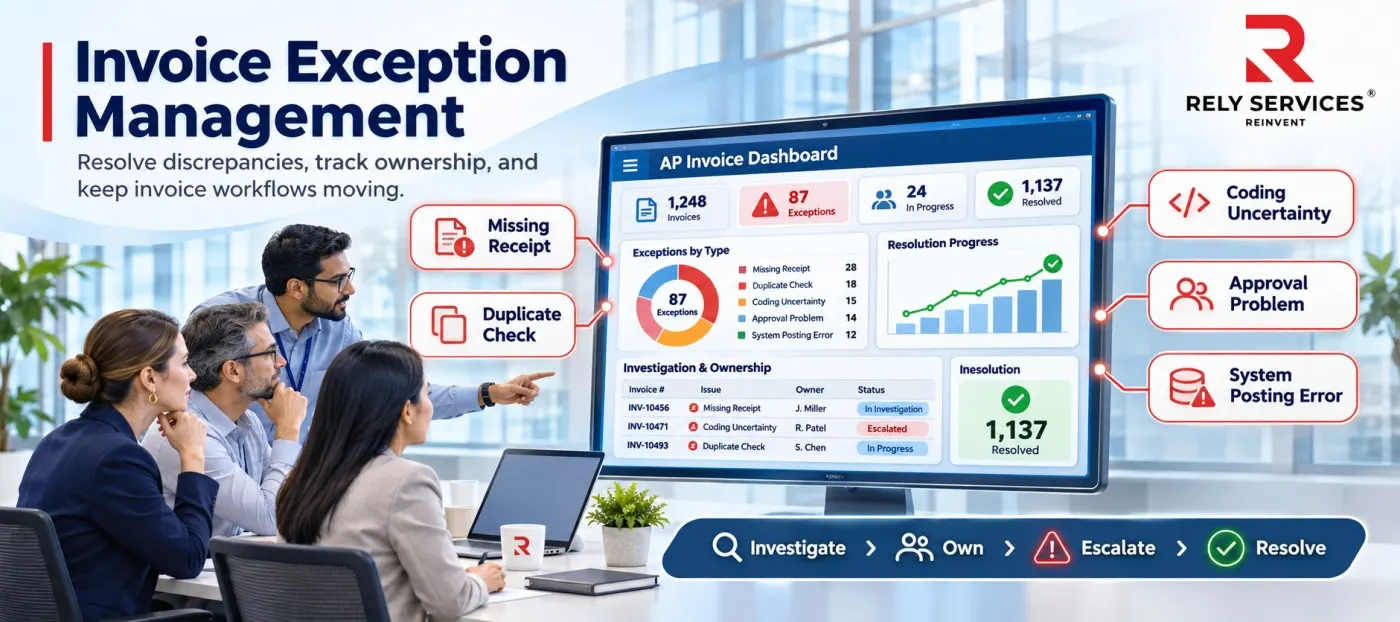
Invoice exception management is the process of identifying, investigating, resolving, and documenting issues that prevent supplier invoices from moving through the normal accounts payable (AP) workflow. Common exceptions include missing invoice information, purchase order mismatches, incorrect pricing, duplicate submissions, and failed accounting system postings.
These issues can delay invoice approvals, create additional work for AP teams, and affect supplier payment schedules. Effective exception management gives every issue a clear owner, a defined resolution process, and the supporting evidence needed before an invoice can move forward.
Before exploring how to handle these issues, it is important to understand the complete invoice processing workflow, from receiving supplier invoices and validating information to approval, posting, and payment reconciliation. This guide focuses specifically on common invoice exceptions, their resolution, and ways AP teams can improve exception tracking and management.
What counts as an invoice exception?
An invoice exception is a condition that prevents the next expected action until information, authorization, or system state is clarified. Define exceptions by the decision they block rather than by a vague label such as “problem invoice.”
Missing receipt evidence may block acceptance of a charge. An invalid account may prevent posting. A bank-detail change request may require an independent verification process. These are different work types, even if the invoice appears in the same application.
Separate exceptions from ordinary waiting
An invoice waiting for a scheduled payment date is not necessarily an exception. An invoice awaiting routine approval may be ordinary work until it breaches the organization’s escalation criteria or cannot reach an authorized decision maker.
Define the boundary in the operating procedure. Otherwise, teams may overcount normal waiting as failure or hide genuine unresolved issues under an ordinary status. Record the reason and the next decision, not just the age of the item.
Classify issues by their resolution path
Create a manageable set of categories, each tied to an owner with the information or authority needed to act. A taxonomy is useful when it improves routing and investigation. It is not useful merely because it produces a more elaborate report.
| Exception category | First investigation | Likely decision owner |
| Missing or unreadable information | Identify the required source detail | Intake owner or supplier contact owner |
| Price or quantity discrepancy | Compare invoice, order, and receipt context | Buyer or designated purchasing owner |
| Missing receipt | Establish whether goods or services were accepted | Receiving or service owner |
| Potential duplicate | Compare prior submissions and accounting entries | Authorized AP reviewer |
| Coding uncertainty | Determine approved entity and accounting treatment | Accounting owner |
| Approval authority problem | Identify the permitted decision maker | Delegation or policy owner |
| Posting failure | Confirm attempted and completed system actions | AP systems and accounting owners |
These are suggested operational categories, not a universal responsibility chart. Confirm each assignment with the teams that will actually receive the work.
Managing invoice exceptions requires more than identifying discrepancies. AP teams also need a structured process for invoice validation, purchase order matching, exception handling, and workflow tracking. When growing invoice volumes put pressure on internal resources, businesses can consider invoice processing services from Rely Services to support these activities and maintain more organized accounts payable operations.
How should AP resolve common invoice discrepancies?
Resolve a discrepancy by establishing the disputed fact, identifying the authorized decision maker, obtaining supporting evidence, and recording the approved outcome. Do not modify the source document or force the invoice through a check simply to reduce the queue.
Missing invoice information
State exactly what is missing and why it prevents the next action. A request for “a corrected invoice” can create another incomplete submission if the supplier does not understand the issue. Use the approved supplier communication channel and keep the request linked to the original receipt.
When a response arrives, compare it with the earlier submission. Decide whether it replaces the earlier document, adds evidence, or creates a separate item. Preserve the relationship so the same liability does not enter processing twice.
Price differences
Compare the relevant invoice line with the approved order or other purchasing evidence. Check currency, unit, quantity basis, and any approved amendment. A difference in unit price may be explained by a changed unit of measure rather than a changed commercial term.
If a tolerance is used, it should come from approved policy and have a documented purpose. Do not invent a percentage or monetary allowance for convenience. Route disputed commercial terms to the person authorized to accept or challenge them.
Quantity differences and partial receipts
Determine whether the invoice covers an entire order or only a shipment or service period. Compare the relevant receipt information rather than assuming the absence of a final receipt proves nothing was delivered.
For a hypothetical split delivery, AP might need confirmation of the accepted quantity before determining how the invoice may proceed. Record whether the outcome is an authorized partial treatment, a hold, or a request for corrected documentation. The available options depend on policy and system capability.
Unconfirmed service delivery
Service invoices may require confirmation from a designated business owner rather than warehouse evidence. Define what that owner must review and how the confirmation is recorded. Do not apply a goods-receipt rule without considering the purchase type.
If the service owner disputes performance, distinguish the commercial dispute from a missing administrative confirmation. The next action and escalation route differ. AP should retain accountability for tracking the invoice without assuming authority to resolve the contract issue.
Investigate duplicates without losing valid invoices
A duplicate candidate is a possible repeat, not a final conclusion. Review supplier identity, invoice reference, amount, currency, source documents, and any related accounting entries. Include the possibility that a later submission corrects an earlier one.
Record the disposition
If a reviewer determines that one submission is redundant, document which record remains active and how the other is treated. Keep enough evidence to explain the decision later. Do not silently delete a file that another team may be investigating.
If the two invoices represent separate charges, record why they are valid despite their similarity. That explanation can support future review without requiring someone to repeat the same investigation from memory.
Keep credits and rebills connected
A credit memo followed by a replacement invoice can resemble duplicate activity if each item is reviewed in isolation. Establish relationships among the original charge, credit, and replacement through the approved accounting process.
Confirm how the net effect is reflected in open items and payment eligibility. The presence of a credit document does not by itself establish that the original payable was adjusted correctly in the accounting system.
Treat supplier payment changes as a separate risk decision
If an invoice or accompanying message asks for different payment details, route the request through the approved supplier master-data verification process. Do not consider a familiar email thread sufficient authority to make the change.
Keep the invoice’s exception status separate from the bank-detail review. A verified invoice may still be ineligible for payment while the payment destination is unresolved. Record the reason and authorized release decision.
Give every exception an actionable case record
The case should show the invoice reference, issue category, blocked decision, owner, required evidence, latest action, and next review point. Link to permitted source records rather than copying sensitive information into uncontrolled spreadsheets or email chains.
Define ownership across handoffs
Identify who maintains accountability while another person investigates. A buyer may resolve a price dispute while AP tracks the invoice and records the outcome. Make those responsibilities visible so neither team assumes the other owns the entire case.
Document when a handoff has been accepted. Sending an email to a department is weaker than assigning the case to a monitored queue or authorized person. Establish a fallback if the intended owner is absent or no longer responsible.
Specify resolution evidence
Each category should have an approved completion condition. Examples include a corrected source document, confirmation from the authorized receiver, an approved accounting decision, or evidence that a failed posting has been reconciled.
Closing the case should explain why the next processing step is now permitted. “Handled” or “supplier contacted” does not demonstrate resolution if the underlying decision remains unanswered.
Prioritize and escalate without bypassing controls
Prioritization can consider the contractual context, payment schedule, operational dependency, dispute consequence, and age. Have responsible owners approve the criteria. An approaching due date should trigger attention rather than permission to skip evidence or authorization.
Use age alongside the next action
Two old items can need different responses. One may await a documented supplier correction; another may have no assigned owner. Segment the queue by cause and next action so escalation addresses the actual obstacle.
Define when to reassign, escalate, or involve another function. Record the outcome rather than automatically sending the same reminder indefinitely. An unresolved request may need a decision about the request itself.
Coordinate with the approval workflow
If an exception is caused by unclear authority or absence coverage, use the approved delegation process. Do not route the invoice to a convenient employee just because that person is available.
If the commercial facts change during resolution, assess whether previous approval remains valid. The responsible owner should decide whether revised amounts, coding, or scope require another review.
Measure resolution quality as well as speed
Useful measures include newly opened cases, resolved cases, aged unresolved cases, reopens, and repeat issues by supplier or category. Define the population and timing rules so held invoices do not disappear from the denominator.
Track time spent waiting separately from active investigation where the system supports it. This distinction helps determine whether the bottleneck is unclear ownership, missing source information, or insufficient review capacity.
Review recurrence at the source
Repeated missing references may call for clearer supplier instructions. Recurring price disagreements may indicate purchasing-data problems. A surge in posting failures may require systems investigation rather than more supplier follow-up.
Review evidence before assigning cause. The team receiving the exception is not necessarily the team that created it. Use the findings to agree on an upstream change and test whether the change addresses the recurring condition.
Review a disputed invoice without losing accountability
Consider a hypothetical supplier invoice that cites a purchase order but uses a different unit price. AP records the discrepancy and assigns the commercial question to the authorized buyer while retaining responsibility for tracking the invoice.
The buyer finds an approved order amendment that was not visible in the receiving workflow. The designated owner checks that the amendment applies to the invoiced item and period. The case then records the supporting reference and approved outcome before the invoice returns to processing.
This is different from overwriting the invoice price or accepting a verbal assurance. If the amendment does not resolve the issue, the case remains open with a next action. The closure decision follows the evidence rather than the pressure to reduce the outstanding count.
Pilot a controlled exception management procedure
Start with a small set of frequent issue categories. Agree on their definitions, owners, escalation points, and evidence needed for closure. Test ordinary resolutions, disputed outcomes, incomplete responses, and an absent owner.
Use approved examples and record expected results before the pilot. Confirm that the final invoice status, accounting treatment, and payment eligibility agree with the decision. A closed case with an unchanged blocked invoice is not a completed handoff.
Effective invoice exception management depends on clear issue classification, accountable ownership, documented resolution decisions, and consistent follow-up. By identifying recurring discrepancies and addressing their underlying causes, AP teams can reduce avoidable rework and maintain better visibility across invoice processing operations.
Businesses that need additional support with invoice validation, purchase order matching, exception handling, and related AP activities can explore Rely Services’ invoice processing services.
Frequently asked questions
Can an invoice have more than one exception?
Yes. Track distinct issues when they require different owners or evidence, while keeping them linked to the same invoice. Define which issues block release and who confirms that all necessary conditions are satisfied. Closing one case should not conceal another unresolved condition.
Should suppliers see internal exception comments?
Use an approved communication policy. Supplier messages should explain the relevant issue and requested action without exposing unnecessary internal discussion, sensitive accounting details, or security information. Keep internal investigation notes in the permitted system rather than assuming every case field can be shared.
Who can authorize a discrepancy tolerance?
The organization should designate the policy owner and approval authority. AP staff should not create a tolerance merely to clear work. Document the scope, rationale, permitted values, and review process, then test how the system applies the approved rule.
Can an exception be reopened after payment?
An issue discovered after payment may require a separate correction, recovery, or accounting review. Preserve its relationship to the original invoice and payment. Have authorized owners determine the response instead of assuming that the earlier case can be changed without downstream consequences.
How should AP handle a supplier that does not respond?
Record the request, approved follow-ups, and the next escalation decision. Involve the designated supplier relationship or purchasing owner where appropriate. Do not invent missing information or automatically release the invoice merely because a response has taken longer than expected.
Is a low exception count always a good sign?
No. It may reflect fewer underlying issues, but it may also reflect weak detection or excluded invoices. Review the population, downstream corrections, and sampled decisions before drawing conclusions. A useful measure represents resolved work accurately rather than rewarding unrecorded problems.