


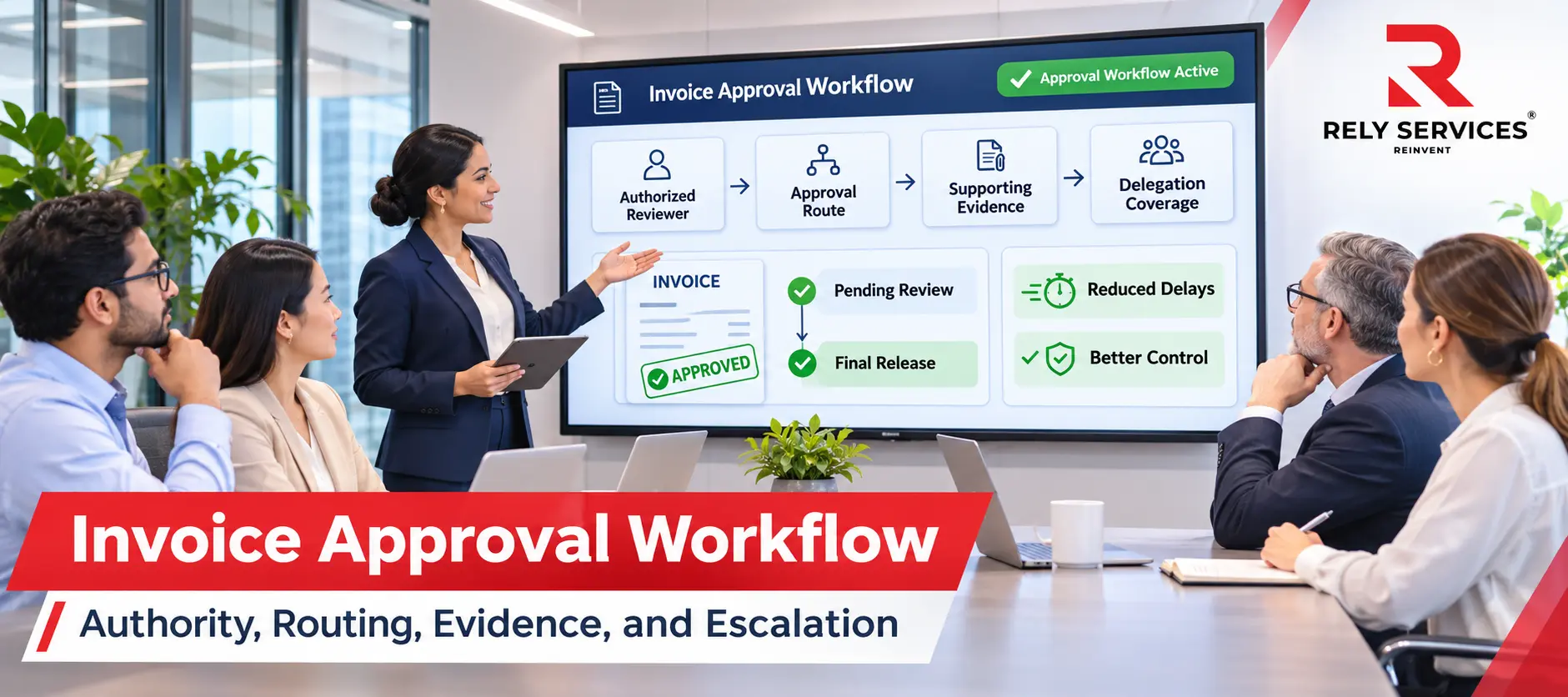
An invoice approval workflow defines who may review and authorize an expense, what evidence they need, how the invoice reaches them, and how the decision is recorded. It also defines what happens when authority is unclear, an approver is absent, or the invoice changes after review.
For AP teams, approval delays are often signals of an unresolved operating decision. The system may not know the correct owner, the reviewer may lack service evidence, or several people may believe someone else must act first. More reminders do not necessarily resolve those conditions.
This guide focuses on authority, routing, decision evidence, and escalation. The invoice processing pillar guide covers the wider lifecycle. Approval rules should be established by the organization’s responsible finance, procurement, and policy owners.
What are the steps in an invoice approval process?
A practical invoice approval process confirms readiness, identifies the authorized reviewer, presents the relevant evidence, records a decision, manages any required additional authorization, and releases the invoice to the next approved stage.
The exact route depends on the organization. An invoice may need a service owner’s confirmation, a budget decision, or additional review based on entity or category. Document the purpose of each decision so serial reviews do not become an unexplained chain.
| Step | Required operating decision | Evidence to define |
| Readiness check | Is the invoice suitable for review? | Required source and purchasing context |
| Assignment | Who has authority for this case? | Current role and delegation rules |
| Review | What is the approver accepting? | Amount, category, entity, and supporting evidence |
| Decision | Approve, reject, or request information? | Explicit disposition and rationale where required |
| Further authorization | Does another decision remain necessary? | Approved threshold or policy rule |
| Release | What is now permitted? | Resulting status and downstream acknowledgment |
Establish an approval matrix before configuring routing
An approval matrix connects transaction characteristics with decision authority. Define the factors that matter, such as buying entity, department, spending category, amount, and relationship to an approved purchase order.
Separate responsibilities that sound similar
Separating invoice review, approval, and payment responsibilities also helps establish stronger accounts payable controls. Businesses should define who can verify a transaction, who has authority to approve the expense, and who can release payment. The University of California, Davis provides additional guidance on accounts payable internal control practices, including approval responsibilities and payment controls.
Identify who can resolve disputed ownership. If an invoice spans departments, define whether allocation decisions occur before approval or within the approved route. A system cannot reliably infer an authority rule that the organization has not agreed upon.
Keep the matrix current
Name an owner for role changes, delegation rules, and route updates. Define how personnel changes are communicated to the workflow administrator. Test the effect on both newly received invoices and work already awaiting approval.
Avoid treating a prior approver’s identity as proof of current authority. A historical decision remains part of the record, while new decisions should follow the applicable current rules and approved transition arrangements.
An effective invoice approval workflow also depends on accurate invoice preparation, complete supporting information, and proper routing before an invoice reaches the approver. Businesses handling high invoice volumes may need additional operational support to manage these activities consistently. Rely Services provides invoice processing services to support invoice handling, data capture, validation, and related accounts payable activities, while businesses retain control over approval authority and payment decisions.
Make an invoice ready for a decision
Define the information and supporting evidence needed by each reviewer. A request that simply says “please approve” may require the approver to reconstruct the transaction before taking responsibility for it.
Present the relevant context
Show the supplier, buying entity, amount, currency, relevant dates, proposed coding, and supporting purchasing or service evidence. Include unresolved conditions that affect the decision rather than hiding them in another application.
Give the reviewer access to the source invoice and necessary documentation through approved permissions. A summary can help navigation, but it should not conceal material terms or prevent the reviewer from inspecting the underlying record.
Route incomplete work deliberately
Some issues should be resolved before approval, while others may require the approver’s judgment. Define which is which. Do not send every incomplete invoice into the approval queue simply because that is the next software status.
If the issue concerns a discrepancy rather than authority, use the invoice exception management guide to define the resolution path. The approval workflow should show how the resolved item returns without losing its earlier history.
Choose routing logic that reflects the decision
Use transaction attributes and approved authority rules rather than a convenient employee name. Define how the route handles uncertain coding, multiple entities, shared expenses, and missing business ownership.
Sequential and parallel review
Sequential review is appropriate where a later decision depends on an earlier one. Parallel review may fit independent decisions, provided the workflow defines how they combine and what happens if they conflict.
Do not use parallel routing merely to create more activity. If all reviewers believe someone else has final responsibility, the invoice can remain blocked. Specify whose decision is needed, what each review covers, and which status ends the stage.
PO and non-PO invoices
An approved purchase order may establish some purchasing context, but the invoice still needs treatment under the organization’s policy. Determine which additional confirmations are necessary for the actual transaction.
Non-PO invoices require a defined alternative route and supporting evidence. The absence of an order should not trigger an improvised chain of approvers or a fabricated reference. Route permitted exceptions according to an agreed policy owner.
How can AP reduce invoice approval delays?
Reduce delays by identifying the blocked decision and correcting its cause: missing evidence, unclear authority, absent coverage, conflicting routes, or an inaccessible system. Set escalation rules that preserve authority instead of substituting reminders for resolution.
Categorize waiting states
Separate “assigned and awaiting review” from “owner unknown,” “information requested,” and “delegation unresolved.” These states require different actions and should not be summarized as one generic delay category.
Review aged work with the operational owner. Confirm whether the assigned person can actually act. An overdue reminder is not helpful when an employee has changed roles or the invoice concerns another department.
Define reminders and escalation
Have responsible owners set the interval and circumstances for follow-up. An escalation can request assistance, reassign under approved authority, or raise a policy question. Specify which outcome the process supports.
Avoid changing an approval decision into a default acceptance because time has passed. If the organization permits any time-based rule, it needs explicit policy approval, defined scope, and suitable evidence. This guide does not prescribe such a rule.
Design absence coverage
Establish authorized delegates, permitted categories, effective dates, and any limitations. Record whether the delegate acts under their own authority or an approved delegation arrangement. The decision history should remain clear about who acted.
Test vacation coverage, unexpected absence, reassignment, and a delegate whose authority is insufficient for a particular invoice. Define the fallback rather than leaving the system to choose the next available person.
Keep approval evidence tied to the reviewed transaction
AP teams should also maintain supporting documents that help establish the accuracy and business purpose of each transaction. These may include supplier invoices, purchase orders, approval records, payment details, and relevant correspondence. Maintaining organized records makes it easier to trace transactions and respond to internal reviews. The IRS explains the importance of recordkeeping for business transactions and retaining documents that support business income and expenses.
Record the decision maker, decision time, relevant invoice version or values, and disposition. Include rationale where policy requires it or where a later reviewer would otherwise be unable to understand the outcome.
Assess changes after approval
If the amount, entity, coding, or commercial context changes, determine whether the original approval remains valid. Define what counts as a material change and who makes that determination.
Do not assume that a document remains approved simply because its file identifier is unchanged. The system should preserve enough history to distinguish an earlier reviewed version from the information now proposed for posting or payment.
Reconcile approvals with downstream status
Confirm that the receiving system accepts the approved outcome and that unresolved issues remain visible. A workflow can record approval while a posting interface rejects the invoice or a later control prevents payment.
Keep invoice approval distinct from payment authorization and settlement. The record should show what each decision permitted. That separation helps avoid a misleading status that appears to authorize every remaining action.
Evaluate invoice approval automation carefully
Automation can support routing, reminders, context presentation, and evidence capture when the task and rules are defined. Whether it may perform an authorization action requires an explicit organizational decision.
Automate stable rules before ambiguous judgment
Test the rule inputs, authority mapping, and exception handling. A route based on an unreliable department field may consistently assign work to the wrong owner. Improving the rule requires correcting the underlying input or ownership model, not just adding another branch.
If a system recommends approvers or summarizes invoices using AI, evaluate the intended use and review requirements. NIST’s AI Risk Management Framework is a candidate reference for organizing evaluation; it does not certify the workflow or replace finance policy.
Preserve intervention and recovery
Identify who can pause incorrect routing, correct an assignment, and reconcile partial actions. Test notification failures, interrupted integrations, duplicate decision messages, and an authority rule changed during processing.
Test the complete decision path before rollout
Use approved cases covering ordinary invoices, non-PO spending, split allocations, absent approvers, conflicting evidence, and changed invoices. Define the expected authorized decision and resulting status for each case.
Ask actual role holders to inspect the review experience. Can they understand what they are accepting? Can they access the evidence? Can they reject or request information without losing accountability for the work?
Record defects and retest affected routes after correction. A successful notification is not sufficient acceptance evidence if the wrong person receives it or the reviewed transaction differs from the posted one.
Walk through a changed invoice and an absent approver
Consider a hypothetical invoice routed to an authorized project owner who becomes unavailable before reviewing it. An approved delegate receives the assignment under the organization’s coverage rules. The system records the reassignment and makes the underlying invoice and service evidence available.
The delegate then notices that the supplier has submitted a revised amount. That is not merely an absence problem. The workflow must establish which version is active, whether the revised information changes the permitted route, and which authorization rules now apply. The earlier assignment cannot answer those questions by itself.
The responsible owner resolves the version and authority issues before asking for a decision. The eventual record identifies who acted, what they reviewed, and what the decision allowed. If the destination system rejects the released invoice, that failure remains an owned system issue rather than being hidden by the approval status.
This scenario should appear in testing because it combines ordinary changes that can interact. Testing delegation and invoice changes separately might miss a route that preserves an obsolete amount or assigns a delegate outside their permitted scope.
For each combined scenario, record the expected route, visible evidence, permitted decisions, and final receiving state. Have the role owner and system administrator review disagreements together. The policy owner should resolve authority questions; the technical team should not invent a rule to make the test pass.
Keep these examples in the operating instructions using synthetic or approved data. They help new reviewers distinguish a routine reassignment from a new decision that requires another check.
Monitor the workflow after release
Review waiting time by state, reassignment frequency, unresolved authority questions, and invoices returned after approval. Include work still open, and explain the measurement boundaries so apparent improvement does not come from excluding difficult items.
Use findings to update roles, input requirements, or escalation instructions. Keep responsibility for policy separate from responsibility for administering the tool. Both are needed when organizational changes alter the route.
When approval delays are part of wider accounts payable challenges, businesses may need support beyond invoice routing and authorization. Rely Services offers accounts payable outsourcing services to help businesses manage selected AP activities and administrative workloads while retaining control over financial policies, approval decisions, and payment authorization.
Frequently asked questions
Can an approval email serve as the decision record?
That depends on the organization’s approved process and evidence requirements. Determine how identity, invoice context, disposition, and retention are captured. An informal email should not automatically substitute for a controlled record simply because it contains the word “approved.”
What happens when two approvers disagree?
Use a defined conflict-resolution path with an authorized owner. Preserve both decisions and the evidence behind them. Do not let the software choose whichever response arrived first unless that rule is explicitly approved for the situation and appropriate to the decisions involved.
Should an approver see every invoice line?
Provide the information needed for the assigned decision and a route to inspect supporting detail. The appropriate view depends on the transaction and policy. A summary should not hide material differences or prevent an authorized reviewer from understanding the expense being accepted.
Can approval rules be shared across business units?
Shared rules can support a consistent model where authority and policy genuinely align. Document approved differences by entity, category, or other relevant factor. Test each variation instead of assuming that a route valid for one unit can authorize another unit’s expenditure.
Who should update an approver’s access?
The organization should define the policy, identity/access, and workflow administration responsibilities. Role changes need coordination among those owners. Updating a route without removing obsolete permissions, or changing access without updating pending assignments, can leave an inconsistent operating state.
Does an approved invoice need another review before payment?
Follow the organization’s payment controls. Accepting an expense and authorizing a payment can be different decisions with different evidence. The workflow should state what invoice approval permits and which payment checks or authorizations remain necessary before funds are released.