


Utility expenses are an unavoidable part of operating a business. Companies depend on electricity, natural gas, water, sewer, waste, and other essential services to keep offices, retail locations, warehouses, manufacturing facilities, healthcare organizations, and commercial properties running.
However, managing utility expenses becomes increasingly difficult as an organization grows.
A business with one location may only manage a few utility accounts. A multi-location organization, on the other hand, may receive hundreds or thousands of invoices from different utility providers every month. These invoices can have different billing formats, rate structures, service periods, account numbers, and charges.
Without a centralized process, utility data can become fragmented across locations, departments, spreadsheets, and accounts payable systems. This is where utility expense management becomes important.
Utility expense management helps businesses gain better control and visibility over utility spending by bringing together utility bill processing, invoice validation, data management, cost analysis, reporting, and other activities related to managing utility expenses.
This guide explains what utility expense management is, how it works, and why it is becoming increasingly important for businesses managing multiple utility accounts and locations.
What Is Utility Expense Management?
Utility expense management is the process of centrally managing, monitoring, analyzing, and controlling an organization’s utility-related expenses.
It typically involves managing costs associated with services such as:
- Electricity
- Natural gas
- Water
- Sewer
- Waste and waste management
- Other location-specific utility services
The purpose of utility expense management is not simply to pay utility bills.
A comprehensive utility expense management solution helps businesses understand what they are spending, verify invoice accuracy, organize utility data, identify unusual costs, and improve visibility across their locations.
Why Is Utility Expense Management Important for Businesses?
Utility expenses can be difficult to manage because they are recurring, variable, and often decentralized.
The amount a business pays can change based on consumption, operating hours, weather, demand, utility rates, taxes, and other charges.
According to the U.S. Environmental Protection Agency’s ENERGY STAR program, benchmarking involves measuring and comparing building energy performance against historical consumption, similar buildings, or reference performance levels. ENERGY STAR describes benchmarking as a way to turn utility bill information into actionable knowledge.
For businesses, this highlights an important point. A utility invoice should not simply be viewed as an amount that needs to be paid.
The information within utility bills can help businesses understand:
- Where utility costs are increasing
- Which locations have unusually high consumption
- How costs vary across facilities
- Whether spending patterns are changing
- Which invoices require further review
However, this is only possible when utility information is collected and managed consistently.
How Does Utility Expense Management Work?
A typical utility expense management process begins when utility invoices are received from different providers. The invoice information is then collected, captured, and organized into a centralized system or workflow.
The next stage is utility invoice validation. During this process, businesses can review account information, billing periods, usage, charges, and other invoice details to identify unusual or potentially incorrect information.
After validation, the information can be used for payment processing, cost allocation, reporting, and utility expense analysis.
A complete utility expense management process generally follows as shown in figure:
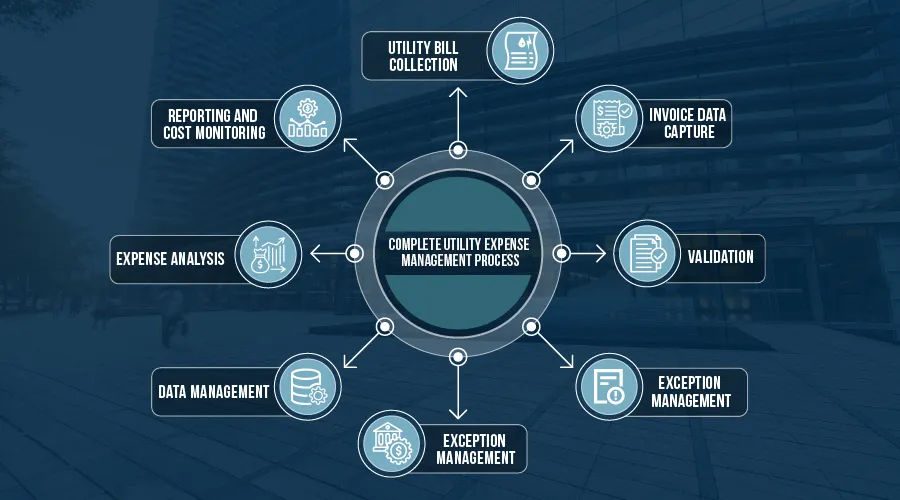
The exact process may differ based on the size and complexity of the organization.
Key Components of Utility Expense Management
Utility Bill Collection and Invoice Processing
The first challenge for many organizations is simply collecting utility invoices. Businesses may receive invoices through:
- Vendor portals
- Electronic billing platforms
- Paper mail
- Multiple internal departments
When invoices are managed separately by individual locations, gaining a complete view of utility spending can become difficult. Centralized invoice collection creates a more consistent starting point for managing utility expenses.
Once invoices are received, relevant information can be captured and prepared for further processing.
Utility Bill Validation
Utility bill validation is an important component of utility expense management. The purpose of validation is to review invoice information and identify discrepancies before the invoice moves through the payment process.
For example, businesses may check whether:
- The service location is correct
- The account is active
- The billing period is reasonable
- The invoice is a duplicate
- Consumption has changed significantly
- Charges appear unusual
- Expected credits are missing
Validation does not mean every invoice is manually audited from beginning to end. A structured process can identify invoices that require further investigation.
This allows businesses to focus their time on exceptions instead of reviewing every invoice in the same way.
Utility Expense & Data Management
One of the most important aspects of modern utility expense management is data. Businesses with multiple locations often receive utility information in different formats from different providers.
One provider may provide detailed consumption information, while another may use a completely different invoice structure. This can make reporting difficult.
Utility expense & data management involves collecting utility information and organizing it into a consistent format.
Utility Expense Analysis
Collecting utility invoices is only the first step. The greater value comes from understanding the information.
Utility expense analysis involves reviewing utility costs and consumption patterns to identify trends and areas that may require further attention. For example, a business may compare:
- Current expenses with previous months
- Year-over-year utility costs
- Usage across similar locations
- Cost per location
- Utility costs by region
- Seasonal consumption patterns
Consider a company operating 100 retail locations. The company may discover that five locations have significantly higher electricity costs than similar locations. That information does not automatically mean those locations are being billed incorrectly.
However, it provides a reason for further investigation. The higher costs may be caused by:
- Different utility rates
- Longer operating hours
- Higher energy consumption
- Facility equipment
- Local climate conditions
- Billing discrepancies
Utility expense analysis helps businesses ask the right questions.
Utility Cost Management vs. Utility Expense Management
The terms utility cost management and utility expense management are often used interchangeably. However, there is a slight difference in how businesses may approach them.
Utility expense management is the broader process of managing utility invoices, data, payments, accounts, and expenses.
Utility cost management focuses more specifically on understanding and controlling the factors that influence utility spending.
Utility cost management may involve:
- Monitoring cost trends
- Reviewing rate changes
- Identifying unusual expenses
- Analyzing consumption
- Improving budget accuracy
- Managing avoidable fees
A strong utility expense management program supports utility cost management because businesses need reliable utility data before they can effectively analyze and manage costs.
The Challenges of Managing Utility Expenses Manually
Managing utility expenses manually creates significant operational burdens for finance and facilities teams. Staff must collect invoices from multiple vendors across different locations, often receiving bills in varying formats and delivery methods. This fragmented approach makes it difficult to maintain consistent data quality and timely processing.
Manual data entry increases the risk of human errors. Studies show 15 to 20 percent of commercial energy invoices contain billing errors or inaccuracies. Approximately 1 in 5 business utility bills contains an error that goes undetected without forensic auditing.
Without centralized tracking, organizations struggle to identify billing errors, rate misapplications, or consumption anomalies. Many businesses remain unaware they are overpaying due to incorrect rate classes, estimated reads that never trued up, or duplicate charges hidden within complex utility invoices.
Limited visibility into historical utility data makes accurate budget forecasting nearly impossible. Organizations cannot benchmark performance across locations or identify optimization opportunities when data remains scattered across spreadsheets and email inboxes. This lack of insight prevents proactive cost management and strategic decision-making.
How Utility Expense Management Helps Multi-Location Businesses
Multi-location businesses face a unique level of complexity. A single organization may have:
- Hundreds of utility accounts
- Multiple service providers
- Different utility rates
- Different billing cycles
- Multiple meters
- Several internal departments
- Numerous service locations
Without centralized management, each location may follow its own process. This can create inconsistent data and make portfolio-level reporting more difficult. Utility expense management creates a centralized approach.
Instead of looking at invoices one location at a time, businesses can analyze utility spending across the entire organization. This can help finance and operations teams gain a broader understanding of utility expenses.
What Should Businesses Track in Utility Expense Management?
A complete utility expense management process should not focus only on the total invoice amount. Businesses should consider tracking relevant financial and operational data.
This may include:
Financial Information: Utility costs, invoice totals, taxes, fees, credits, payment status, and cost allocations.
Consumption Information: Electricity usage, gas usage, water consumption, and other relevant consumption metrics.
Account Information: Utility provider, account number, meter number, service location, and account status.
Performance Information: Historical trends, usage changes, cost variations, and exceptions.
The information a business tracks will depend on its industry, number of locations, and utility portfolio.
What Is a Utility Expense Management Solution?
A utility expense management solution is a combination of processes, technology, and services used to manage utility expenses.
A solution may include:
- Utility bill collection
- Invoice data extraction
- Invoice validation
- Exception management
- Payment support
- Account management
- Utility data management
- Cost allocation
- Reporting
- Utility expense analysis
Some organizations manage these activities internally. Others use utility expense management software or outsource some or all of the process.
The right approach depends on factors such as invoice volume, number of locations, internal resources, and reporting requirements.
Utility Expense Management Services vs. Software
Businesses considering a utility expense management solution generally have two broad options. They can implement technology internally or work with a service provider.
Utility Expense Management Software
Software can help businesses centralize utility information and automate tasks such as:
- Invoice data capture
- Reporting
- Data analysis
- Exception alerts
- Payment workflows
However, software may still require internal teams to manage data exceptions, provider communication, account changes, and other operational activities.
Utility Expense Management Services
Utility expense management services involve external support for managing all or part of the utility expense process.
Services may include:
- Utility invoice collection
- Invoice processing
- Data extraction
- Invoice validation
- Exception handling
- Account reconciliation
- Reporting
- Utility expense analysis
For businesses with limited internal resources, outsourcing can reduce the administrative workload associated with managing large volumes of utility invoices.
When Should a Business Consider Utility Expense Management Services?
Businesses may benefit from utility expense management services when they experience increasing complexity.
This may happen when an organization:
- Opens multiple locations
- Manages a large number of utility accounts
- Receives invoices from numerous providers
- Uses multiple invoice formats
- Struggles to consolidate utility data
- Spends significant time on manual invoice processing
- Has limited visibility into utility costs
The goal of outsourcing should not simply be to move invoices from one team to another. A strong service model should improve process consistency, data visibility, and the ability to analyze utility expenses.
How Technology Supports Utility Expense Management
Technology plays an increasingly important role in utility expense management. OCR and data extraction technology can help capture information from invoices received in different formats.
Automation can also identify invoices that meet predefined exception rules. For example, a system may flag an invoice when:
- The invoice appears to be duplicated
- The amount changes significantly
- Usage differs from historical patterns
- The billing period overlaps with another invoice
Automation can improve efficiency, but it should not completely replace review processes. Utility invoices can be complex, and unusual charges may require human investigation.
The strongest approach often combines automation with experienced operational oversight.
A Practical Utility Expense Management Process
A structured utility expense management process helps businesses reduce errors, improve visibility, and control costs across multiple locations.
Step 1: Centralize invoice collection
Gather all utility invoices into a single repository, whether through email, vendor portals, or document management systems. This eliminates scattered data and ensures no bills are missed or delayed.
Step 2: Capture and standardize data
Extract key details from each invoice, including account numbers, billing periods, consumption, rates, charges, and taxes. Standardize this data across all vendors and utility types for consistent reporting.
Step 3: Validate and audit bills
Review invoices for accuracy by checking rate classes, tariff applications, meter reads, demand charges, and tax exemptions. Flag discrepancies, estimated reads, or unusual consumption patterns for investigation.
Step 4: Code and reconcile
Assign appropriate general ledger codes and reconcile invoices with accounting records. Ensure payments align with approved charges and resolve any exceptions before processing.
Step 5: Analyze and report
Track utility spend by location, vendor, and account. Monitor consumption trends, compare actual costs against budgets, and identify optimization opportunities such as rate class changes or efficiency improvements.
Step 6: Continuous improvement
Conduct regular audits, update forecasting models, and refine processes based on findings. Use historical data to support strategic decisions and drive ongoing cost reduction.
Industries That Can Benefit From Utility Expense Management
Any organization managing utility costs across multiple locations, meters, or accounts can benefit from structured utility expense management. The following industries typically see the greatest impact.
Retail and Multi-Site Businesses
Retail chains, franchise networks, and restaurant groups operate dozens or hundreds of locations, each with separate utility accounts and vendors. Electricity costs for lighting, HVAC, and refrigeration represent a significant portion of operating expenses. Centralized utility expense management helps these businesses standardize invoice processing, identify billing errors across locations, and benchmark energy performance to find underperforming stores.
Commercial Real Estate
Property managers and real estate owners handle utility costs for office buildings, shopping centers, industrial facilities, and mixed-use developments. Utility expenses directly affect net operating income and asset value. Effective utility expense management supports tenant billing accuracy, vacant cost recovery, capital planning for efficiency upgrades, and portfolio-wide energy benchmarking.
Healthcare
Hospitals, clinics, and senior care facilities operate 24/7 with critical reliability requirements. High energy and water usage for sterilization, HVAC, medical equipment, and laundry creates complex utility portfolios. Utility expense management helps healthcare organizations track consumption patterns, validate bills across multiple service types, support sustainability goals, and free clinical staff from administrative burdens.
Hospitality
Hotels, resorts, and restaurant chains face seasonal occupancy fluctuations and high utility usage for guest rooms, kitchens, pools, and landscaping. Utility expense management supports accurate cost tracking across properties, identifies consumption anomalies indicating waste or equipment issues, and helps optimize spending during peak and off-peak periods.
Hospitality
Hotels, resorts, and restaurant chains face seasonal occupancy fluctuations and high utility usage for guest rooms, kitchens, pools, and landscaping. Utility expense management supports accurate cost tracking across properties, identifies consumption anomalies indicating waste or equipment issues, and helps optimize spending during peak and off-peak periods.
Logistics and Warehousing
Distribution centers and logistics hubs manage large facilities with significant lighting, HVAC, and material handling equipment costs. Multi-location operators benefit from centralized utility invoice processing, consumption tracking across warehouses, and identification of optimization opportunities such as LED retrofits or demand management programs.
Education
School districts, universities, and multi-academy trusts operate campuses with diverse building types and utility needs. Utility expense management supports budget forecasting, capital planning for efficiency projects, grant reporting, and comparison of energy performance across facilities.
Professional Services
Firms with regional offices, co-working spaces, or branch locations can consolidate utility expense tracking to improve visibility and control. Centralized management reduces administrative workload for finance teams and ensures consistent coding and reporting across all locations.
How Rely Services Can Support Utility Expense Management
Rely Services provides utility expense management support to help businesses manage utility-related administrative work more efficiently. Our teams can support utility invoice processing, data capture, validation, account matching, exception handling, account reconciliation, reporting, and payment-support workflows.
We help organizations collect utility invoices from multiple vendors and locations into a centralized workflow. Our teams extract key details from each invoice, review bills for accuracy, and flag discrepancies for investigation. We also support reconciliation of utility invoices with accounting records and general ledger coding.
Rely Services provides utility expense reporting that tracks spend by location, vendor, and account. This gives finance and facilities teams clearer visibility into utility expenses and helps support strategic decision-making. Our support is designed for organizations managing complex utility portfolios, recurring invoices, multiple vendors, and decentralized facilities.
Frequently Asked Questions (FAQs)
What is utility expense analysis?
Utility expense analysis is the process of reviewing utility costs and consumption data to identify trends, changes, unusual expenses, and opportunities for further investigation.
Can utility expense management be automated?
Yes. Technology can automate parts of the process, including invoice data extraction, data standardization, exception identification, reporting, and workflow management. Complex exceptions and provider-related issues may still require human review.
What are the signs that a business needs a utility expense management solution?
Common signs include a growing number of utility invoices, multiple locations, fragmented utility data, frequent billing discrepancies, and difficulty tracking utility costs across the organization.
How can businesses reduce manual work in utility expense management?
Businesses can centralize invoice collection, automate data extraction, standardize workflows, and use exception-based reviews. This reduces the need to manually process and review every utility invoice.