


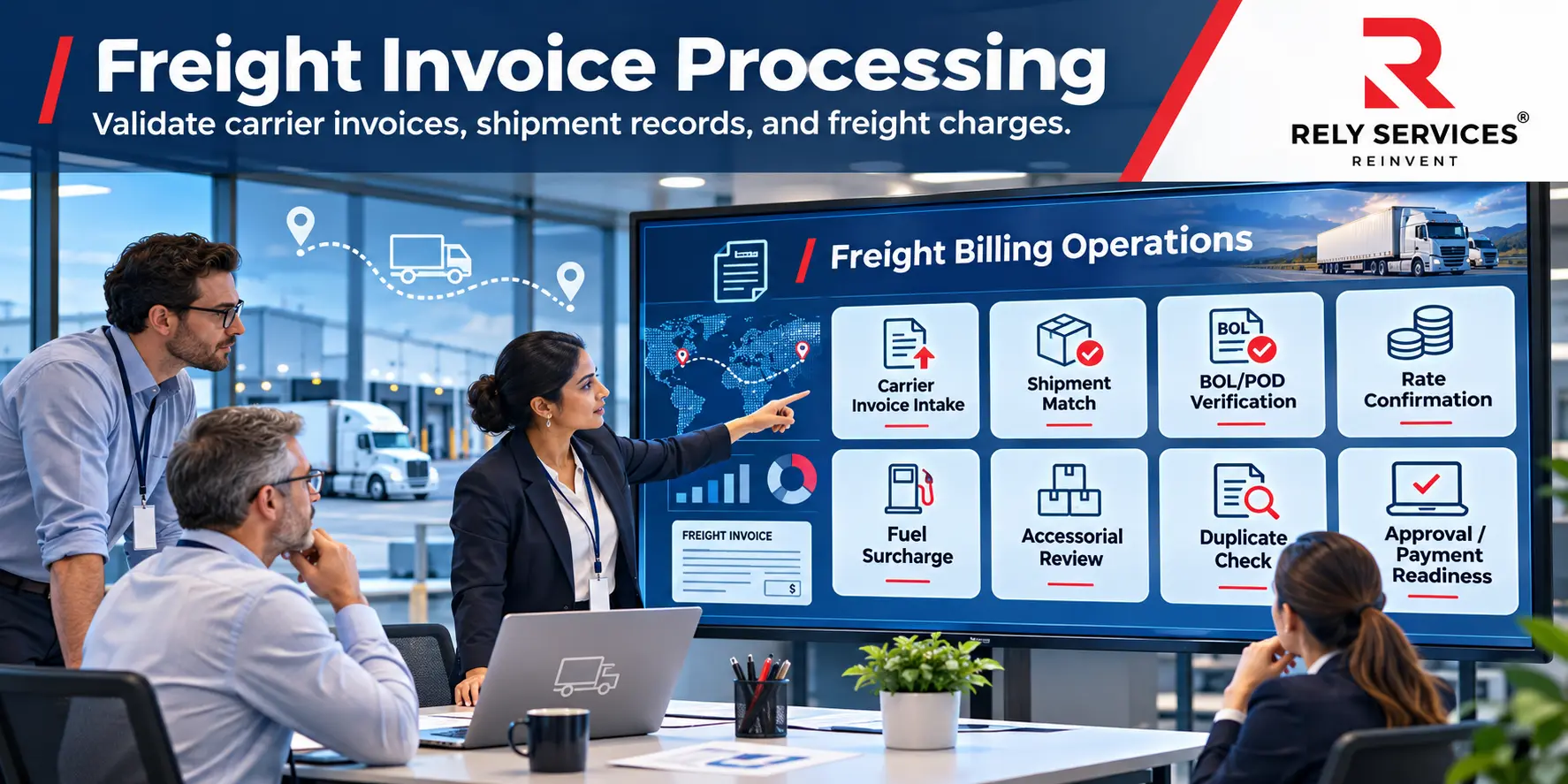
Freight invoice processing is the process of receiving, reviewing, validating, and recording invoices from carriers, freight brokers, and other transportation providers. It helps logistics and finance teams confirm that freight charges match shipment details, agreed rates, and supporting documents before they approve an invoice for payment.
For companies that manage multiple carriers, shipments, and transportation routes, the freight billing process can involve a high volume of invoices with different formats and charge structures. Each invoice may include line-haul charges, fuel surcharges, accessorial fees, weight adjustments, and other transportation costs that teams need to verify.
Without a consistent process, missing shipment details, incorrect rates, duplicate invoices, and unsupported charges can create additional work for logistics and accounts payable teams.
This guide explains how freight invoice processing works, which documents teams need, the steps involved in the freight billing process, and how logistics businesses can improve processing accuracy.
What Is Freight Invoice Processing?
Freight invoice processing is the workflow that logistics and finance teams follow to capture, verify, organize, and prepare transportation invoices for approval and payment. The process connects carrier billing information with shipment records, rate agreements, and delivery documentation.
A freight invoice typically identifies the carrier, shipment reference, origin and destination, transportation charges, applicable surcharges, and total amount due.
Different businesses handle freight invoices in different ways:
- Shippers: Review invoices from carriers that transport their goods.
- Freight brokers: Verify carrier invoices against load details and agreed carrier rates before processing payments.
- Third-party logistics providers (3PLs): Manage freight billing information across customers, carriers, and transportation partners.
- Freight forwarders: Review transportation and related service charges across domestic and international shipments.
- Carriers: Prepare and submit freight invoices to customers or other responsible parties.
Businesses can manage this process manually, use transportation and accounting systems, or work with an outsourced processing team.
For companies that handle high invoice volumes, freight invoice processing services can support invoice data capture, validation, matching, and exception handling. This support allows internal teams to focus on financial decisions and payment approvals.
What Documents Are Required for Freight Invoice Processing?
A freight invoice needs supporting records that establish what the business booked, transported, delivered, and agreed upon. The exact documents depend on the shipment type and the company’s billing procedures.
| Document | Purpose in freight invoice processing |
| Freight invoice or freight bill | Provides the billed charges, carrier details, shipment reference, and amount due |
| Rate confirmation | Shows the agreed transportation rate and applicable service terms |
| Bill of Lading (BOL) | Records shipment details, including shipper, consignee, origin, destination, and freight information |
| Proof of Delivery (POD) | Provides evidence that the shipment was delivered |
| Carrier contract or rate agreement | Establishes negotiated rates and applicable billing conditions |
| Purchase order or shipment order | Connects the freight charge to the relevant business transaction |
| Accessorial receipts or supporting records | Helps verify additional charges such as detention, loading, or special handling |
These documents help reviewers compare billed amounts with shipment details and agreed terms. Therefore, teams should identify missing or inconsistent information before an invoice moves to the next stage.
For US motor carriers subject to the applicable requirements, 49 CFR § 373.103 describes information that must appear on certain freight or expense bills. Businesses should confirm which requirements apply to their operations and shipment types.
How Does the Freight Billing Process Work?
The freight billing process generally moves through several stages, from invoice receipt to payment preparation. The exact workflow varies by carrier, transportation mode, company policy, and accounting system.
Step 1: Receive and Register the Freight Invoice
The process begins when a carrier or transportation provider submits an invoice.
Invoices may arrive through:
- Email attachments
- Carrier billing portals
- Electronic Data Interchange (EDI)
- Accounting or transportation systems
- Scanned documents or paper submissions
The receiving team records the invoice and captures key details such as the carrier name, invoice number, invoice date, shipment reference, and total amount.
Maintaining an invoice register helps teams monitor incoming documents, identify missing submissions, and prevent the same invoice from entering the workflow more than once.
Step 2: Capture and Validate Invoice Data
Next, the team captures the invoice information and checks whether the document contains all required details.
Important data fields include:
- Carrier name and carrier identification
- Invoice number and invoice date
- Load number, PRO number, or shipment reference
- Bill of Lading number
- Origin and destination
- Shipment weight and freight classification, where applicable
- Line-haul charges
- Fuel surcharge
- Accessorial charges
- Taxes and total invoice amount
The reviewer checks whether required fields are present, readable, and consistent with the source document.
For businesses processing invoices in different formats, OCR-assisted document capture can help extract information from PDFs and scanned invoices. However, reviewers should still compare extracted information with the original document, especially when fields are unclear or charge structures are complex.
Step 3: Match the Invoice With Shipment Documents
Invoice matching connects the carrier’s charges with the shipment that generated them.
The reviewer compares the invoice with available records, such as the rate confirmation, BOL, POD, shipment order, and carrier agreement.
Common checks include:
- Does the carrier match the assigned carrier for the shipment?
- Does the shipment reference match the invoice?
- Are the origin and destination correct?
- Does the shipment weight or freight classification match the available records?
- Is there proof of delivery where required?
- Do the billed services match the services recorded for the shipment?
For example, an invoice may reference a shipment number that does not match the BOL or transportation record. In that situation, the reviewer should flag the invoice and confirm the correct shipment instead of matching it to an unrelated record.
Step 4: Verify Freight Rates and Additional Charges
Rate verification is an important part of the freight billing process. The reviewer compares the billed charges with the applicable rate confirmation, contract, tariff, or other approved pricing record.
The review may include:
Line-haul charges: Confirm that the base transportation charge matches the agreed rate for the shipment.
Fuel surcharges: Check that the fuel surcharge follows the applicable agreement, calculation method, and effective period.
Accessorial charges: Review additional charges for services such as detention, liftgate, residential delivery, reweighing, redelivery, or special handling. Confirm that the service was applicable and supported by the required evidence.
Weight and freight classification: Compare the billed weight or classification with the shipment information and applicable pricing rules.
Additional fees: Check other charges against the carrier agreement and supporting records.
However, a difference between an invoice and the agreed terms does not automatically mean the carrier made an error. The reviewer should determine whether an approved service, shipment event, contract provision, or other documented reason supports the difference.
Step 5: Identify and Resolve Invoice Exceptions
If the invoice contains missing information or a discrepancy, the team should route it through a defined exception process.
Common freight invoice exceptions include:
| Exception | Example | Recommended action |
| Rate mismatch | Billed amount differs from the rate confirmation | Compare the applicable rate and shipment details |
| Duplicate invoice | The same shipment charge appears more than once | Check invoice references, shipment identifiers, and payment records |
| Incorrect weight | Invoice weight differs from shipment documentation | Review available weight records and supporting evidence |
| Unsupported accessorial | Detention or special handling is billed without supporting records | Request the required evidence and verify contract terms |
| Missing POD | Delivery evidence is unavailable | Follow the agreed document-retrieval process |
| Incorrect shipment reference | Invoice and BOL contain different shipment identifiers | Confirm the correct shipment before matching |
| Incomplete invoice | Required billing information is missing | Request clarification or a corrected invoice |
Each exception needs an owner, a documented reason, supporting evidence, and a clear next action. Therefore, teams should not move an invoice forward simply because they have identified an issue. Instead, they should follow the required review and approval controls.
For more on document-related exceptions, logistics teams can also review Rely’s logistics data entry services, which support freight invoice capture, validation, shipment document processing, and related back-office activities.
Step 6: Approve and Record the Invoice
Once the invoice passes the required checks and the team resolves outstanding exceptions, it can move to the authorized approval stage.
The approval process may involve logistics operations, transportation management, procurement, or accounts payable, depending on the company’s responsibilities and financial controls.
Before approving an invoice, the team should confirm:
- The invoice relates to the correct shipment.
- Required supporting documents are available.
- The team has checked charges against applicable terms.
- Reviewers have resolved exceptions or handled them under an approved procedure.
- The invoice contains the correct cost center, account, or business unit.
- The company has not already approved or paid the invoice.
After approval, the team records the invoice information in the company’s accounting or enterprise resource planning system according to its procedures.
Step 7: Prepare Payment and Reconcile Records
After approval, the invoice moves into the company’s payment workflow. The finance team schedules and processes payment according to the agreed payment terms and internal authorization requirements.
Reconciliation helps confirm that the invoice amount recorded, approved, and paid is consistent with the relevant financial records.
Teams may also review carrier statements, open invoices, credit notes, short payments, and unresolved disputes to identify outstanding items.
A clear record of invoice receipt, validation, approval, and payment helps support financial reporting and future reviews.
Common Challenges in the Freight Invoice Processing Workflow
Logistics businesses often face challenges because freight invoices contain information from multiple carriers, shipment systems, and billing arrangements.
High Volumes of Carrier Invoices
Companies working with several carriers may receive invoices in different formats and through multiple channels. Manually registering and reviewing each document can increase administrative work.
Inconsistent Invoice Formats
Carrier invoices may use different field names, layouts, reference numbers, and charge descriptions. This makes it harder to standardize information for matching and reporting.
Missing Shipment Documentation
A missing BOL, POD, rate confirmation, or accessorial receipt can delay invoice verification. Teams may need to contact operations, carriers, or other departments to obtain the required information.
Freight Billing Discrepancies
Differences in rates, fuel surcharges, weights, freight classifications, and accessorial charges require investigation. Without a documented review process, the same issues may repeatedly consume staff time.
Disconnected Systems and Manual Data Entry
Shipment records, carrier invoices, and accounting information may sit in separate systems. Therefore, employees may need to enter the same information across multiple applications, increasing the possibility of inconsistent records.
Unclear Exception Ownership
When logistics and finance teams do not have defined responsibilities, invoices can remain unresolved while employees wait for clarification or approval.
How Can Logistics Teams Improve Freight Invoice Processing?
Businesses can improve freight invoice processing by establishing consistent procedures and clear responsibility for each stage.
- Standardize invoice intake: Define approved channels for receiving invoices and record each submission consistently.
- Create standard data fields: Use common fields for carrier details, invoice references, shipment identifiers, charges, and totals.
- Maintain accessible shipment records: Organize rate confirmations, BOLs, PODs, and supporting documents so reviewers can retrieve them when needed.
- Use documented validation rules: Establish how teams should check rates, surcharges, accessorials, weights, and shipment references.
- Define exception ownership: Assign responsibility for investigating discrepancies and specify when employees should escalate issues.
- Use technology appropriately: Consider OCR, EDI, and system integrations to reduce repetitive capture and improve information flow. Keep human review for unclear documents and decisions requiring business judgment.
- Monitor processing performance: Review invoice volumes, unresolved exceptions, processing time, duplicate submissions, and recurring error categories.
These practices can help logistics teams create a more consistent freight billing process without weakening their financial controls.
When Should Logistics Businesses Consider Outsourcing Freight Invoice Processing?
Outsourcing may be worth evaluating when freight invoice volumes increase, internal teams spend substantial time on repetitive data entry, or invoice backlogs make it difficult to maintain consistent processing.
It may also be useful when a business needs additional support with:
- Freight invoice data capture and indexing
- Carrier and shipment information validation
- Matching invoices with BOLs, rate confirmations, and purchase orders
- Identifying duplicate or incomplete records
- Reviewing freight billing discrepancies
- Organizing exception records and supporting documentation
- Preparing structured information for accounts payable systems
Rely Services provides Freight Invoice Processing Services to support businesses with freight invoice capture, validation, matching, exception management, and payment-ready records.
Its broader logistics BPO services also cover logistics data management, document processing, shipment records, and related back-office workflows.
For companies that need wider financial operations support, accounts payable outsourcing services can support invoice processing, reconciliation, and other AP activities.
Outsourcing does not transfer every financial decision to the service provider. Businesses should define processing responsibilities, approval authority, exception escalation, system access, and reporting requirements before starting an engagement.
Conclusion
Freight invoice processing helps logistics businesses verify transportation charges, maintain accurate shipment and financial records, and prepare invoices for approval and payment. A consistent freight billing process connects carrier invoices with shipment documentation, agreed rates, exception reviews, and accounting records.
As invoice volumes and carrier relationships grow, managing these activities manually can put pressure on logistics and finance teams. Standardized workflows, appropriate technology, and additional processing support can help businesses maintain organized records and handle recurring invoice work more consistently.
Businesses that need help managing freight invoice data capture, validation, and related back-office activities can explore Rely Services’ freight invoice processing and logistics data entry solutions.
Frequently Asked Questions About Freight Invoice Processing
What is the difference between freight invoice processing and freight auditing?
Freight invoice processing covers the broader workflow of receiving, capturing, validating, matching, recording, and preparing freight invoices for payment. Freight auditing is the review of billed charges against shipment records, contracts, rate confirmations, and supporting documents to identify discrepancies.
What is the freight billing process?
The freight billing process generally includes invoice submission, invoice registration, data capture, shipment matching, rate and charge verification, exception resolution, approval, payment preparation, and reconciliation.
What documents are used to verify a freight invoice?
Common documents include the freight invoice, rate confirmation, bill of lading, proof of delivery, carrier contract, purchase order, and supporting records for accessorial charges. The required documents depend on the shipment and the company’s procedures.
What are common freight invoice errors?
Common issues include incorrect rates, duplicate invoices, incorrect shipment references, weight discrepancies, unsupported accessorial charges, missing delivery documentation, and incomplete invoice details.
How does EDI support freight invoice processing?
Electronic Data Interchange (EDI) allows businesses to exchange standardized transaction information electronically. For example, the X12 210 Motor Carrier Freight Details and Invoice transaction supports the electronic exchange of motor carrier freight charge details and invoice information. Its use depends on the trading partners’ systems and agreements.
Can OCR be used for freight invoice processing?
Yes. OCR can help capture information from scanned freight invoices and PDFs. However, teams should validate extracted fields against the original documents, particularly shipment identifiers, charge amounts, and accessorial details.
Can freight invoice processing be outsourced?
Yes. Businesses can outsource selected activities such as invoice capture, data entry, validation, shipment matching, exception documentation, and preparation of records for approval. The client should retain clearly defined control over financial approvals and payment authorization.
How can logistics businesses reduce manual freight billing work?
Businesses can standardize invoice intake, maintain organized shipment documentation, establish consistent validation rules, and use OCR or EDI where appropriate. Additionally, they can outsource repetitive processing activities when internal capacity becomes limited.