


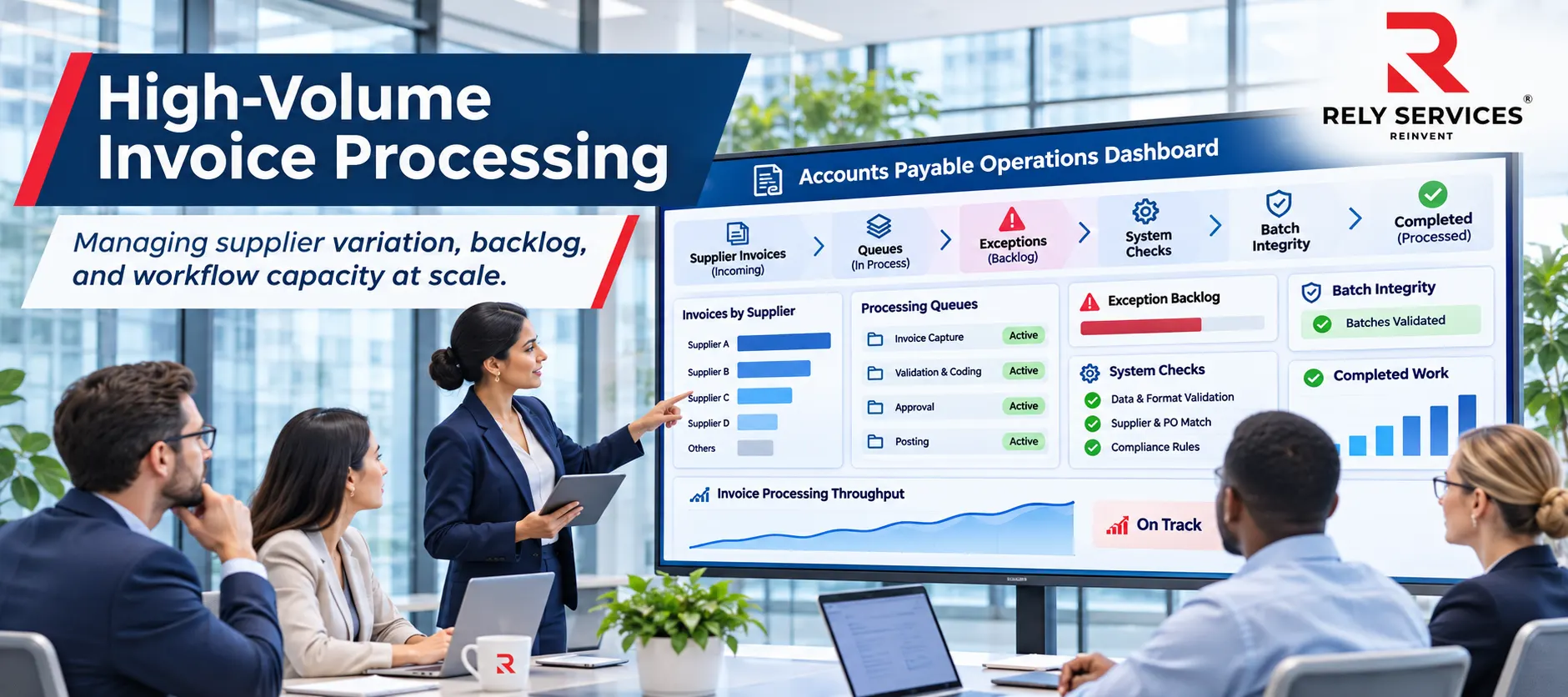
High volume invoice processing is an operating challenge in which the arrival rate, variety, and outstanding workload require deliberate capacity, queue, and reconciliation controls. The relevant threshold depends on the organization, systems, supplier mix, and work required per invoice rather than a universal monthly count.
An AP team can handle many straightforward invoices while struggling with a smaller group of complex submissions. Supplier variation, partial receipts, multiple buying entities, and system failures can create different workloads even when the document count remains stable.
This guide focuses on managing scale across suppliers. The invoice processing lifecycle guide explains the underlying stages. The recommendations here concern segmentation, capacity, batch integrity, continuity, and evidence that no work has disappeared.
Managing high invoice volumes requires a consistent process for receiving invoices, capturing data, validating information, handling exceptions, and tracking completed work. Businesses that need additional operational capacity can explore Rely Services’ invoice processing services. These services support invoice handling and related accounts payable activities while businesses retain control over approval policies, accounting decisions, and payment authorization.
What makes invoice volume difficult to manage?
Volume becomes difficult when incoming work, required handling, review capacity, and downstream system limits no longer fit the operating model. Count documents, but also examine their complexity and the work already waiting.
Measure arrivals and outstanding work separately
Track what arrives during the observation period and what remains from earlier periods. A stable daily intake can coexist with a growing backlog if completion does not keep pace or unresolved cases accumulate.
Define the unit of work. A file may contain several invoices, while one invoice may span multiple documents or require several review tasks. Counting attachments alone may not represent the work the team must complete.
Identify the dimensions of complexity
Useful segments may include buying entity, supplier family, source channel, PO status, line complexity, exception history, and destination system. Select segments because they change the operating response, not because the data is easy to report.
Document what each segment requires. A supplier with stable inputs may need ordinary handling, while an unfamiliar layout may need specialist capture review. Avoid assuming that a large supplier is automatically a low-risk processing category.
Build an intake model that preserves accountability
Establish approved receipt channels and ensure that bypassed submissions enter the same tracked system. Record source references and arrival information sufficient for reconciliation through permitted tools.
Set supplier instructions that support the actual workflow
State how invoices should be submitted, which references are necessary, and where suppliers should ask questions. Align the instructions with purchasing documents and business-unit practices so suppliers are not given conflicting destinations.
Provide a controlled route for suppliers that cannot use the preferred channel. A fallback should define acceptance and ownership rather than leaving a separate mailbox that no one reconciles.
Businesses receiving paper invoices or maintaining physical invoice records may also need a process to convert those documents into organized digital files before further processing. Rely Services provides document digitization services covering document scanning, OCR conversion, indexing, and digital file organization.
Detect resubmissions without discarding changes
Supplier follow-ups may include the same invoice, an updated invoice, or additional evidence. Define how the intake process identifies possible relationships and routes ambiguous cases for review.
Do not delete a submission solely because a file name or amount resembles an earlier item. Preserve enough information to distinguish redundant attachments from valid corrections or separate transactions. Duplicate detection should support investigation rather than conceal work.
How should AP segment a large invoice workload?
Segment the workload by the handling path, required expertise, and consequence of errors. Each segment needs an owner, entry criteria, completion criteria, and an exception destination. A priority label without these elements does not create a usable queue.
| Queue or segment | Purpose | Control to define |
| Ordinary supported inputs | Handle invoices meeting agreed entry conditions | Acceptance checks and completion evidence |
| Capture review | Resolve unclear fields or unsupported layouts | Qualified reviewer and source access |
| Purchasing discrepancies | Resolve price, quantity, or receipt issues | Authorized commercial or receiving owner |
| Approval work | Obtain specified decisions | Current authority and absence coverage |
| System failures | Reconcile interrupted or rejected actions | Retry rules and final-state confirmation |
| Urgent review | Examine cases meeting approved priority criteria | Reason, authorized owner, and retained controls |
Keep priority separate from permission
An invoice can deserve prompt attention without being eligible for posting or payment. Define which factors affect work order and which conditions remain mandatory before release.
Avoid allowing an approaching date or a persistent supplier to bypass evidence. Prioritization should direct resources toward the decision, not replace the decision. Record why a case changes priority and who can authorize that change.
Plan capacity around work types and waiting states
Estimate the effort required by the actual mix rather than multiplying a single handling assumption by the document count. Include capture review, exception investigation, approval coordination, posting failures, and returned work.
Observe workload before adding a throughput target
Use pilot or sampled observations with a defined period and population. Keep active handling separate from waiting for an external response. Explain where estimates are uncertain instead of presenting them as guaranteed staffing requirements.
Account for skill differences. A general processing team may not be authorized to resolve a supplier identity issue, accounting judgment, or commercial dispute. Capacity planning should include access to those decision owners, not just invoice-entry staff.
Prepare for predictable peaks
Review known business events that may alter arrivals or completion capacity. Define coverage, handoffs, escalation, and the evidence needed to use temporary capacity. Do not assume a surge can be handled by relaxing acceptance checks.
Set conditions for activating additional support and for returning to the ordinary model. Include the backlog left after the peak, not just the peak-day intake. Otherwise, temporary improvements can leave unresolved work hidden in later periods.
Use batch controls without losing invoice-level visibility
A batch can simplify a system operation, but it should not erase the identity and status of its component invoices. Define the manifest, expected destination, and outcome for each item.
Reconcile the batch at each boundary
Record which items were submitted, accepted, rejected, and left uncertain. Account for authorized exclusions and duplicate dispositions. A matching total count can still conceal the wrong records, so use stable references as well as counts.
Retain the relationship between batch-level activity and invoice-level results. If one invoice fails, the operator should know whether the rest succeeded and what remains eligible for retry.
Prevent duplicate processing during retries
Before resubmitting, establish what the destination already accepted. A timeout may mean the response was lost rather than the action failed. Use supported controls to identify completed transactions and reconcile uncertain states.
Do not assume that running the whole batch again is safe. Define the permitted retry unit and recovery authority. Test repeated submissions, partial success, and interrupted transfers in an approved environment before relying on the approach at scale.
Manage supplier variation as an operating input
Different layouts, submission channels, reference practices, and purchasing arrangements affect how work should be handled. Maintain an owned record of the supported input conditions and relevant exceptions.
Introduce new supplier patterns through review
When an unfamiliar document family appears, assess the required fields, source interpretation, destination mapping, and review workload. Keep an approved fallback until the supported path has been validated.
When invoice layouts or supplier formats require manual capture and verification, additional data entry support can help manage the workload. Rely Services offers invoice data entry services to support invoice information capture, verification, and organization for accounts payable workflows.
For capture-specific testing, use the invoice data extraction guide. This high-volume guide focuses on how unsupported inputs affect queues and capacity rather than repeating field-level extraction rules.
When supplier invoices arrive in different layouts, scanned formats, or image-based files, OCR can help capture information and convert it into machine-readable data. Businesses that handle recurring document volumes can explore Rely Services’ OCR services for document extraction, data validation, cleanup, and human review of processing exceptions.
Review recurring supplier issues with evidence
Group issues by the condition needing resolution, such as missing references, repeated resubmissions, or inconsistent buying-entity details. Confirm cause before changing supplier instructions or assigning responsibility.
Discuss the findings with the designated purchasing or supplier relationship owner. A new instruction should reflect a feasible process on both sides. Test whether it improves usable intake rather than merely reducing submissions to the preferred channel.
Keep exceptions from becoming a separate hidden backlog
Track exception age, next action, and accountable owner alongside ordinary throughput. A team can complete many simple items while leaving disputed invoices unresolved. Both populations belong in the operating picture.
Match specialist capacity to the queue
Identify issue categories that need commercial, accounting, systems, or security decisions. Agree on a monitored route to those owners. More general processing capacity may not improve a queue whose next action requires authority the team lacks.
Use the invoice exception management guide for case evidence and resolution rules. Keep the scale review focused on access to decision capacity and the integrity of the backlog.
Count returned work
Include invoices returned after apparent completion because of missing evidence, incorrect association, or failed destination updates. Link the return to the original work item where permitted so the team can investigate recurrence.
Do not count each pass as a separate successful invoice. Define completion and rework consistently. Otherwise, a high activity figure can reward repeated handling without demonstrating accepted output.
Plan continuity across systems and people
Document what happens when receipt, capture, approval, accounting, or payment-related systems are unavailable. State which work may continue, where it is tracked, and what must wait for a controlled recovery.
Exercise a disruption scenario
Suppose a hypothetical destination stops responding during a batch transfer. The team should identify pending items, preserve evidence of attempted actions, and prevent uncontrolled retries. After recovery, it should reconcile actual outcomes before releasing remaining work.
Test the runbook with someone who did not design the integration. Instructions that depend on one specialist’s memory are a capacity and continuity constraint. Define authorized escalation and access before the disruption occurs.
Preserve supplier-change controls under pressure
Higher volume is not a reason to accept payment-detail changes from invoice text or an unverified message. Keep independent verification and authorized master-data processes intact. FBI business email compromise guidance is a candidate source for reviewing the relevant risk.
Make the unresolved state visible so an ordinary processing queue does not mistakenly treat the invoice as fully payment-ready. A valid charge and a verified payment destination are separate decisions.
Rehearse a surge that includes difficult work
Consider a hypothetical period when several suppliers submit invoices at once and a destination interface becomes unreliable. The intake team records arrivals through the approved channels and separates ordinary work from items needing specialist review. Priority follows the agreed criteria rather than the order in which suppliers complain.
The team then inspects where work is accumulating. Additional capture capacity would not solve a queue waiting for purchasing decisions, while more approvers would not establish whether the interrupted interface created accounting entries. Each segment needs the resource or decision that can move it forward.
For the interrupted transfer, the authorized recovery owner reconciles invoice-level outcomes before resubmission. The manifest distinguishes accepted items, rejected items, and unresolved outcomes. After service returns, the team confirms which items still need action rather than assuming that every invoice in the batch failed.
The surge review also includes work left behind after ordinary arrivals resume. Returned items and unresolved supplier questions remain part of the backlog, with owners and next actions. A return to normal intake does not prove that the disruption is over operationally.
Use this exercise to test staffing assumptions, permissions, handoffs, and continuity instructions together. Record where the team needed undocumented help and update the runbook before relying on it. The scenario provides evidence about readiness; it does not establish a universal capacity figure or a guaranteed processing rate.
Evaluate external capacity with clear boundaries
Define the work that can be performed externally, permitted access, escalation responsibilities, acceptance evidence, and ownership of unresolved cases. Confirm service-specific capability rather than inferring it from a broad processing label.
Use a representative pilot that includes supplier variation and difficult cases. Assess the receiving team’s ability to use the output and the workload retained internally. Do not evaluate fit solely on the number of invoices handled in a demonstration.
The GAO Green Book is a candidate resource for internal-control discussion within its federal scope. It is not a universal mandate for a private company’s queue or staffing design. Finance and policy owners should approve applicable controls.
If supplier invoice volumes are outgrowing internal capacity, businesses may need support across a wider range of accounts payable activities. Rely Services provides accounts payable outsourcing services covering invoice receipt, data extraction, validation, purchase order matching, exception handling, and workflow management. Businesses can evaluate outsourcing based on their supplier mix, processing requirements, and internal control responsibilities.
Frequently asked questions
Is there a fixed number that makes processing high volume?
No universal threshold is assumed here. Evaluate arrivals, complexity, outstanding work, required decisions, and system capacity together. An organization may need a different operating model even without a large document count if its invoices require substantial specialist handling.
Should every supplier have a separate queue?
Create separate queues only where they support a different handling path, owner, or operational need. Excessive fragmentation can obscure the total backlog. A shared queue can still retain supplier-level visibility if the system and reporting support the required distinctions.
Can invoices from several entities share one batch?
Only use an arrangement approved for the receiving system and accounting process. Preserve entity identification and item-level outcomes. Test access, routing, and reconciliation so a batch-level success does not conceal a posting to the wrong legal entity.
How should AP handle a sudden backlog increase?
First determine whether arrivals increased, completion fell, or unresolved work accumulated. Segment the cause before assigning extra capacity. Keep controls and ownership intact, and define which temporary measures are authorized, how they are monitored, and when they end.
Are bulk processing and automatic approval the same?
No. Bulk processing groups an operation; authorization remains governed by approved policy and evidence. A batch may contain invoices with different review requirements. Do not let the convenience of a batch release override unresolved issues or individual decision boundaries.
What should a high-volume dashboard show?
Show incoming work, accepted completions, outstanding items by state and age, unresolved exceptions, returns, and uncertain system outcomes. Define the populations and timing rules. Combine queue and quality views so a strong throughput figure cannot conceal lost or repeatedly handled work.