


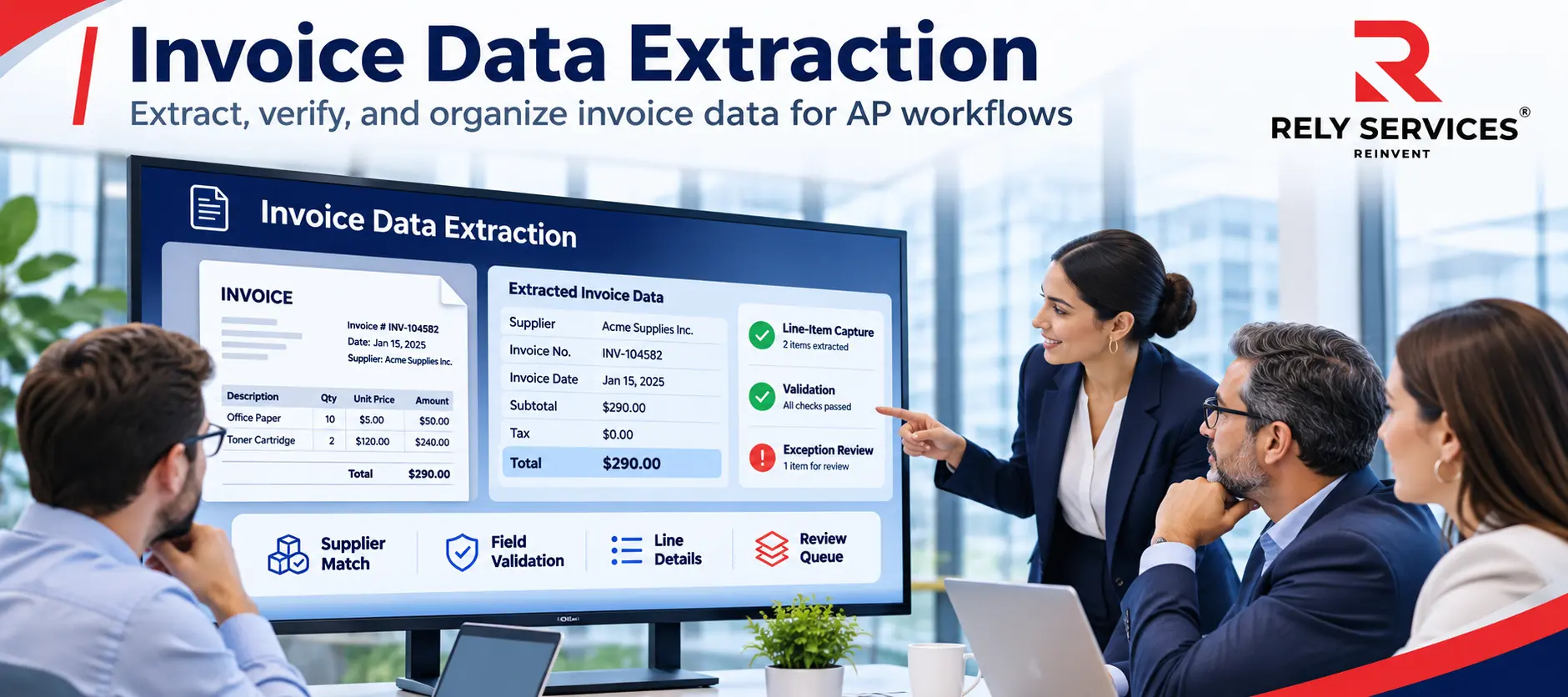
Invoice data extraction converts selected information from a supplier invoice into fields that a business system or reviewer can use. The work includes identifying the document, reading the required values, associating line items correctly, and preserving a route back to the source for validation.
Capturing a value is different from accepting it as correct or authorizing the invoice. A system can read the printed total accurately while associating it with the wrong supplier. It can also capture all visible text without identifying which date or amount the workflow needs.
This guide focuses on the capture and validation boundary. For the complete operational sequence, use the invoice processing guide for AP teams. The examples below describe testable design choices rather than claims about a particular product’s accuracy.
For businesses handling high volumes of supplier invoices, capturing and validating invoice information can create significant administrative work. Rely Services provides invoice data entry services to help businesses extract, verify, and organize invoice details for accounting systems and accounts payable workflows. This support can help manage recurring invoice data requirements while internal finance teams retain control over accounting decisions and payment authorization.
What information should a business extract from invoices?
Extract the fields required for the defined downstream workflow, with explicit meanings and source rules. A typical design considers supplier identification, invoice reference, invoice date, currency, amounts, purchasing references, and line details needed for review or accounting.
Do not begin by copying every field a tool can detect. Extra data creates more validation and maintenance work. Give each selected field a purpose, an owner, and an approved response when the source does not contain it.
| Field group | Example purpose | Important distinction |
| Supplier information | Associate the invoice with an approved supplier record | Printed name versus master-data identifier |
| Invoice reference | Identify the document and support duplicate review | Invoice number versus order or account number |
| Dates | Support review and agreed processing rules | Issue date versus due date or service period |
| Amounts and currency | Support arithmetic and accounting checks | Subtotal, tax, charges, credits, and total |
| Order references | Associate purchasing evidence | Whole-document versus line-level reference |
| Line details | Support quantity, price, and allocation review | Row grouping, units, and negative values |
Distinguish capture methods before choosing a tool
The source may be structured electronic data, a digital document, an image, or material requiring manual review. Evaluate the permitted input formats and actual supplier mix before selecting a capture method.
Structured information and document reading
A supported structured input may make certain values available directly. It still requires validation of field meaning, sender association, and destination mapping. A technically valid message is not proof that every business value is suitable for use.
For image or document inputs, a workflow may combine text recognition, layout interpretation, extraction rules, and review. Evaluate those activities separately so a reading failure is not confused with an incorrect mapping or wrong supplier association.
OCR and invoice extraction are related but distinct
Optical character recognition makes visible text machine-readable. An invoice extraction system then needs to associate relevant text with defined fields or tables. Microsoft’s invoice-model documentation is a candidate technical reference for one implementation approach, not evidence that every tool behaves the same way.
Businesses working with scanned invoices, PDFs, and image-based documents may also need support with document recognition and structured data capture. Rely Services offers OCR services to help convert document information into machine-readable data, with additional processing and human review where required.
Test on the actual document families in scope. A successful result on a clean supplier template does not establish performance on scans, unfamiliar layouts, rotated pages, or invoices with several tables.
Define field meanings and preserve the source
Create a capture specification that records each field’s definition, accepted representation, source location or logic, validation rule, and exception destination. Keep it aligned with the receiving system rather than assuming matching labels mean matching concepts.
Make dates and missing values explicit
An invoice may show an issue date, due date, delivery date, and service period. Decide which field each belongs to and what happens when the source is ambiguous. Do not place the first recognized date into a required field by default.
Similarly, distinguish missing information from a zero, blank, or not-applicable value. A default can make an incomplete invoice appear complete. Define when the workflow may proceed and when a reviewer or supplier response is required.
Keep evidence available to the reviewer
Link captured fields to an approved source reference. Where supported, a reviewer may benefit from the relevant page or region, but the whole document should remain available when context is necessary.
When supplier invoices arrive as paper documents or scanned files, businesses may first need to convert them into organized digital records. Rely Services provides document digitization services to support document scanning, OCR conversion, indexing, and digital record organization.
Do not create uncontrolled image copies or export patient, personal, or financial information unnecessarily into a testing spreadsheet. Use approved access, storage, and test-data arrangements appropriate to the actual invoices involved.
Capture line items without losing their relationships
Header-level extraction does not demonstrate that line-level data is usable. A line may include description, quantity, unit, price, discount, tax treatment, and a purchasing reference. Define which relationships matter for the intended review.
Check row boundaries and continuation pages
A long description may span several visual lines without creating a new billable item. A table may continue onto another page with repeated headers. Test that the extraction preserves the intended rows rather than merging unrelated values or counting headings as charges.
Include invoices with wrapped descriptions, blank cells, mixed units, and negative line amounts. Record expected results before testing. The reviewer should be able to identify where a field came from and whether the grouping is plausible.
Distinguish charges, credits, and summary amounts
Separate document totals from line totals and avoid treating a summary row as another charge. Test discounts, shipping, tax, and credits according to the supported invoice population and approved accounting interpretation.
An arithmetic check can flag an inconsistency, but it does not authorize the team to alter the source values. Route unexplained differences to the appropriate review process rather than forcing a calculated result into the invoice record.
How should AP validate extracted invoice data?
Validate extracted information by comparing it with source evidence, checking the field’s intended meaning, testing relevant relationships, and confirming that the receiving system interprets it correctly. Give higher-consequence fields and ambiguous cases an approved review path.
Separate three levels of validation
First, test capture fidelity: does the value match what the source shows? Second, test semantic placement: is it the right kind of value for that field? Third, test business association: does it belong to the intended supplier, entity, or purchasing context?
A correctly read account number can still be the wrong identifier for supplier matching. A correctly read amount can still be the subtotal rather than the amount due. Keeping the levels separate helps investigators find the actual failure.
Do not treat confidence as correctness
A tool’s confidence score needs evaluation against observed errors in the selected document population. Define how it is used for routing, and test whether high-confidence outputs can still fail important checks.
Do not invent an acceptance threshold or claim that a particular score guarantees accuracy. Establish the review boundary with the responsible operational and control owners, using evidence from the actual test set.
Treat payment details differently from ordinary capture
Reading a bank account from an invoice does not establish permission to change the approved supplier payment destination. Keep extraction separate from independent master-data verification. FBI business email compromise guidance is a candidate reference for reviewing the relevant payment-diversion risk.
Document what the capture system may store or suggest and what it must not update automatically. A visible field on a supplier document is information to review, not an authorization instruction.
Build a review queue that can resolve uncertainty
Define categories such as unreadable source, uncertain field meaning, conflicting values, missing required information, and unsupported layout. Route each category to someone able to resolve it or obtain an approved source response.
Give reviewers useful context
Show the source, proposed value, reason for review, and relevant comparison fields through approved access. If the reviewer needs another application, document how to reach it and what evidence is authoritative.
Record the final decision and reason for a material correction. Avoid a workflow where reviewers silently overwrite values, leaving no basis for diagnosing recurring errors or evaluating a model or rule change.
Separate extraction defects from business discrepancies
If the extraction correctly reads a price that disagrees with the purchase order, the capture stage may have worked. The remaining issue is a business discrepancy with a different owner and evidence requirement.
Use the invoice exception management guide for those cases. This boundary prevents the extraction team from changing source values simply to satisfy a downstream matching check.
Test the supplier mix before expanding
Create a representative test set using approved examples. Cover the actual channels, layouts, document quality, currencies, line structures, and invoice categories in scope. Include unfamiliar and deliberately difficult cases.
Define expected results field by field
Have appropriate reviewers establish the correct captured values and permissible missing states before the test. Record disagreements in the expected set rather than using uncertain labels to judge the tool.
Evaluate header fields, line associations, required-field omissions, and destination behavior separately. An overall figure can conceal a consequential weakness, such as unreliable currency recognition or missed negative line amounts.
Test the full transfer to the receiving system
Confirm that fields arrive in the intended places without truncation, unsupported characters, or changed number and date interpretation. Inspect actual receiving records, not just the extraction system’s output file.
Include rejected imports, interrupted transfers, and retries. Define whether the destination created nothing, a complete record, or an incomplete record. Reconcile uncertain states before retrying so the test does not create unexplained duplicates.
Monitor changes and maintain the capture specification
Suppliers can change layouts, required fields can evolve, and downstream applications can change their interfaces. Assign responsibility for detecting relevant changes and deciding which tests must be repeated.
Review correction patterns
Group corrections by field, source family, and failure type. A recurring date issue may require a definition change or a layout rule, while several missing pages may point to intake rather than extraction.
Use evidence before assigning cause. A correction made in the destination may not be an extraction defect. Preserve the source-to-output relationship so reviewers can distinguish capture, mapping, and business-review problems.
Govern AI-assisted changes
If the workflow uses AI, document the intended task, tested boundaries, reviewer responsibilities, and conditions for suspending automatic handling. NIST’s AI Risk Management Framework is a candidate evaluation resource, not certification of a capture system.
Retest affected document families after meaningful changes. Keep a supported previous configuration or another approved continuity path where feasible. Do not assume that a vendor update preserves the earlier acceptance results.
Review a field error and a business error differently
Consider a hypothetical invoice with an issue date, a service-period range, and a printed due date. The extraction correctly reads all the characters but places the service-period start into the invoice-date field. That is a field-meaning or mapping problem even though the text recognition was successful.
The reviewer compares the proposed value with the approved capture specification, corrects it through the permitted process, and records the reason. The team then tests related layouts to see whether the rule confuses those date labels elsewhere. It does not conclude that every invoice from the supplier is wrong.
Now suppose the same invoice contains a price that is read and mapped correctly but differs from the approved order. Changing the capture rule would not resolve that commercial question. The invoice needs the discrepancy path and an authorized decision, while the extracted source value remains distinguishable from any later correction.
These cases illustrate why field-level expected results and separate error categories matter. A review report that calls both cases “extraction failure” directs effort toward the wrong remedy. Preserve enough source context and decision evidence to identify which part of the workflow needs attention without making uncontrolled copies of the invoice.
Turn extraction results into usable AP work
The final handoff should explain what was captured, what remains uncertain, and what the next team may do. A clean-looking data record is not useful if important ambiguity has disappeared from view.
If manual invoice capture is part of a wider accounts payable workload, businesses may need support with activities beyond data extraction. Rely Services provides accounts payable outsourcing services covering invoice processing, data extraction, validation, purchase order matching, and related AP workflows. Businesses can evaluate support based on their processing requirements while retaining control over financial policies and payment authorization.
Frequently asked questions
Can one extraction rule handle every supplier layout?
Do not assume universal coverage. Evaluate the rule on the actual supplier population and define handling for unfamiliar or changed layouts. A controlled review path is preferable to silently forcing unsupported documents into a known template with misleading results.
Should AP extract every line on every invoice?
Extract the detail needed for the approved downstream use. Some workflows require line-level matching or allocation, while others have different requirements. Document the purpose and acceptance criteria rather than collecting all available information without a business need.
How should the system handle handwritten corrections?
Use an approved review route for uncertain or altered information. Preserve the source and establish who can determine its meaning or request clarification. Do not replace ambiguous handwriting with a likely value merely because a required field must be populated.
Can extracted totals be recalculated automatically?
A calculation can support a validation check, but unexplained differences need review. Keep the original source value distinguishable from a calculated value. The responsible accounting owner should approve how rounding, credits, tax, and other components are treated.
What if the extraction is correct but the supplier is wrong?
Treat supplier association as a separate validation failure. Investigate the master-data match and destination mapping while retaining the correctly read source. Fixing the text-recognition rule will not necessarily resolve a wrong business association or an ambiguous supplier identity.
Is extraction accuracy enough to approve a rollout?
No. Assess review workload, missing-value handling, system transfer, exception ownership, and downstream usability as well as field results. Define the population and expected outcomes. A favorable aggregate figure does not establish that consequential fields or difficult documents are adequately controlled.