


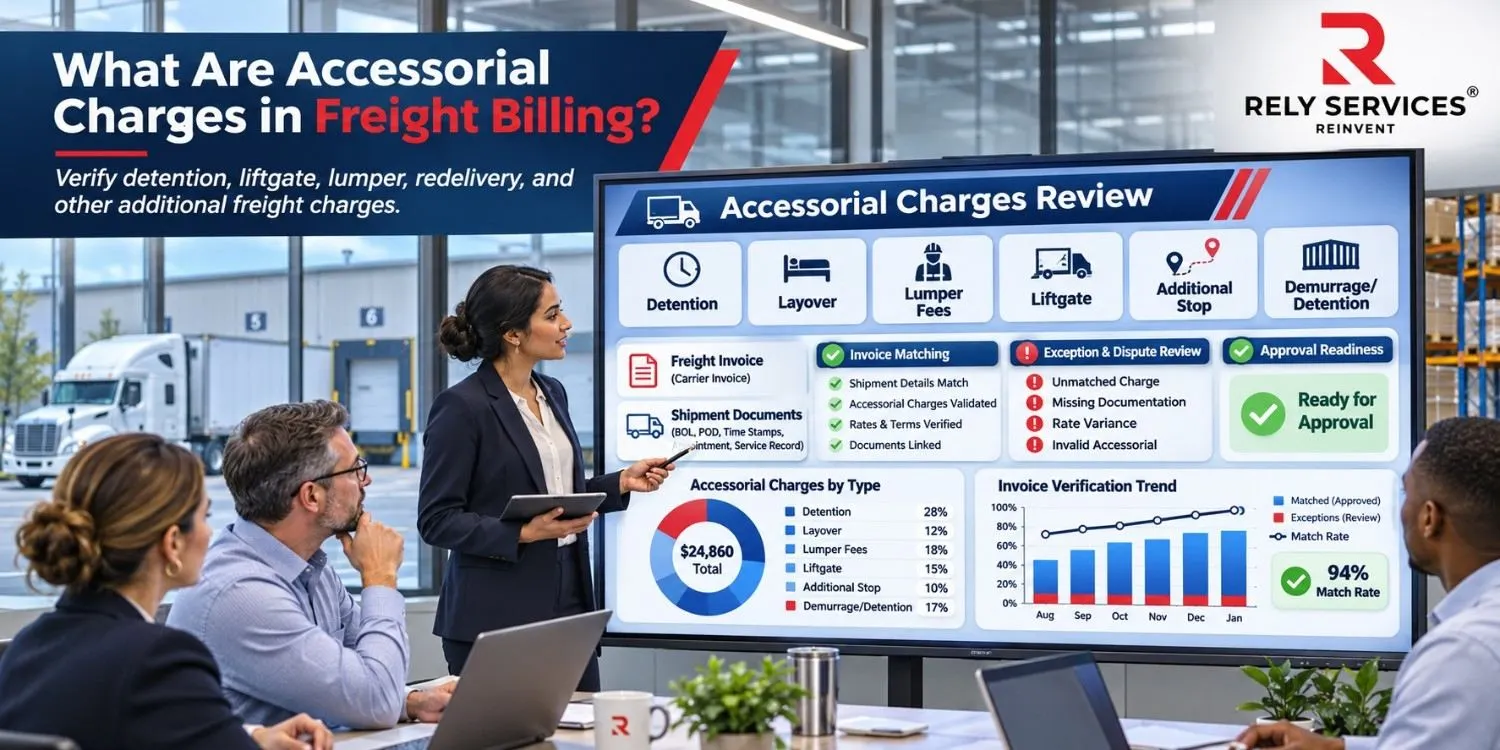
Accessorial charges are additional fees that freight carriers apply when a shipment requires services, equipment, handling, or delivery conditions beyond standard transportation. These charges appear separately from the base line-haul rate and can affect the total amount businesses pay to move goods.
For example, a carrier may charge an additional fee for waiting at a loading dock, using a liftgate, delivering to a residential address, or making an extra stop. Although these services may be necessary, businesses need to understand when carriers apply them and how to verify the charges.
For freight brokers, shippers, carriers, freight forwarders, and third-party logistics providers (3PLs), accessorial charges can create additional invoice review work. Missing documentation, unclear billing terms, and incorrect charge entries can also lead to payment delays and disputes.
This guide explains what accessorial charges are in freight and shipping, the common types, the documents used to verify them, and how logistics teams can manage them during freight billing. Businesses handling high volumes of carrier invoices can also explore Rely Services’ freight invoice processing services for support with invoice data capture, validation, and related back-office activities.
Why Do Carriers Apply Accessorial Charges?
Carriers apply accessorial charges when a shipment requires additional resources or services beyond the standard transportation arrangement. These requirements may arise before pickup, during transit, or at the delivery location.
Common reasons include:
- Additional equipment: A shipment may require a liftgate, special handling equipment, or other resources that the standard service does not include.
- Extra labor: Drivers or third-party workers may need to assist with loading, unloading, inside delivery, or handling.
- Waiting time: A truck may remain at a pickup or delivery facility beyond the free time allowed under the applicable agreement.
- Special delivery locations: Residential properties, construction sites, schools, and limited-access facilities may require additional arrangements.
- Shipment changes: A customer may request another delivery location, an additional stop, or redelivery after the original attempt fails.
- Special handling requirements: Hazardous materials, oversized freight, or other shipment characteristics may require additional services.
These charges help carriers account for the resources required to complete a shipment under conditions that differ from the original transportation arrangement.
However, an additional charge should not be accepted automatically. Logistics teams should confirm that the service occurred, the applicable terms support the fee, and the invoice includes the required information. These checks form an important part of the freight invoice processing workflow, where teams match carrier charges with shipment records and supporting documents.
What Are the Common Types of Accessorial Charges in Freight?
The types of accessorial charges vary across full truckload (FTL), less-than-truckload (LTL), intermodal, ocean, air, and parcel transportation. The following examples cover common fees that logistics and finance teams may encounter.
Detention Charges
Detention charges apply when a truck or driver waits beyond the permitted free time at a pickup or delivery facility.
For example, a carrier may arrive at a warehouse at the scheduled time but wait several additional hours before the facility unloads the shipment. Depending on the carrier agreement, the carrier may bill detention for the additional waiting period.
Documents to review: Arrival and departure timestamps, signed bills of lading, facility check-in records, appointment details, and the applicable rate confirmation.
Layover Charges
Layover charges apply when a driver or truck must remain at a location overnight or for an extended period because the shipment cannot move or be completed as scheduled.
For instance, a delivery facility may postpone unloading until the following day. If the carrier agreement allows a layover fee, the carrier may include it on the invoice.
Documents to review: Dispatch records, appointment details, delay notifications, revised delivery schedules, and written approval where required.
Lumper Fees
A lumper fee covers the cost of hiring third-party workers to load or unload freight at a warehouse, distribution center, or other facility.
For example, a grocery distribution center may require a separate unloading crew to remove pallets from a trailer. The carrier may pay the unloading team and submit the expense for reimbursement according to the agreed terms.
Documents to review: Lumper receipts, payment records, delivery documentation, and the applicable reimbursement terms.
Liftgate Charges
A liftgate charge applies when a truck needs a hydraulic platform to load or unload freight at a location without a suitable loading dock.
This service is common for deliveries to residential addresses, small businesses, retail stores, and other locations without dock access.
Documents to review: Original shipment instructions, delivery address details, service confirmation, and the carrier’s invoice.
Residential Delivery Charges
Carriers may apply residential delivery charges when they transport freight to a home or another location classified as residential under their service terms.
These deliveries may require different equipment, routing, or handling arrangements than standard commercial deliveries.
Documents to review: Delivery address, shipment booking details, carrier service classification, and proof of delivery.
Inside Delivery Charges
Inside delivery charges apply when the carrier must move freight beyond the standard delivery point, such as a loading dock, curb, or building entrance.
For example, a business may request that a carrier move equipment into a designated room instead of leaving it at the receiving dock.
Documents to review: Delivery instructions, service request, proof of delivery, and any applicable authorization.
Redelivery Charges
Redelivery charges apply when a carrier must make another delivery attempt because the original delivery could not be completed.
Common reasons include an unavailable receiver, incorrect delivery information, a refused shipment, or a location that was not ready to accept the freight.
Documents to review: Initial delivery attempt records, refusal notes, updated delivery instructions, and proof of the subsequent delivery.
Additional Stop Charges
An additional stop charge applies when a carrier must make another pickup or delivery beyond the stops included in the original transportation agreement.
For example, a shipment may require deliveries to two warehouses instead of one. The carrier may charge an additional fee for the extra stop.
Documents to review: Original load instructions, revised shipment orders, stop details, and the rate confirmation.
Reweigh and Reclassification Charges
These charges may apply when a carrier identifies a difference between the shipment’s declared weight or freight classification and the information recorded during carrier inspection.
In LTL shipping, incorrect shipment weight or freight classification can affect the applicable transportation rate.
Documents to review: Original shipping documents, inspection records, weight certificates where available, freight classification details, and the carrier’s adjustment notice.
Storage Charges
Storage charges may apply when a carrier, terminal, or warehouse holds freight beyond the included storage period or under conditions that trigger a separate fee.
For example, a shipment may remain at a facility because the consignee cannot accept delivery or because the business needs to arrange a new delivery date.
Documents to review: Storage dates, facility records, shipment status, applicable tariff or contract terms, and release documentation.
Demurrage Charges
In ocean freight, demurrage generally refers to charges associated with keeping a shipping container at a marine terminal beyond the allowed free time.
For example, an importer may not collect a container from the port within the permitted period. The ocean carrier or terminal may then assess demurrage under the applicable terms.
Documents to review: Container availability date, free-time period, terminal records, container release details, and the applicable tariff or service contract.
For ocean shipments, businesses should also understand the applicable demurrage and detention billing requirements, which address invoice information and billing practices for covered ocean transportation charges.
Detention Charges in Ocean Shipping
Ocean shipping also uses the term detention for charges associated with keeping a carrier’s container outside the terminal beyond the allowed free time.
For example, an importer may collect a container but return it after the permitted period. The applicable ocean carrier terms may trigger a detention charge.
Documents to review: Container interchange records, pickup and return timestamps, free-time details, and the applicable contract or tariff.
The meaning of detention can differ between truckload and ocean transportation. Therefore, logistics teams should review the transportation mode and billing terms before classifying a charge.
Note: Fuel surcharges may also appear as additional freight invoice line items. However, carriers and contracts do not always classify them as accessorial charges. Some list fuel separately from both line-haul and accessorial fees. Teams should follow the carrier’s billing structure and the applicable agreement.
What Documents Are Needed to Verify Accessorial Charges?
Supporting documents help logistics and accounts payable teams determine whether an accessorial charge relates to an actual shipment event or an authorized service.
The documents required depend on the type of charge and the carrier’s billing terms.
| Document | How it supports accessorial verification |
| Rate confirmation | Shows agreed rates, accessorial terms, free time, and applicable service conditions |
| Bill of Lading (BOL) | Provides shipment details, pickup and delivery information, and relevant handling instructions |
| Proof of Delivery (POD) | Confirms delivery completion and may include notes about additional services or exceptions |
| Carrier invoice | Identifies the accessorial charge, billed amount, shipment reference, and carrier details |
| Lumper receipt | Supports the cost of third-party loading or unloading services |
| Appointment records | Help verify scheduled pickup and delivery times |
| Arrival and departure timestamps | Support detention or other time-related charge reviews |
| Weight or inspection records | Help validate reweigh and freight classification adjustments |
| Container interchange records | Support ocean container pickup and return time reviews |
| Revised shipment instructions | Help verify additional stops, redelivery, or changes to the original shipment |
Teams should connect each accessorial fee to the relevant shipment and supporting evidence. If a document is missing or the information does not match, the reviewer should record the discrepancy and request clarification before moving the invoice forward.
For ocean freight invoices, teams should also stay informed about ocean demurrage and detention billing practices, including regulatory updates that may affect invoice review and charge disputes.
How Are Accessorial Charges Reviewed During Freight Invoice Processing?
Accessorial charge verification is an important part of freight invoice processing. The review helps businesses confirm that additional fees match the services performed, shipment records, and agreed billing terms.
A typical review includes the following activities:
- Identify the accessorial line item: Review the carrier invoice and identify each additional charge separately from the base transportation rate.
- Match the shipment reference: Confirm that the invoice, BOL, POD, and other supporting records relate to the same shipment.
- Check the agreed terms: Compare the charge with the rate confirmation, carrier contract, or applicable tariff.
- Verify the service or event: Confirm that the carrier performed the additional service or experienced the event that triggered the fee.
- Review the supporting evidence: Check receipts, timestamps, delivery notes, appointment records, or other documents required for that charge.
- Identify discrepancies: Flag unsupported charges, incorrect rates, duplicate entries, and missing documentation.
- Record the review outcome: Document the evidence, exception reason, responsible reviewer, and next action.
- Prepare the invoice for approval: Move the invoice forward only after the required checks and exception procedures are complete.
For example, if a carrier bills a detention fee, the reviewer should compare the recorded arrival and departure times with the free time and billing terms in the applicable agreement. If the invoice includes a lumper fee, the reviewer should check the supporting receipt and reimbursement requirements.
This process helps businesses maintain accurate freight billing records and make informed payment decisions.
Rely Services supports freight invoice capture, validation, accessorial charge checks, exception handling, and related back-office activities through its freight invoice processing services.
How Can Logistics Teams Manage and Reduce Accessorial Charge Disputes?
Businesses cannot eliminate every accessorial charge because some services and shipment conditions are necessary. However, they can improve visibility and reduce avoidable disputes through consistent procedures.
Share Accurate Shipment Information Before Booking
Provide carriers with correct pickup and delivery addresses, facility details, dock availability, shipment dimensions, weight, and handling requirements.
This information helps carriers identify potential additional services before dispatch.
Review Accessorial Terms in Rate Confirmations
Before confirming a shipment, review applicable charges, free-time allowances, approval requirements, and supporting documentation rules.
Clear terms help shippers, brokers, and carriers understand which fees may apply.
Maintain Complete Shipment Documentation
Keep rate confirmations, BOLs, PODs, receipts, appointment records, and revised shipment instructions organized and accessible.
As a result, reviewers can investigate additional charges without repeatedly requesting the same information from different departments.
Establish Standard Invoice Validation Rules
Create a consistent checklist for reviewing detention, lumper, liftgate, residential delivery, reweigh, redelivery, and other common charges.
The checklist should identify the required evidence, applicable rate, approval process, and escalation owner for each charge.
Track Recurring Accessorial Charges
Monitor accessorial expenses by carrier, facility, shipment type, lane, and charge category.
This analysis can help businesses identify recurring issues, such as warehouse delays, incomplete delivery information, or frequent reweigh adjustments.
Assign Clear Exception Ownership
Define which team handles missing documents, rate discrepancies, disputed charges, and approval requests.
Clear ownership helps prevent invoices from remaining unresolved between logistics, procurement, operations, and accounts payable.
Review Carrier Invoices Regularly
Use regular invoice reviews to identify duplicate charges, unsupported fees, incorrect rates, and repeated billing discrepancies.
A consistent review process also helps businesses maintain better visibility into transportation expenses.
When Should Businesses Consider Outsourcing Accessorial Charge Processing?
As shipment volumes increase, logistics teams may need to review hundreds or thousands of carrier invoice line items. Each invoice may contain multiple accessorial fees, different supporting documents, and carrier-specific billing terms.
This workload can become difficult to manage when internal teams also handle shipment coordination, carrier communication, accounts payable, and financial reporting.
Businesses may consider outsourcing when they experience:
- High volumes of freight invoices and accessorial line items.
- Delays in matching invoices with shipment documents.
- Repeated data entry and validation work.
- Backlogs caused by missing receipts or supporting records.
- Frequent rate discrepancies and billing exceptions.
- Limited internal capacity for freight bill review and reconciliation.
Rely Services provides back-office support for freight invoice capture, validation, rate checks, accessorial charge coding, exception handling, and carrier statement reconciliation.
Businesses can explore logistics data entry services for support with freight documents, shipment records, and invoice-related data processing.
For broader transportation and supply chain workflows, logistics BPO services can support freight billing, document processing, shipment updates, logistics data management, and other back-office activities.
Additionally, companies that need support across vendor invoices and financial workflows can review accounts payable outsourcing services.
Outsourcing can support repetitive processing and documentation activities. However, businesses should define approval authority, payment controls, exception escalation, and responsibility for disputed charges before starting an engagement.
Frequently Asked Questions About Accessorial Charges
What are accessorial charges in shipping?
Accessorial charges in shipping are fees for additional services, equipment, handling, or shipment conditions that are not included in the standard transportation rate. The exact charges depend on the carrier, transportation mode, contract, and applicable tariff.
Who pays accessorial charges?
The responsible party depends on the transportation agreement, carrier contract, rate confirmation, and shipment arrangements. A shipper, broker, consignee, or another contracted party may be responsible for the charge. Businesses should review the applicable billing terms before approving payment.
Are fuel surcharges considered accessorial charges?
Not always. Many carriers list fuel surcharges separately from accessorial charges because they apply under a separate pricing method. However, classification can vary by carrier, transportation mode, tariff, and contract.
What is the difference between detention and demurrage?
In truckload transportation, detention generally refers to additional waiting time for a truck or driver beyond the permitted free time. In ocean shipping, demurrage generally relates to keeping a container at a marine terminal beyond the allowed free time. Ocean detention generally relates to keeping a carrier’s container outside the terminal beyond the permitted period.
Can accessorial charges be disputed?
Yes. Businesses can question a charge when the service did not occur, the billed amount does not match the applicable terms, the supporting evidence is missing, or the carrier applied the fee incorrectly. The dispute process and required evidence depend on the carrier agreement and applicable rules.
How can businesses verify accessorial charges on freight invoices?
Businesses can compare each charge with the rate confirmation, carrier contract, shipment records, BOL, POD, receipts, timestamps, and other relevant documents. They should also confirm that the service occurred and that the carrier applied the correct rate.
How do accessorial charges affect freight invoice processing?
Accessorial charges add additional line items and supporting-document checks to the freight invoice workflow. Teams need to identify each fee, match it with shipment records, verify the applicable terms, and document any discrepancies before approval.
Conclusion
Accessorial charges are an important part of freight billing because shipments often require additional services, equipment, handling, or time beyond standard transportation. Detention, layover, lumper fees, liftgate service, residential delivery, and other charges can all affect the final freight invoice.
For logistics teams, the main challenge is not simply identifying these fees. It is confirming that each charge is supported by shipment records, agreed terms, and the required documentation.
By maintaining accurate shipment information, reviewing carrier agreements, and following consistent invoice validation procedures, businesses can improve freight billing visibility and reduce avoidable disputes.
Companies that need support with freight invoice capture, accessorial charge validation, and logistics back-office processing can explore Rely Services’ freight invoice processing and logistics data entry solutions.