


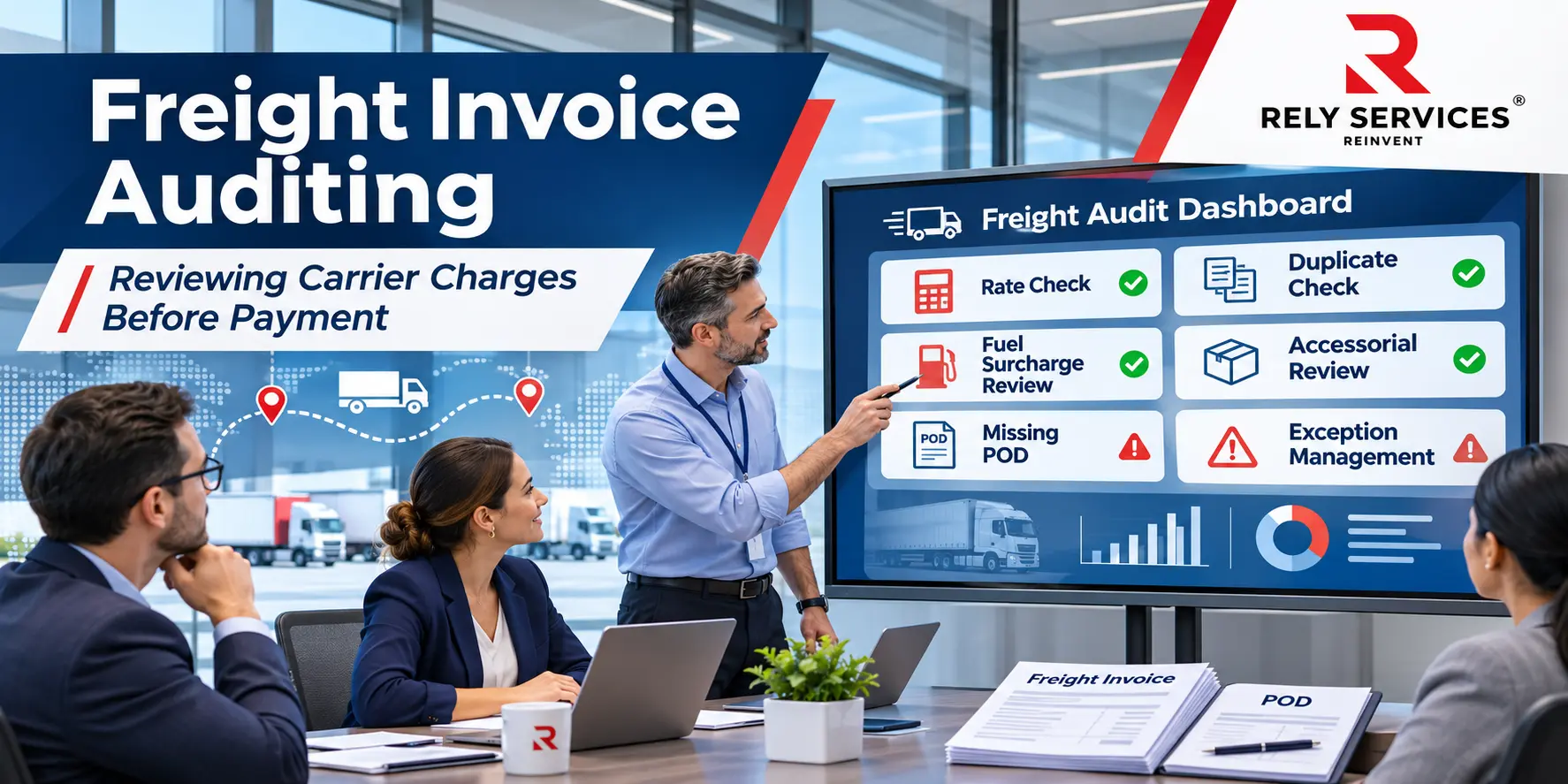
Freight invoice auditing is the process of reviewing carrier invoices against shipment records, approved rates, carrier agreements, and supporting documents. Through this review, businesses can verify each charge and confirm that it is supported before approving the invoice for payment.
A freight bill audit helps logistics and finance teams identify rate differences, duplicate invoices, unsupported accessorial charges, incorrect fuel surcharges, missing documentation, and other billing exceptions.
However, the purpose is not to challenge every carrier charge. Instead, it is to ensure that the business pays the correct amount for the transportation service it actually received. Rely’s freight invoice processing services support freight bill audit and payment workflows through invoice capture, validation, shipment matching, accessorial review, exception management, and payment-ready output.
Freight Invoice Auditing vs. Freight Invoice Processing
Freight invoice auditing is one control within the broader freight invoice-processing workflow.
| Term | Scope | Main activities |
| Freight invoice processing | The complete workflow from invoice receipt to payment-ready status | Intake, capture, validation, matching, exception handling, approval preparation, and AP handoff |
| Freight invoice auditing | Reviewing carrier charges against shipment and commercial terms | Rate checks, duplicate detection, accessorial review, document review, and exception identification |
| Freight bill audit and payment | Audit plus payment preparation or payment execution, depending on scope | Charge validation, exception resolution, approval support, and payment preparation |
| Freight billing process | The end-to-end operational workflow | Invoice receipt through reconciliation and payment-ready records |
Freight audit teams typically compare invoices with contracted rates, shipment records, and service agreements. By doing so, they can identify billing errors, duplicate charges, and accessorial.
Prepayment and Post-Payment Freight Audits
Freight invoice auditing can occur before or after payment.
| Audit type | When it occurs | Main purpose |
| Prepayment audit | Before an invoice is approved or paid | Identify invalid, incomplete, or nonconforming charges before cash leaves the business |
| Post-payment audit | After payment has been made | Identify potential recoveries, billing patterns, process gaps, and carrier issues |
The U.S. General Services Administration defines a prepayment audit as a review of transportation billing documents and related documents before payment to determine validity, propriety, and conformity with tariffs, quotations, agreements, contracts, or tenders. A post-payment audit performs a similar review after payment.
For most businesses, a prepayment audit is the primary control because it can prevent an incorrect invoice from entering the payment queue. A post-payment audit can still provide useful insight into recurring carrier issues and process weaknesses.
What a Freight Bill Audit Reviews
A freight bill audit reviews more than the invoice total. It examines whether each charge is supported by shipment information and commercial terms.
| Review area | What the auditor checks | Why it matters |
| Carrier identity | Carrier name, vendor ID, remit-to details, and invoice source | Helps prevent payment to the wrong vendor |
| Invoice reference | Invoice number, invoice date, shipment date, and load or PRO number | Supports matching, duplicate prevention, and audit trails |
| Shipment details | Origin, destination, mode, service level, weight, and freight description | Confirms the invoice relates to the correct shipment |
| Base freight rate | Line-haul rate against the contract, tariff, quote, or rate confirmation | Helps prevent incorrect rate application |
| Fuel surcharge | Fuel index, applicable date, percentage, and calculation | Helps validate fuel-related charges |
| Accessorial charges | Liftgate, detention, inside delivery, residential delivery, redelivery, reweigh, and other special services | Helps identify unsupported or disputed charges |
| Duplicate invoices | Carrier, invoice number, shipment reference, amount, date, and payment history | Helps prevent duplicate payments |
| Taxes and fees | Applicable tax treatment and calculation | Helps support accurate AP coding and reconciliation |
| Supporting documents | Bill of lading, proof of delivery, delivery receipt, rate confirmation, and carrier contract | Provides evidence for the shipment and charges |
The Freight Audit Process: Step by Step
The exact workflow varies by carrier mix, transportation mode, ERP environment, and internal policy. The following seven-step model is a practical framework for parcel, LTL, truckload, intermodal, and other freight invoices.
1. Receive and Index the Carrier Invoice
The audit begins once a carrier invoice is received through email, a carrier portal, EDI, PDF, scan, or another agreed channel.
The invoice should be indexed with the carrier, invoice number, shipment reference, invoice date, amount, and other agreed fields. Structured indexing makes it easier to locate the invoice later and compare it with supporting records.
Rely’s logistics data entry services support freight billing data entry, invoice indexing, shipment updates, and structured logistics records.
2. Validate Invoice and Carrier Details
Before reviewing charges, the team confirms that the invoice is complete and usable.
Validation checks may include:
- Carrier identity and vendor record
- Invoice number and duplicate-invoice risk
- Invoice and shipment dates
- Required shipment references
- Amount and currency
- Tax fields
- Payment terms
- Supporting-document availability
- Client-specific business rules
A duplicate check should consider more than the invoice number. Carrier, shipment reference, invoice date, amount, and payment history can all help identify potential duplicate submissions.
3. Match the Invoice With Shipment Records
Matching connects the invoice to the shipment and supporting documents.
Depending on the workflow, supporting records may include:
- Purchase order
- Bill of lading
- Proof of delivery
- Delivery receipt
- Shipment record
- Rate confirmation
- Carrier contract
- Rate card
- Accessorial authorization
The purpose is to confirm that the business ordered the transportation, received the service, and is being invoiced under agreed terms.
4. Audit Base Freight and Fuel Charges
The team compares the base freight charge and fuel surcharge with the applicable rate agreement, contract, tariff, quote, or rate confirmation.
The review should consider:
- Line-haul rate
- Applicable mileage or distance
- Shipment weight or measurement
- Freight classification
- Service level
- Fuel index and calculation date
- Applicable surcharge percentage
- Rounding rules and tolerances
A rate difference does not always indicate an error. It may reflect an approved rate change, a shipment adjustment, or a timing difference. The exception should be reviewed against the applicable commercial terms.
5. Audit Accessorial Charges
Accessorial charges are additional carrier fees for services, conditions, delays, or special handling beyond the base transportation rate.
Common examples include liftgate service, residential delivery, inside delivery, detention, redelivery, reweighing, limited-access delivery, appointment scheduling, and fuel surcharges.
Each accessorial should be reviewed against the shipment record, carrier terms, and supporting evidence. For example, a liftgate charge may be valid if the delivery location has no dock, but the amount should still match the applicable carrier rate.
For a detailed explanation of these charges, link to the related article: What Are Accessorial Charges in Freight Billing?
6. Identify and Categorize Exceptions
An exception is an invoice that cannot move forward because information is missing, inconsistent, disputed, or outside approved tolerances.
Common freight invoice exceptions include:
- Missing shipment or PRO number
- Missing bill of lading or proof of delivery
- Rate or fuel-surcharge difference
- Unsupported accessorial charge
- Duplicate invoice number
- Incorrect carrier or vendor details
- Shipment-date mismatch
- Incomplete invoice data
- Approved rate change not reflected in the invoice
Each exception should be categorized, documented, and routed to the appropriate owner. Logistics, procurement, AP, or carrier teams may need to provide additional information or make a commercial decision.
7. Prepare Validated Invoices for Approval
Once an invoice passes the required checks, it is prepared for the internal approval workflow.
Preparation may include:
- Invoice coding
- Cost-center or GL allocation
- Approval routing
- Supporting-document attachment
- Payment-term review
- Payment-ready file preparation
- Status updates in the AP or ERP system
Approval requirements should reflect the organization’s internal controls. A processing team can prepare and route the invoice, but the client should retain authority over approvals and payment decisions.
Freight Invoice Audit Example
A carrier submits an invoice for $1,250 for shipment PRO 45821.
The AP team captures the invoice details and checks for duplicates. The invoice matches the shipment reference, but the proof of delivery is missing.
The team also identifies a $75 accessorial charge that is not supported by the rate confirmation or shipment record.
The invoice cannot move directly to approval. It is routed as an exception with two issues:
- Missing proof of delivery
- Unsupported accessorial charge
The logistics team obtains the POD, while the carrier dispute owner reviews the accessorial charge. Once both items are resolved and documented, the invoice can proceed through approval and payment preparation.
This example shows why a freight bill audit requires more than matching an invoice total to a PO.
Common Freight Invoice Audit Exceptions
| Exception | Possible cause | Practical response |
| Rate difference | Outdated rate table, shipment adjustment, or contract change | Compare with the applicable rate authority and route for review |
| Duplicate invoice | Carrier resubmits an invoice under a new number | Check carrier, shipment reference, amount, date, and payment history |
| Unsupported accessorial charge | Service not requested, delivered, or documented | Request supporting evidence and route for commercial review |
| Fuel-surcharge difference | Incorrect index, date, or calculation | Validate against the applicable fuel index and agreement |
| Missing POD | Delivery confirmation not received or not linked | Follow up with the carrier or logistics team |
| Weight discrepancy | Incorrect weight, reweigh, or classification issue | Compare shipment data and carrier documentation |
| Missing shipment reference | Invoice lacks a usable load or PRO number | Request clarification before matching |
| Incorrect carrier details | Vendor master-data issue or invoice error | Validate carrier identity before payment preparation |
How Automation Supports Freight Invoice Auditing
Automation can support invoice intake, OCR-based capture, duplicate checks, rules-based validation, matching, exception routing, and reporting.
It is most useful for repeatable work. For example, a system can flag an invoice that exceeds an approved tolerance or identify a missing shipment reference.
However, automation does not remove every operational task. Teams may still need to investigate unusual charges, obtain missing documents, resolve carrier disputes, and prepare invoices for approval.
Rely’s freight invoice approach combines automation support with trained specialists for validation, matching, exception handling, and payment-ready processing.
Freight Invoice Audit KPIs to Track
Use clearly defined start and end points so performance can be measured consistently.
| KPI | Suggested definition |
| Audit cycle time | Time from invoice receipt to audit completion |
| First-pass match rate | Share of eligible invoices matched without manual exception work |
| Exception rate | Share of invoices requiring investigation |
| Duplicate-invoice rate | Share of invoices flagged as potential duplicates |
| Accessorial-exception rate | Share of invoices with accessorial-charge exceptions |
| Aged exception backlog | Unresolved exceptions grouped by age |
| On-time payment rate | Share of payments completed within agreed terms |
| Carrier-query resolution time | Time required to resolve recorded carrier requests |
Review these measures together. Faster processing is not an improvement if it creates more errors, weakens controls, or increases unresolved exceptions.
How Rely Services Supports Freight Invoice Auditing
Rely’s freight invoice processing service supports freight bill audit and payment workflows through invoice receipt, data capture, validation, carrier and shipment matching, accessorial review, duplicate checks, exception management, indexing, ERP-ready output, and reporting.
The service page specifically identifies contracted freight rates, fuel surcharges, accessorial fees, duplicate invoices, shipment dates, origin and destination, weight information, service levels, taxes, and supporting documents as areas that can be reviewed.
For businesses that need broader AP support, Rely’s accounts payable services include invoice processing, vendor management, payment-processing support, and reconciliation.
If freight invoices are creating recurring exceptions or slowing AP workflows, explore Rely’s freight invoice processing services to review your current invoice volume, carrier mix, systems, and approval process.
Conclusion
Freight invoice auditing is the process of reviewing carrier charges against shipment records, approved rates, carrier agreements, and supporting documentation.
A reliable freight bill audit includes invoice matching, rate validation, duplicate detection, accessorial review, exception management, and approval preparation.
The goal is not simply to process invoices faster. It is to ensure that the right carrier is paid the right amount for the right shipment, with documentation that supports finance and operational decisions.
Frequently Asked Questions
What is a freight bill audit?
A freight bill audit is another term for freight invoice auditing. It reviews carrier charges for accuracy, completeness, and conformity with applicable rates and commercial terms.
What is the difference between freight invoice auditing and freight invoice processing?
Freight invoice auditing is one control within freight invoice processing. Freight invoice processing covers the complete workflow from invoice receipt through capture, validation, matching, exception handling, and payment preparation.
What is a prepayment freight audit?
A prepayment freight audit reviews transportation billing documents and related documents before payment to determine validity, propriety, and conformity with applicable rates and agreements.
What is a post-payment freight audit?
A post-payment freight audit reviews transportation billing documents after payment to identify potential recoveries, billing patterns, process gaps, and carrier issues.
What are common freight invoice audit exceptions?
Common exceptions include rate differences, duplicate invoices, unsupported accessorial charges, fuel-surcharge differences, missing proof of delivery, weight discrepancies, and missing shipment references.
Does every freight invoice require an audit?
Not necessarily. Audit requirements depend on invoice value, carrier risk, shipment type, internal policy, and available supporting records. Critical charges and high-risk invoices may require stricter review.
Can freight invoice auditing work with an existing ERP?
Yes, subject to system access, integration requirements, controls, and agreed procedures. The workflow should define required inputs, outputs, field rules, responsibilities, and system steps before production begins.
Does outsourcing freight invoice auditing mean giving up AP control?
No. A managed operating model can keep payment authorization, approval authority, supplier policies, and financial controls within the organization. The provider handles only the activities defined in the agreed scope.